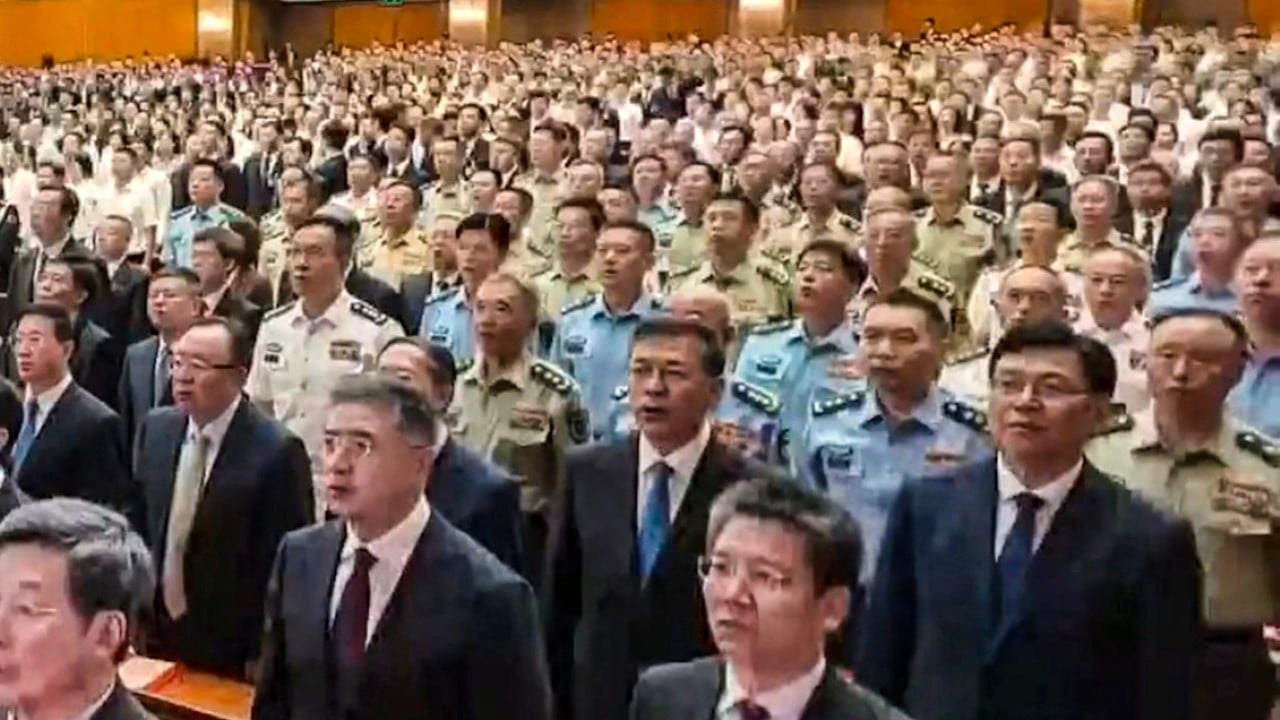
Kremlinology died with the Soviet Union, but its brain-dead cousin, Pekinology, is thriving in Western defense hubs. Every time the Chinese Communist Party holds a plenary session or the Central Military Commission calls a high-level meeting, an army of analysts pulls out magnifying glasses. They scan the podium. They count the chairs. They measure the distance between a general's shoulder and Xi Jinping’s elbow.
They claim these seating arrangements are a definitive map of China's military future.
It is a joke. It is lazy analytic tradecraft. Worst of all, it actively blinds defense planners to how the People’s Liberation Army actually operates under its current high command.
Staring at wooden chairs in Beijing to predict the next theater commander assumes the Chinese military operates on a predictable, linear bureaucratic code. It does not. The obsession with protocol-parsing has transformed serious intelligence analysis into a high-stakes game of astrology. While the West decodes who sat where at the latest military work conference, it misses the actual structural tectonic shifts happening beneath the surface.
The Disappearance of the Protocol Playbook
The foundational flaw of seating-chart analysis is the assumption that protocol equals power. In the pre-Xi era, there was some validity to this. The PLA operated under a highly institutionalized, predictable system of seniority, factional balancing, and consensus-driven promotions. If a general moved up two spots on the roster, you could reasonably predict his trajectory toward the Central Military Commission.
That era is over. The massive 2015 PLA structural reforms did not just reorganize army corps; they permanently broke the old rulebook.
Xi Jinping dismantled the four traditional general departments—Staff, Politics, Logistics, and Armaments—and split their functions into 15 smaller, hyper-siloed agencies reporting directly to him. This structural fragmentation means that visibility at major meetings no longer correlates with actual operational clout. A general sitting prominently in the front row may head a ceremonial or legacy administrative organ, while a lower-ranking officer tucked away in the back row might wield massive influence over real-world cyber, electronic warfare, or strategic rocket deployments.
I have watched defense analytical teams waste weeks debating why a specific general was seated three spots down from his expected rank, only to discover it was a mundane administrative scheduling conflict, not a political execution. Conversely, we have seen top military leaders occupy prime real estate on the podium mere weeks before being purged. Seating charts do not reveal the future; they project a manufactured snapshot of the immediate present.
The Rocket Force Purge Blew Up the Thesis
If seating arrangements were an accurate leading indicator of political health, the massive purge of the PLA Rocket Force and the defense-industrial complex would have been visible months in advance.
It was not.
Look at the timelines of former Defense Minister Li Shangfu and the top brass of the PLARF, including Generals Li Yuchao and Xu Zhongbo. Up until the very moment the Central Commission for Discipline Inspection stepped in, these men were occupying their exact, protocol-mandated seats. They were photographed smiling next to senior leadership, fulfilling their choreographed roles perfectly.
Imagine a scenario where an analyst bases a long-term threat assessment on the stable seating of the Rocket Force leadership, only for the entire command structure to vanish overnight due to an internal hardware corruption probe. That is exactly what happened. The purges were not telegraphed by subtle shifts in the seating order at the Great Hall of the People. They were triggered by internal, classified audits into the procurement of missile silos and infrastructure quality.
The political status of a Chinese military officer is binary: you are entirely in, or you are entirely out. There is no slow, public demotion down the seating line to warn the outside world. The protocol remains pristine until the handcuffs come out.
Why Beijing Weaponizes the Seating Chart
The consensus view treats the seating chart as a passive reflection of reality. The reality is far more sinister: Beijing knows the West obsesses over these visuals, and they use them for active strategic deception.
The Central Military Commission understands that foreign intelligence agencies scrape every frame of CCTV footage. If Beijing wants to project an illusion of stability during an internal crisis, they will intentionally stage a perfectly aligned, harmonious seating arrangement. They will place a vulnerable general right in the thick of things to project unity, completely throwing off Western assessments of internal instability.
Relying on these public displays means letting the target write your intelligence reports. It creates a massive confirmation bias loop. Analysts develop a theory about a particular military faction, find one CCTV clip where a general looks slightly detached or is seated marginally further away, and declare their theory proven. It is a dangerous, circular logic that costs billions in misallocated intelligence collection resources.
The Real Metrics of Power
If seating charts are useless, what actually matters? To understand where the PLA is going, you have to look at hard operational and institutional inputs, not stage management.
| Flawed Metric | Real Metric | Why It Matters |
|---|---|---|
| Podium Seating Position | Cross-Theater Command Experience | Shows who can actually execute a joint-service invasion. |
| Appearance at State Dinners | Budgetary Control Over Strategic Domains | Tracks the shift from legacy land forces to space and cyber. |
| Rank Seniority | Defense-Industrial Technical Background | Identifies the rise of the "aerospace clique" in leadership. |
True power in the modern PLA is found in the intersection of technical capability and absolute political loyalty. The leaders rising through the ranks today are not career political commissars who excelled at sitting in the right chairs. They are engineers, rocket scientists, and space program veterans—the so-called "Aerospace Clique."
Furthermore, operational power has shifted to the Theater Commands. The commanders who matter are the ones managing the Eastern and Southern Theaters, facing Taiwan and the South China Sea. Their influence is measured by their ability to coordinate joint operations across the Army, Navy, and Air Force, not by how often they are flown back to Beijing to sit on a stage for a political rubber-stamping session.
Dismantling the Premise of Your Questions
When Western defense analysts look at China's military leadership, they ask the wrong questions entirely.
- Flawed Question: "Who is positioned to replace the current Vice Chairmen of the Central Military Commission based on the latest plenary lineup?"
- Brutally Honest Answer: It does not matter. The formal succession order is an illusion. Xi Jinping has thoroughly personalized the military command structure. He can bypass senior leaders entirely, extend retirement ages at will, or appoint a junior officer to run a critical operation if he trusts their loyalty.
- Flawed Question: "Does the absence of a particular general from a high-level military meeting signal a loss of political favor?"
- Brutally Honest Answer: Not necessarily. The PLA is actively preparing for high-intensity conflict. Top-tier commanders are frequently in the field conducting unannounced readiness audits, overseeing sensitive technological tests, or managing distributed command posts. Assuming an absence equals a political downfall is a projection of Western political norms onto a military operating on a war footing.
The Downside of Discarding the Tea Leaves
There is a reason the seating-chart method remains popular despite its systemic failures: it is easy. It gives analysts quantifiable data points to put into a spreadsheet or a slick briefing deck for politicians who want clean answers.
If you stop reading the tea leaves of protocol, you have to accept a far more uncomfortable truth. You have to admit that the internal political dynamics of the PLA are deeply opaque, volatile, and highly resistant to outside observation. It forces you to rely on harder, more fragmented data points—like regional procurement contracts, localized party discipline notices, and changes in operational doctrine. It requires deep, grueling expertise instead of visual pattern recognition.
But if the goal is to accurately predict how the PLA will behave in a crisis, embracing that analytic difficulty is the only viable path forward. The next conflict will not be won by the side that best analyzed a seating plan in the Great Hall of the People. It will be won by the side that understood the real, unvarnished capabilities of the commanders executing the strike. Stop looking at the chairs. Start looking at the machinery.