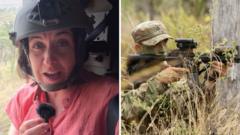
Thousands of United States Marines and Japanese Ground Self-Defense Force soldiers are currently enduring the blistering heat of the Australian bush for one primary reason: to prepare for a high-end, coordinated war in the Indo-Pacific. Operating under joint maneuvers like Exercise Southern Jackaroo and the massive Talisman Sabre, these foreign forces are not just practicing standard drills. They are using Australia’s vast, unpopulated terrain to solve the most brutal logistical nightmare of a potential Pacific conflict: how to fight, communicate, and survive across thousands of miles of open ocean when supply lines are severed.
The Geography of Empty Space
Modern military operations require massive amounts of land. Dense population centers and tight environmental restrictions across North America and Asia make large-scale live-fire training nearly impossible to execute without disrupting civilian infrastructure. Australia offers an entirely different proposition.
The Mount Bundey and Townsville Field Training Areas provide vast expanses of raw, unforgiving wilderness. Here, mechanized units can move freely. Heavy artillery can fire maximum-range salvos without hitting a village or an interstate highway. For Japan, a nation with severe geographic constraints and constitutional limitations on military deployment, the Australian outback represents a rare opportunity to fire long-range missiles and test combined-arms coordination at a distance that is physically impossible at home.
This is not a casual partnership. The environment itself acts as a harsh filter. Soldiers face extreme heat, isolation, and terrain that breaks equipment. Testing weapons and communication networks in these conditions exposes flaws that would remain hidden in a sterile simulator.
Overcoming the Pacific Friction Point
Getting three distinct militaries to operate as a singular machine is an administrative and technological nightmare. Different radio frequencies, incompatible data sharing networks, and contrasting command structures routinely create friction during joint deployments. The training in the bush forces these entities to merge their tactical systems in real time.
Consider the mechanics of a coordinated strike. An Australian scout locates a target. The coordinates must travel through an American communication network to a Japanese artillery battery. If the software programs cannot talk to each other, the target escapes. The drills focus intensely on aligning these data paths so that a digital message sent from a US Marine command tent can instantly populate on a screen inside a Japanese command vehicle.
Language barriers pose an immediate challenge. To counter this, units rely on standardized visual signals, shared digital maps, and integrated command staff. They practice force-on-force offensive maneuvers where units are deliberately mixed, forcing a platoon of Marines to take orders directly from an Australian brigade commander while receiving mortar support from Japanese gunners.
The Shadow of Logistics
The ultimate bottleneck in any Pacific crisis is sustainability. A military can possess advanced stealth fighters and precision guided missiles, but they are useless without a steady supply of fuel, ammunition, and clean water. The outback simulates the isolation of an island-hopping campaign.
Moving heavy armor across hundreds of miles of unpaved, dusty tracks mirrors the challenge of moving supplies across remote archipelagos. Mechanics must repair complex engines in the middle of nowhere using only what they carried with them. Medical teams must practice long-distance casualty evacuations where the nearest field hospital is hours away by air. This logistical friction is the core of the entire exercise.
Rising Regional High Stakes
The strategic alignment of these three nations has accelerated rapidly. Decades ago, the idea of Japanese troops conducting offensive combat drills on foreign soil would have caused major diplomatic friction. Today, regional shifts have made this cooperation an absolute necessity for the participants.
The trilateral alliance is designing these exercises to send a clear message of deterrence. By demonstrating that they can rapidly deploy, integrate, and sustain a multinational force in a harsh environment, the allies are signaling their readiness to protect vital maritime trade corridors. This preparation transforms the remote Australian bush into the literal anvil where the future security architecture of the Indo-Pacific is being forged.
The days of isolated, nation-specific defense strategies are gone. The soldiers sweating in the dust of the Northern Territory are building a combined capability that relies entirely on mutual survival.