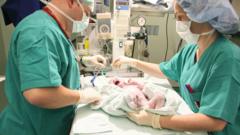
One in four births in England is now an emergency caesarean section. This figure does not merely represent a statistical shift; it marks a fundamental restructuring of British maternity care. For the first time in history, surgical deliveries have overtaken unassisted vaginal births, fundamentally altering the reality of how families enter the world.
The standard narrative blames this surge on changing demographics. We are told that older mothers and rising obesity levels are driving up complexity, forcing the hands of obstetricians. While these population health trends are real, they serve as a convenient shield for a deeper, institutional crisis. The explosive rise in emergency surgeries is not just a biological inevitability. It is the direct consequence of systemic understaffing, a defensive medical culture terrified of litigation, and an infrastructure buckling under the weight of decades of mismanagement.
The Illusion of Choice under Structural Collapse
For years, the ideological battleground in British maternity care pitted the promotion of unassisted birth against the right to elective surgical intervention. In 2017, the Royal College of Midwives formally abandoned its campaign for normal birth. By 2022, the National Health Service ordered hospitals to scrap arbitrary targets aimed at keeping caesarean rates below 20%. The intent was noble: prioritize safety over dogma.
The practical outcome, however, has been entirely different. While elective, planned caesareans now account for roughly 20% of deliveries, emergency surgeries have climbed to 25.1%. This is where the demographic argument begins to fray. An emergency caesarean is, by definition, an unplanned intervention triggered when a vaginal birth becomes too dangerous to continue.
When maternity units are desperately short of experienced staff, the capacity to patiently manage a slow, complex labor disappears. Midwives running back and forth between multiple laboring women cannot provide the continuous, intensive support that keeps high-risk deliveries on track.
"In some cases women are going for caesarean sections as a kind of least-worst option because they don't really believe they're going to have the kind of support they need to have a safe, straightforward, positive labour and birth in hospital," notes Soo Downe, a professor of midwifery at the University of Central Lancashire.
When the system cannot guarantee basic, attentive care, surgery becomes the default safety valve. It is a controlled, predictable medical procedure that can be scheduled, managed, and billed within a precise timeframe, unlike the volatile, unpredictable timeline of natural labor.
Defensive Medicine and the Shadow of Litigation
The fear of a catastrophic outcome hangs over every delivery room in England. Decades of high-profile maternity scandals have left an indelible mark on the medical community. The ongoing inquiry into systemic failures in Nottingham, alongside previous damning reports from Shrewsbury and Telford, has made one thing clear: failing to intervene quickly enough leads to tragedy, ruined lives, and historic legal payouts.
The institutional response to this fear has been the adoption of hyper-vigilant, defensive medicine. When a continuous fetal heart rate monitor shows even a minor, ambiguous dip, the pressure to intervene immediately is immense. No obstetrician wants to face an inquiry and explain why they waited.
The result is a low threshold for major surgery. The moment labor slows or a reading looks slightly abnormal, the team moves to the operating theater. This shift protects the hospital from litigation, but it subjects thousands of women to major abdominal surgery that might, under better-resourced conditions, have been avoided.
The Realities of Complex Public Health
To understand why the system triggers the emergency alarm so frequently, one must look at the physical condition of the population entering the labor ward. This is where the long-term failure of preventative public health comes home to roost.
+-----------------------------------------------------------+
|   Maternal Profile and Corresponding Surgical Realities    |
+---------------------+-------------------------------------+
| Maternal Age        | Over 40: 59% Caesarean Rate         |
|                     | Under 30: Vaginal Birth Dominant    |
+---------------------+-------------------------------------+
| Public Health       | Rising Obesity, Chronic Illness,    |
| Variables           | Deprivation, and Lack of Pre-Natal  |
|                     | Optimization                        |
+---------------------+-------------------------------------+
| Systemic Triggers   | High Induction Rates (approx. 33%), |
|                     | Cascades of Medical Intervention    |
+---------------------+-------------------------------------+
The medicalization of birth is directly tied to maternal age. For women under 30, natural vaginal delivery remains the most common outcome. For women aged 30 and over, caesareans take the lead. By the time a mother reaches 40, the chance of a surgical delivery climbs to a staggering 59%.
As Donna Ockenden pointingly observed, maternity teams operate at the very end of a long chain of public health failures. Staff cannot magically erase the effects of poverty, deprivation, or pre-existing chronic conditions when a woman walks through the hospital doors in active labor.
Furthermore, the widespread use of medical induction further complicates the situation. Approximately one-third of all labors in England are now started artificially using hormone drips, pessaries, or sweeps. Induction frequently triggers a well-documented cascade of intervention. Artificial contractions are sharper and more painful, often leading to a demand for epidurals. Epidurals restrict movement, which can slow labor down, eventually leading to a diagnosis of failure to progress and an immediate trip to the operating theater.
The True Cost of the Surgical Pivot
A caesarean section is an incredibly effective, lifesaving tool. When a baby is in acute distress or a mother's health is failing, the ability to perform a rapid surgical delivery is invaluable. However, treating a major operation as a routine, one-in-four occurrence carries significant long-term consequences.
Recovery from a caesarean is lengthy and painful, presenting immediate challenges for mothers trying to care for a newborn. The surgical scar also dictates the management of all future pregnancies. A uterine scar increases the risk of serious complications like placenta previa or placental accreta in subsequent births, meaning that once a woman has an emergency caesarean, she is highly likely to require surgical deliveries for any future children.
The financial burden on an already overstretched NHS is immense. Operating theaters, surgical teams, anesthetists, and extended postnatal hospital stays cost vastly more than uncomplicated midwife-led deliveries. Resources channeled into managing avoidable surgical births are resources taken away from preventative prenatal care, creating a self-perpetuating cycle.
Fixing this trend requires looking beyond the statistics. The rising caesarean rate cannot be solved by simply reinstating arbitrary targets or lecturing women about giving birth younger. It requires addressing the chronic shortage of midwives, reinvesting in continuous labor support, and actively improving public health long before a pregnancy test ever turns positive. Until the structural foundations of maternity care are rebuilt, the operating theater will remain the only dependable safety valve the system has left.