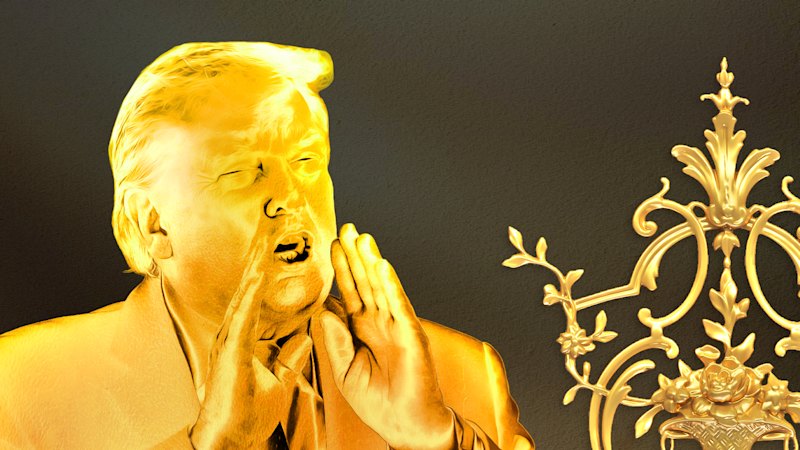
Walk into the Oval Office right now and you might think you stumbled into a miniature Versailles or a high-end Florida hotel lobby. The subtle, understated tones of the Biden era are gone. In their place is a blinding, unapologetic wave of yellow metal.
We aren't just talking about a couple of family photos in shiny frames. It's on the ceiling. It's on the doorframes. It's on the drink coasters.
Donald Trump's second term has a distinct visual brand, and that brand is gilded. While critics call it gaudy and supporters call it a return to American grandeur, the sudden transformation of the White House complex reveals a lot about how this administration views power, legacy, and the economy. It's not just interior design. It's a political statement.
Inside the Extreme Makeover of the West Wing
The speed of the transformation caught historic preservationists off guard. During Joe Biden's presidency, the Oval Office fireplace mantel featured simple potted ivy. Within the first few weeks of Trump moving back in, that ivy vanished. It was replaced by a rotating collection of gold urns, a 19th-century French compotier from the White House collection, and a dessert tray.
Over the past year, the "goldening" of the executive mansion reached a whole new level.
- The Ceilings and Trim: Trump brought in his personal cabinet maker from Florida, 70-year-old John Icart, to fly to Washington on Air Force One. Icart, who worked on Mar-a-Lago, added gold trim across the ceiling, doorframes, and even painted the sculpted cherubim inside the door frames.
- The Desktop Details: If you look at recent photos of meetings with foreign leaders, the coffee tables feature heavy gold drink coasters stamped with the Trump name. Next to them sits a thick gold paperweight.
- The Signage: The aesthetic doesn't stop at the office door. New signs in cursive gold script popped up outside the West Wing, the Oval Office, and the Rose Garden.
White House Press Secretary Karoline Leavitt openly embraced the aesthetic, calling it a "golden office for the golden age." Meanwhile, independent onlookers have been less kind. Musician Jack White famously mocked the redesign online, comparing the historic room to a "wrestler's dressing room" and calling it "vulgar."
Reports even swirled among the White House press corps that the painter used metallic paint instead of actual gold leafing because the synthetic stuff reflects light more aggressively under television cameras. Whether it's 24-karat gold or a hardware store replica, the visual impact is exactly what the president intended.
Power Versus Wealth
People often look at Trump's obsession with shiny surfaces and assume it's just a billionaire flaunting his net worth. That misses the point. Gold isn't just a symbol of money. It's a historical marker of absolute authority.
Historically, acquiring enough precious metal to cover your walls required massive state power, control over global supply chains, and the ability to command legions of labor. From King Midas to the Egyptian pharaohs to Louis XIV at Versailles, rulers used shiny, reflective surfaces to make themselves look larger than life.
By plastering these motifs across the executive mansion, Trump isn't trying to look like a standard modern politician. He's channeling the imagery of old-world rulers. In a second term explicitly defined by a push to expand executive authority, slash the federal bureaucracy, and challenge the traditional balance of power, the visual environment matches the political agenda perfectly.
The Economic Irony of the Yellow Metal
There's a strange parallel between the visual environment of the West Wing and what's happening in the broader financial markets. Trump's policies have a massive, direct impact on the actual price of gold, which recently crossed historic thresholds to trade over $4,000 per troy ounce.
When Trump took office for his first term in January 2017, the metal sat at $1,572.40. By the time he left in January 2021, it had jumped 42% to $2,228.89. A huge driver of that growth was the Tax Cuts and Jobs Act (TCJA), which pumped cash into the economy, alongside massive pandemic-era spending that stoked inflation fears.
Investors flood into precious metals for a few specific reasons:
- Inflation Fears: When the government prints cash or runs massive deficits, currency loses purchasing power. You can't print more gold.
- Tariff and Trade Pressures: The administration's aggressive stance on universal tariffs and trade fights with China and the EU creates market instability.
- Geopolitical Chaos: Escalating international tensions, including military actions in the Middle East, drive global investors to look for a safe haven.
The irony is glaring. The administration promotes a domestic "golden age" of economic growth, but the policies of high tariffs, massive tax cuts, and geopolitical friction create the exact kind of economic anxiety that makes the actual commodities market value gold above almost anything else.
The Collectible Boom
The obsession with this specific aesthetic trickles down to consumer markets. Enterprising companies—and even official Trump brand entities—are capitalizing on the public's fascination with this second-term visual identity.
RealTrumpCoins launched an officially licensed 1/10th ounce .9999 fine gold Second Edition medallion featuring Trump's profile alongside the dual numerals 45 and 47. Despite a steep premium price tag of over $630, these items regularly sell out to collectors and political supporters. On the secondary market and sites like eBay, everything from certified numismatic proof coins to cheap $7 gold-plated base metal commemorative tokens are trading hands by the thousands.
For supporters, owning a piece of this shiny iconography is a way to feel connected to the movement. For the administration, it solidifies a distinct cultural brand that separates this presidency from any that came before it.
If you want to understand where this administration is going, look at the walls of the West Wing. The era of muted institutional gray is over. The new standard is bright, loud, reflective, and completely impossible to ignore.
To get a better sense of how drastic these structural and visual updates really are, check out this quick look at Trump's extreme goldening of the Oval Office. This video clip shows the exact before-and-after breakdown of the historic room, detailing how the historic space was completely remodeled with custom moldings and bright trim.