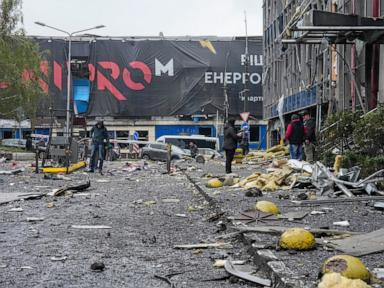
Silence. That is the first thing you notice when the air raid siren finally winds down its long, metallic wail over Kyiv, leaving only the distant hum of emergency generators and the crunch of glass under boots.
For a few seconds before dawn, a city of millions holds its breath. Somewhere in the dark, a life has just ended. Somewhere else, eight people are bleeding, bruised, or staring at ceilings that no longer belong to them. On a wire service feed, those facts arrive in a tidy, brutal sentence: Russian missiles and drones hit Kyiv overnight, killing one and injuring eight.
Eight. One. Overnight.
Numbers are merciful to the reader because they keep grief at arm's length. You can read "killing 1 and injuring 8" while drinking coffee in a quiet kitchen thousands of miles away and feel a brief, hollow ache before scrolling on. A single casualty count feels almost small compared to the vast scale of modern warfare. Yet a single dead person had a favorite mug, a set of keys on a hook, a mother or a child or a neighbor who knew the sound of their footsteps on the stairs. Eight injured people have bodies that will ache when the weather turns, hospital gowns that feel too thin in the autumn chill, and memories of a ceiling collapsing in the dark.
I have stood in stairwells in Kyiv at three in the morning when the air smelled of wet plaster, cordite, and cold rain. You do not feel heroic in those moments. You feel small, awkward, and strangely ordinary, clutching a phone with a dying battery while someone two floors up coughs from dust. Even if you have never heard a Shahed drone buzz overhead—that unmistakable, lawnmower-like thrum that makes your stomach drop before you even see a light in the sky—you know the sound of dread. Anyone who has waited for bad news at midnight recognizes that tightening in the chest.
To understand why an overnight strike that leaves one person dead and eight injured still shakes an entire capital, we have to look past the tally and examine what a barrage actually targets.
The Architecture of Fear
A ballistic missile or a long-range attack drone is a piece of engineering built for a specific geometry: distance, speed, explosive yield, and disruption. When Russian forces launch missiles and drones at Kyiv overnight, the immediate tactical goals usually involve testing air defenses, straining interceptors, striking infrastructure, or forcing civilians underground hour after hour.
Air defense crews work through the night tracking blips on radar screens, calculating trajectories, and firing interceptors into pitch-black skies. Every interception is a triumph of split-second math and nerve. Every falling debris fragment or unintercepted warhead is a gamble lost in the dark.
But there is a second target that never appears on a military briefing slide. Fatigue.
Think of a city's nervous system like a household circuit breaker. One sudden surge tests the wire; a constant, grinding load over months and years heats the insulation until the whole house risks going dark. When sirens sound at 1:00 a.m., then 3:30 a.m., then again just as the sky turns bruised purple, sleep becomes rationed currency. Parents carry half-asleep children into hallways or metro stations wrapped in quilts. Older residents sit on folding chairs because their knees hurt too much to lie on concrete.
(Note: The following portrait of a morning routine is a hypothetical scenario constructed to illustrate how routine life collides with overnight strikes, grounded in the documented realities of wartime Kyiv.)
Consider a hypothetical resident named Olena, a primary school music teacher in her late forties who lives on the sixth floor of a panel apartment block. She is not a soldier. She does not hold state secrets. Her greatest professional crisis on a normal Friday is getting thirty seven-year-olds to clap in four-four time without hitting each other. At 2:14 a.m., her phone buzzes with an alert, followed seconds later by the distant thud of air defense and a vibration she feels through the soles of her bare feet. She pulls on a fleece jacket, wakes her elderly father, and sits on the landing between floors. Nothing hits her building directly. Down the street, though, a strike and falling debris leave one person dead and eight injured. By 7:30 a.m., Olena is back in her classroom, tuning a battered upright piano, trying to keep her voice steady while her hands still carry a faint tremor.
That is the hidden math of an overnight attack. One fatality and eight injuries are the visible wounds. Exhaustion, hypervigilance, and quiet grief are the tissue damage spread across three million lives.
Why "Just One" Never Feels Small in a Living Room
Readers outside a war zone often ask a fair, uneasy question: in a conflict marked by massive offensives and heavy losses elsewhere, why does a single overnight strike on Kyiv with one death and eight injuries draw headlines?
Capitals carry weight. Kyiv is the political, cultural, and symbolic heart of Ukraine, as well as a dense urban center where millions of people live, work, commute, and try to keep a normal rhythm going. When missiles and drones hit Kyiv overnight, the shockwave is not confined to one street. It travels through train stations, bakeries, hospitals, and apartment blocks across the river.
There is also a deeper human truth at work here. Our minds struggle with massive numbers, yet we connect effortlessly with specific scenes. A tragedy involving one lost life and eight wounded bodies is small enough to picture clearly. You can imagine one ambulance pulling up to a shattered entrance. You can imagine eight hospital beds in a brightly lit ward at dawn.
Let's use a simple metaphor to see how that works. Imagine a heavy glass window in a quiet house. If a pebble taps it once, the glass holds. If stones keep hitting it through the night—some bouncing off, one finally cracking the pane—you do not just worry about the hole. You worry about the stress running through the entire frame.
A city under repeated missile and drone attacks lives inside that stressed frame. Even when air defenses intercept the majority of incoming threats, debris can spark fires, blow out windows, sever power or heating lines, or strike residential and commercial buildings. Each overnight wave reminds residents that safety in a modern city depends on layers of protection working without a single failure—and that even when they mostly work, tragedy can still slip through.
Inside the Long Night
Modern aerial warfare has turned the hours between dusk and sunrise into a contest of endurance. Attack drones fly low and slow compared to supersonic missiles, stretching out the tension. A drone warning can linger for hours as air defense units track targets weaving across regions toward the capital. Ballistic missiles cut that timeline down to minutes, leaving almost no margin between the first warning and impact.
People cope in ways that would look strange to an outsider and entirely logical to a local. Some head straight to a designated shelter or a metro station deep beneath the earth. Some stay in a windowless corridor behind two load-bearing walls, gambling on speed and comfort over depth. Some keep a "go bag" packed by the door with water, power banks, documents, and medication, while others admit openly that they are simply too tired to move anymore.
I have to be honest here: writing about fear from a distance, or even recalling fear after the danger passes, can feel inadequate next to the person whose window just blew inward. There is no tidy moral that makes an overnight strike easier to bear. Uncertainty is one of the cruelest parts of war. You do not know in the dark whether the boom you just heard was an interceptor firing miles away, debris hitting an empty courtyard, or a warhead striking two blocks over.
And in the morning, the city has to decide what kind of day it is going to have.
Municipal crews arrive with brooms, plywood, heavy machinery, and tarps. Paramedics and emergency responders move between triage, transport, and clearing hazards. Neighbors sweep glass from sidewalks without waiting to be asked. A cafe down the block might open late, offering hot tea to people whose hands are still cold from sitting on a stairwell floor.
What Cold Headlines Leave Out
Standard news dispatches are built for speed and clarity. They tell you when the attack happened, what weapons were reportedly used, and the casualty count at the time of filing: killed one, injured eight. Those details matter. Accurate reporting keeps the record straight when rumors fly in the fog of an early morning.
Yet a bare summary can leave readers feeling strangely detached, as if watching a weather report from another planet. When you strip away the human texture, you miss how war reshapes ordinary days. You miss the student trying to finish an exam by flashlight. You miss the paramedic drinking lukewarm coffee at 6:00 a.m. before another shift begins. You miss the quiet resolve of people who refuse to surrender their routines to terror, even while their bodies keep score of every lost hour of sleep.
History shows again and again that cities rarely break from a single blow alone; they endure through stubborn solidarity, mutual aid, and sheer refusal to disappear. Still, endurance has a cost. Every life lost is irreplaceable. Every injured person faces recovery—physical, financial, or psychological—long after the breaking news alert has faded from someone else's screen.
Next time you see a brief line about missiles and drones hitting a city overnight, with one person killed and eight injured, pause for ten seconds before you swipe past it.
Picture the darkness just before dawn. Hear the quiet that follows the siren. Remember that behind every small number is a whole universe that mattered deeply to someone—and a city still standing in the gray morning light, trying to breathe.