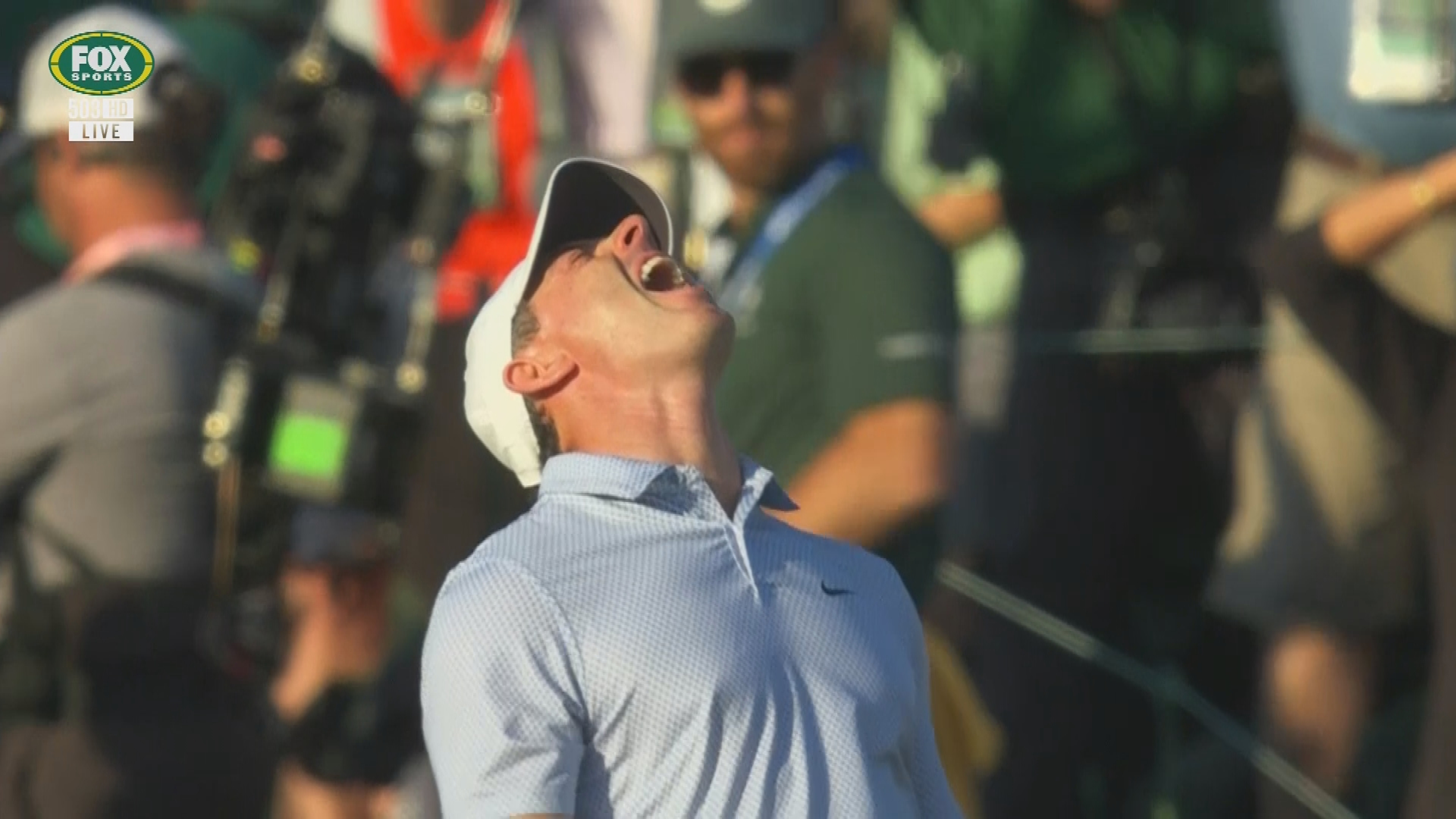
The lead at Augusta National is a heavy thing to carry, especially when it belongs to Rory McIlroy. After years of scar tissue and Sunday collapses, McIlroy has clawed his way back to the top of the Masters leaderboard, but this isn't the same player who dominated the early 2010s. This is a man fighting his own shadow. While the headlines focus on the scorecard, the real story is the mechanical and psychological overhaul McIlroy has undergone to survive the most punishing stretch of holes in professional golf. He is currently outstripping the field not through raw power, but through a newfound, almost agonizing level of restraint.
The Northern Irishman finds himself in the outright lead because he finally stopped trying to overpower a course that rewards patience over aggression. For a decade, McIlroy’s undoing at the Masters was his insistence on treating Augusta like any other tour stop—a place where high launch angles and ball speed dictate the outcome. That approach failed him. This week, we are seeing a calculated pivot. He is missing in the "right" places, playing away from tucked pins, and accepting par as a victory. It is a grueling way to play for a natural-born attacker, yet it is the only path left for his career grand slam. For a more detailed analysis into this area, we suggest: this related article.
The Technical Shift in the Short Game
The numbers reveal a startling change. Historically, McIlroy’s wedge play has been his Achilles' heel under pressure. When the nerves kick in, his path tends to get steep, leading to inconsistent strikes on the tight lies of Georgia turf. This year, the data shows a much shallower angle of attack. He is using the bounce of the club rather than trying to nip the ball perfectly clean. It is a defensive adjustment that has turned potential bogeys into easy saves.
Observers in the gallery might see a lucky break when a ball catches the fringe and stops, but it is actually the result of a deliberate change in spin rates. By taking more club and swinging with less effort, he is keeping the flight lower and more predictable. This reduces the variables that usually haunt him on the back nine. He isn't hunting flags; he is managing proximity. For broader background on this issue, extensive reporting can be read at Bleacher Report.
Mentality Over Mechanics
It is easy to credit a swing change for a lead, but the mental fortitude required to stay at the top of this specific leaderboard is immense. McIlroy has been here before. In 2011, he held a four-shot lead going into Sunday only to shoot an 80. That ghost still wanders the fairways of the national. The difference now is a refusal to engage with the narrative of "destiny."
Instead of feeding the media frenzy about his legacy, McIlroy has retreated into a bubble of process-oriented golf. He is walking slower between shots. He is spending more time with his caddie, Harry Diamond, discussing targets that are nowhere near the hole. This "boring" golf is his greatest weapon. It frustrates his playing partners and keeps the pressure on the rest of the field to make mistakes. While others try to force birdies to keep pace, Rory is waiting for the course to come to him.
The Fragility of the Outright Lead
Being the frontrunner at Augusta is a double-edged sword. The wind shifts here in ways that don't happen anywhere else on earth. A two-shot lead can evaporate in the time it takes to play the 12th hole. The tributary of Rae’s Creek is littered with the hopes of players who thought they had the tournament won on Saturday afternoon.
McIlroy’s lead is built on a foundation of improved putting, specifically from the five-to-ten-foot range. This is the "kill zone" at the Masters. If you make those, you stay in the hunt. If you miss, you start pressing. So far, the flat stick has been his savior, but the greens will only get firmer and faster as the weekend progresses. The moisture in the sub-air system is being sucked out, and the surfaces are turning into glass.
Navigating the Amen Corner Trap
The stretch from 11 to 13 is where the tournament is usually decided. McIlroy’s strategy here has been radically different this year. On the 11th, the hardest par four on the course, he is aiming thirty feet right of every pin. He is essentially playing it as a par 4.5. This removes the water from the equation entirely.
On the par-three 12th, he is no longer looking at the flag. He is hitting to the center of the green, regardless of where the cup is cut. It looks cowardly to the casual fan, but it is the hallmark of a veteran who understands that you cannot win the Masters on Friday or Saturday, but you can certainly lose it.
The Physical Toll of the Chase
At 36, McIlroy is no longer the young phenom. The physical demands of four days of high-stakes golf are starting to show in his posture. He is working harder than ever in the gym to maintain the core stability needed for his high-torque swing. However, the Masters is as much a hiking trip as it is a golf tournament. The elevation changes take a toll on the legs, and when the legs go, the swing timing follows.
His lead is a testament to his fitness, but the real test will be the final five holes on Sunday. That is when the lactic acid and the adrenaline collide. We have seen his foot slip before. We have seen the quickened tempo. To stay ahead, he must maintain a rhythmic cadence that defies the screaming pressure of the moment.
The Field in Pursuit
Despite the lead, the rearview mirror is crowded. Scottie Scheffler and Jon Rahm are not players who wilt under pressure. They represent a different kind of threat—one that doesn't rely on "feel" as much as McIlroy does. They are machines. If McIlroy plays "boring" golf and makes pars, he invites these predators to hunt him down with a string of birdies.
The danger for Rory is falling into a "prevent defense" mindset. There is a fine line between playing smart and playing scared. If he becomes too passive, the course will eventually bite him. Augusta rewards courage, but only if it is tempered with wisdom. He has to find the moments to strike, specifically on the par fives, which remain the only places where he can truly use his length to gain an advantage.
Historical Precedent and the Weight of 1986
Every time a veteran golfer leads the Masters, the ghosts of Jack Nicklaus in 1986 are summoned. But Rory isn't Nicklaus, and this isn't a comeback story yet—it's an endurance test. The drought since his last major win in 2014 is the giant elephant following him up every fairway. Every made putt is a relief; every missed one is a potential catastrophe.
The media wants the fairy tale. The fans want the Grand Slam. Rory just wants to get off the 18th green with his dignity intact. The lead he holds now is a shield, but it is a heavy one. He is swinging against his own history as much as he is swinging against the field.
The Equipment Factor
A subtle but vital part of this lead is his recent change in ball specification. Moving to a ball with slightly more drag has allowed him to control his distances better in the thin morning air. Earlier in the season, he struggled with "flyers"—balls that would jump off the face and sail over the green. At Augusta, long is dead. By switching to a ball that settles faster, he has regained the confidence to swing fully at his targets.
This equipment tweak, combined with a slightly softer shaft in his driver, has tightened his dispersion. He is hitting more fairways, which at Augusta means he is hitting from the flat spots. You cannot control the spin from the pine straw. By staying in the short grass, he is giving himself the best possible angle to greens that are designed to repel anything but a perfect shot.
The Final Hurdle
The lead is a statistical reality, but the Masters doesn't care about statistics. It cares about the 15th hole when the wind is swirling and the water is staring you in the face. It cares about the 18th green when your hands are shaking so hard you can barely find the ball in your pocket.
McIlroy’s performance so far has been a masterclass in professional management. He has diagnosed his past failures and applied a clinical solution. But the clinical approach only works until the heart rate hits 140 beats per minute. The outright lead is his for now, but Augusta has a way of asking the one question no player wants to answer: how much do you really want this?
The strategy is set. The swing is holding. The putter is warm. But as the sun sets over the Georgia pines, the only thing that matters is whether the man who has lost it all here before can finally find a way to win. He must stop fighting the course and start letting it carry him home.