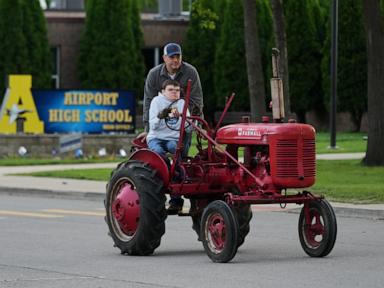
Local news editors love a wholesome, small-town photo op. Every spring, right around graduation, the same cookie-cutter headline makes the rounds across America's heartland: "Seniors Arrive at School in Style on Tractor Day."
Cue the images of smiling teenagers chugging down main street at eight miles per hour, waving American flags from the cabs of multi-ton John Deere and Case IH rigs. The comments section fills with boomer nostalgia about community pride, hard work, and good old-fashioned American grit.
It is a beautiful, heartwarming lie.
As an agricultural economist who has spent two decades analyzing the shifting balance sheets of family farms across the Midwest, I look at those photos and see something else entirely. I see a profound misunderstanding of modern rural life. I see a generational wealth trap wrapped in a parade.
Tractor Day is not a celebration of a thriving agricultural tradition. It is a monument to an industry that is rapidly cannibalizing its youth. The "style" these kids are arriving in is financed by crushing, inescapable debt that ensures most of them will never actually own the land they are driving across.
The Six-Figure Toy Illusion
Let’s dismantle the first myth of the high school tractor parade: the idea that this represents a quaint, accessible way of life.
The machinery idling in these school parking lots is not granddad’s rusty old farmall. These are highly advanced, GPS-guided, climate-controlled tech platforms. A modern mid-range row-crop tractor costs anywhere from $250,000 to over $600,000. Combine harvesters easily push past the $800,000 mark.
When a 17-year-old drives a half-million-dollar piece of equipment to physics class, they are not showcasing self-reliance. They are operating a highly leveraged corporate asset.
Average Cost of Modern Row-Crop Tractor:  $350,000 - $600,000
Average Net Farm Income per Operation:     $140,000 (Highly Volatile)
Asset-to-Debt Ratio for Young Farmers:     Dropping sharply since 2018
The sheer economics of modern farming mean that the barrier to entry has become an insurmountable wall. According to USDA data, the average age of the American farmer is now over 58 years old. Why? Because the capital required to start an independent farming operation from scratch is completely out of reach for anyone without a massive inheritance.
When we cheer for Tractor Day, we are romanticizing an economic reality that no longer exists for the average teenager in that cab. We are applauding the chains of a consolidation crisis that has forced small-holder farms to scale up drastically or die. To afford that tractor, a farm needs thousands of acres, massive commercial credit lines, and zero room for error.
Dismantling the People Also Ask Nonsense
If you search for these events online, the public questions reveal a deep, systemic misunderstanding of what is actually happening in rural communities.
"Is Tractor Day safe for high school students?"
The standard response from school boards involves traffic permits, police escorts, and slow-moving vehicle signs. That misses the point entirely. The real danger isn't a fender bender on Route 6. The danger is the normalization of high-risk economic exposure.
We are teaching kids to find their identity in machinery that costs more than a suburban mansion, before they even understand how commodity futures or interest rate hikes work. The safety risk isn't physical; it's financial.
"Do Tractor Days help keep kids interested in agriculture?"
No. They keep kids interested in the aesthetic of agriculture. Driving a shiny machine for two miles is easy. Managing a balance sheet while the Federal Reserve jacks up interest rates and a trade war tanks soybeans is brutal.
By treating agriculture as a novelty parade, we fail to prepare the next generation for the reality of the business. We are feeding them nostalgia when we should be teaching them risk management, soil biology, and algorithmic trading.
The Cold Truth of the Right to Repair
Look closely at the cabs of those modern tractors. The teenagers driving them cannot fix them.
For generations, the pride of the American farmer was self-reliance. If a machine broke down in the middle of a harvest, you grabbed a wrench, got grease under your fingernails, and fixed it.
Today, if a sensor misreads a emission metric on a new John Deere, the tractor enters "limp mode." The farmer is legally barred from accessing the proprietary software required to diagnose or fix their own machine. They must wait for a certified dealership technician to drive out with a laptop, charging hundreds of dollars an hour just to click "clear codes."
Traditional Farming:   Mechanically Independent -> High Sweat Equity -> Low Overhead
Modern Farming:        Software Dependent       -> High Debt         -> Corporate Lock-in
Tractor Day celebrates an independence that has been thoroughly engineered out of existence by corporate monopolies. The teenagers in those seats are not masters of their machines; they are glorified operators renting software licenses from equipment conglomerates.
The Dark Side of Generational Obligation
I have sat at kitchen tables across Michigan, Ohio, and Iowa, looking at the tax returns of families whose kids participate in these parades. The tension is palpable.
There is a crushing psychological weight on these seniors. They feel an intense, cultural obligation to take over the family business. To drop out of the running for a tech or medical career to keep the multi-generational farm alive.
But taking over the farm today does not mean inheriting a stable asset. It means inheriting a massive debt portfolio. It means betting your entire financial future on weather patterns that are becoming increasingly erratic and global commodity markets that fluctuate based on geopolitical theater.
"We are forcing 18-year-olds to make a choice between familial loyalty and financial sanity."
When schools sponsor Tractor Day, they aren't just hosting a fun spirit day. They are validating a cultural pipeline that funnel young people into a highly volatile, low-margin industry without giving them the critical tools to evaluate if that’s actually a smart business decision.
The Actionable Pivot: What We Should Celebrate Instead
If we actually care about the future of rural youth, we need to stop treating agriculture like a museum exhibit. We need to transition from celebrating iron to celebrating intellect.
Instead of a Tractor Day, rural high schools should be hosting Ag-Tech and Capital Allocation Days.
- Ditch the parade, bring the data: Challenge students to present optimization models showing how drone mapping can reduce nitrogen runoff.
- Deconstruct the financials: Have seniors build a mock farm portfolio, hedging crop risks against real-world market volatility using futures and options.
- Focus on ownership, not operation: Teach the mechanics of land trusts and cooperative financing structures that allow young people to actually gain equity in land, rather than just driving expensive leased machinery.
The downside to this approach? It isn't photogenic. It won't get 5,000 shares on a local Facebook group. It won't make people feel warm and fuzzy about the good old days.
But it might actually save a family farm.
The next time you see a line of tractors idling outside a high school, do not smile at the tradition. Look at the numbers. Understand that the shiny paint jobs are masking an industry running on fumes, debt, and corporate dependency. Stop applauding the parade and start demanding that we give these kids the financial and technological literacy to actually own their future, rather than just driving through it.

