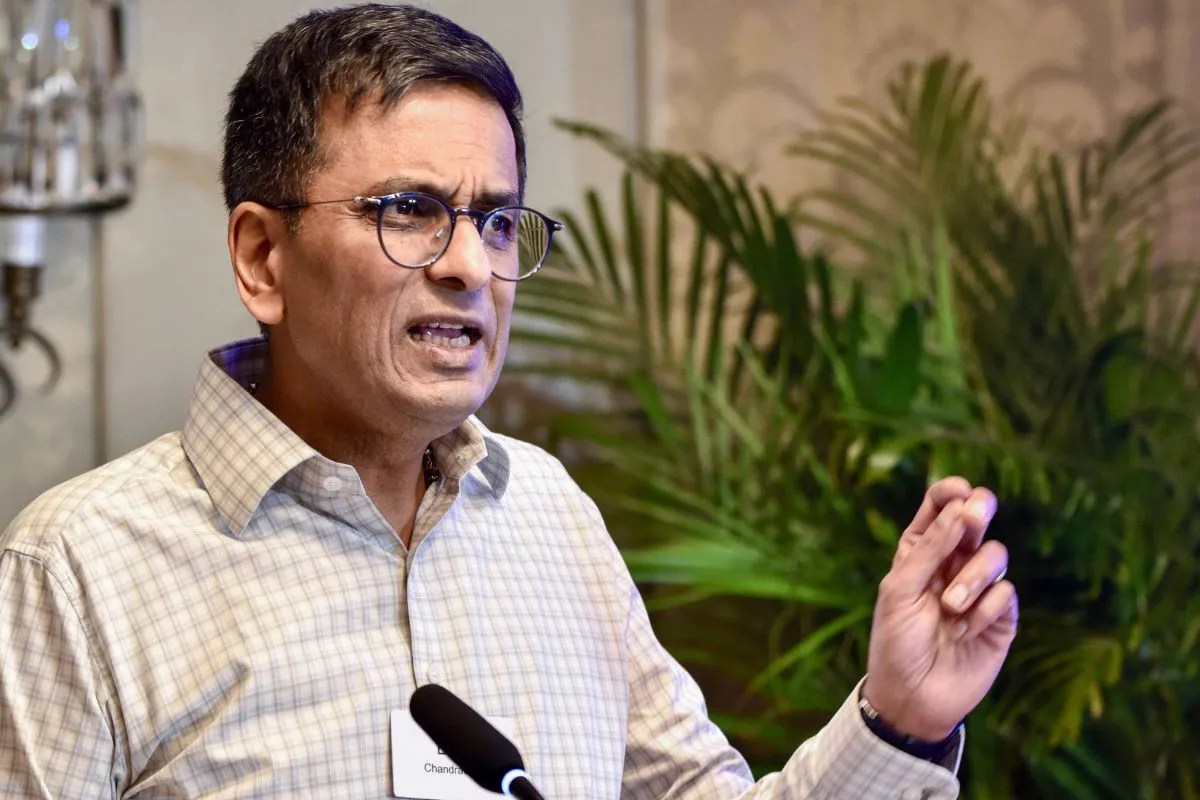
When a superpower like Russia picks a retired Chief Justice of India to sit on an international tribunal, people pay attention. Former Chief Justice of India DY Chandrachud has been officially named by Moscow as its arbitrator in a heavy-hitting investment treaty dispute. The opposing party is Oschadbank, a major state-owned Ukrainian bank seeking hundreds of millions of dollars for assets allegedly lost following the 2022 invasion.
If you are wondering why this specific legal appointment matters, it goes far beyond a simple routine assignment. It places a prominent Indian judicial figure right at the center of high-stakes geopolitical litigation stemming from the ongoing Russia-Ukraine war. Let us look at what is actually happening behind the scenes of this multi-million dollar dispute and why Chandrachud's new role is turning heads globally.
The Core of the Dispute Involving Oschadbank
The legal battle playing out before the international tribunal is not about minor financial disagreements. Oschadbank initiated formal arbitration proceedings after serving Moscow with a notice of dispute in July 2025 that allegedly went unanswered. The bank claims it suffered total asset destruction and lost business operations across four key Ukrainian regions: Donetsk, Luhansk, Kherson, and Zaporizhzhia.
These losses trace directly back to Russian military actions and the full-scale invasion. Under the framework of the 1998 bilateral investment treaty between the Russian Federation and Ukraine, Oschadbank is demanding massive financial compensation.
The three-member tribunal handling this complex litigation features a carefully balanced composition:
- Dyala Jimenez, a Costa Rican arbitrator and former trade minister, serves as the president of the tribunal after being jointly selected by Russia and Oschadbank.
- Stavros Brekoulakis, a Greek arbitrator and professor at the National University of Singapore, was appointed by Oschadbank.
- Justice DY Chandrachud was chosen directly by Russia as its appointed member.
The Background on Chandrachud Prior Approaches
What makes this appointment particularly fascinating for legal experts is that it marks a clear shift in stance. Justice Chandrachud had previously turned down earlier approaches from Russia. Moscow had previously sought to appoint him as an arbitrator in separate investment treaty disputes involving German energy firm Wintershall Dea and Ukrainian state-owned power transmission company Ukrenergo.
Those past approaches hit a roadblock because they coincided with his designation by the Permanent Court of Arbitration as an appointing authority in the Wintershall proceedings, leading him to step down from that role after transparently disclosing those communications. By accepting the current Oschadbank assignment, Chandrachud steps directly into the arena of wartime asset litigation.
This case is entirely separate from Oschadbank's previous long-running legal war against Russia over the 2014 annexation of Crimea. In that older case, a tribunal awarded the Ukrainian bank roughly 1.1 billion dollars, which triggered years of appellate battles and twists in French courts regarding jurisdiction and tribunal fairness.
What Happens Next in the Tribunal
International investment arbitrations governed by bilateral treaties are notorious for dragging on for years. Both sides have lined up elite legal firepower, with international law firms representing each camp. Russia relies on counsel from Pinna Goldberg, while Oschadbank is backed by legal heavyweights from Quinn Emanuel Urquhart & Sullivan and Asters.
With the tribunal now fully constituted with Jimenez, Brekoulakis, and Chandrachud, the panel will begin evaluating the jurisdictional nuances of the 1998 treaty, the extent of wartime asset seizures, and the astronomical financial liabilities claimed by Kyiv's state bank. As proceedings unfold, the decisions rendered by this panel will set powerful precedents for how international law handles corporate and state asset losses in active combat zones.