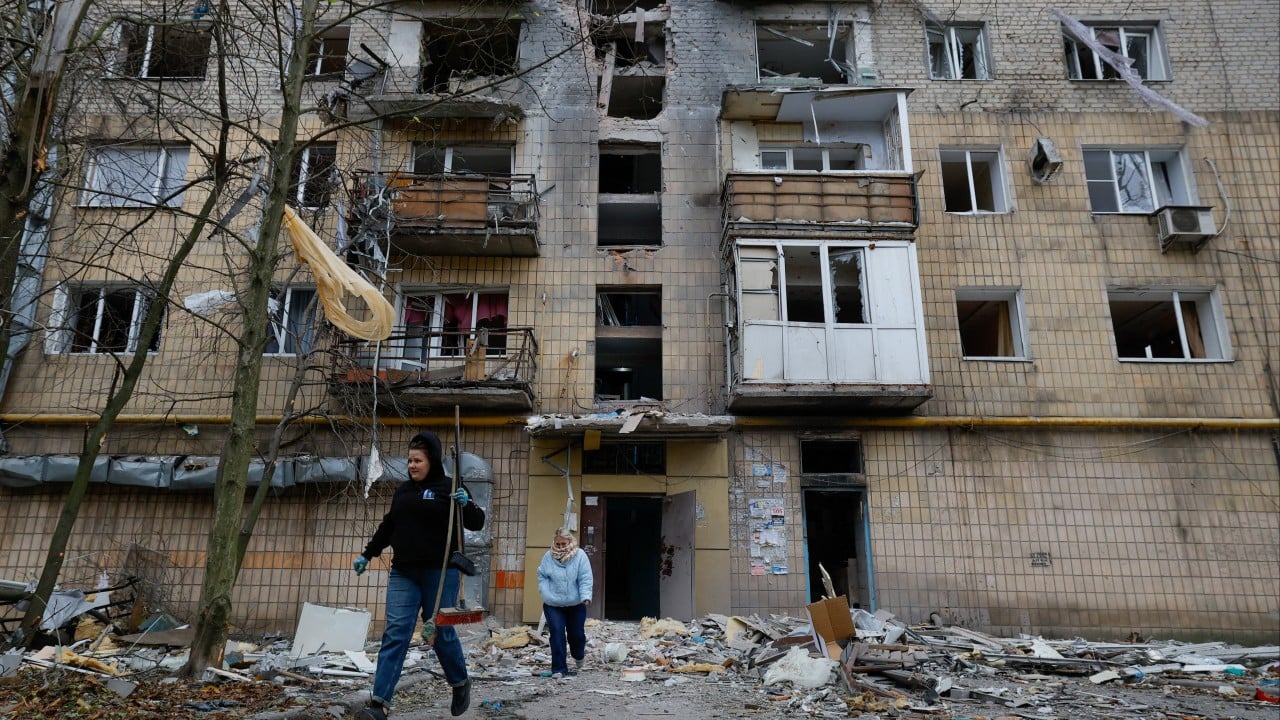
Diplomats rarely sit across from mortal enemies out of sudden goodwill. They do it because the cost of standing up has become too high to bear. When representatives from Moscow and Kyiv entered US-backed talks—their first direct engagement since the full-scale invasion began in February 2022—the headlines focused on the diplomatic breakthrough. That framing misses the point. Peace talks at this stage are not an olive branch; they are an audit of exhaustion.
After years of grinding attrition, shifting geopolitical priorities in Washington, and mounting domestic pressures in both capitals, the war has reached a structural inflection point. The decision to engage under American mediation reflects a cold calculation by both sides. Neither has achieved its maximalist objectives on the battlefield, and the political oxygen required to sustain an indefinite conflict is running thin.
The Architecture of a Stalled War
To understand why Russia and Ukraine are talking now, look at the map and the balance sheets. The front lines have hardened into a brutal, high-tech version of trench warfare, where incremental territorial gains cost thousands of lives and billions in hardware.
In Kyiv, the calculus is dictated by manpower and materiel. Ukraine has demonstrated extraordinary resilience, repeatedly defying expectations against a numerically superior adversary. Yet resilience does not manufacture artillery shells or replace exhausted infantry brigades. Western aid packages, while massive, have arrived in fits and starts, often constrained by domestic political gridlock in donor nations. Ukrainian leadership faces a stark reality: continuing the war without guaranteed, long-term supply lines risks a catastrophic collapse along the eastern front. Entering US-backed talks allows Kyiv to test whether diplomacy can secure what force of arms currently cannot—namely, concrete security guarantees and a halt to the destruction of its infrastructure.
Moscow’s motivations are equally pragmatic, though masked by triumphant rhetoric. The Russian economy has been placed on a wartime footing, generating short-term industrial growth at the expense of long-term stability. Inflation is sticky, labor shortages are acute, and the state is burning through sovereign wealth reserves to fund military expenditures and social payouts to soldiers' families. Furthermore, Russia’s military hardware losses have forced it to rely on aging Soviet stockpiles and foreign procurement from isolated regimes. For the Kremlin, talks offer a chance to lock in territorial gains, fracture Western unity, and relieve economic pressure without appearing to retreat.
Washington's Pivot From Blank Check to Broker
The phrase "US-backed talks" carries heavy diplomatic freight. For the first phase of the war, Washington’s official posture was defined by the mantra "as long as it takes," paired with the insistence that nothing about Ukraine would be decided without Ukraine. That consensus has eroded.
American foreign policy is never conducted in a vacuum; it is tethered to domestic political cycles and competing global crises. With intense pressure on the US budget, growing skepticism among segments of the American electorate regarding open-ended foreign commitments, and escalating tensions in the Indo-Pacific and the Middle East, the White House has shifted its strategy. Washington no longer views an indefinite stalemate as a viable containment strategy against Moscow.
By actively brokering these negotiations, the United States is asserting control over the endgame. American diplomats understand that if they do not shape the parameters of a settlement, they risk a chaotic collapse of the Ukrainian front or a unilateral European fracture. Washington holds the primary leverage over both parties: for Kyiv, it is the tap of intelligence, air defense, and advanced weaponry; for Moscow, it is the architecture of global financial sanctions and the potential for future economic normalization. The US is using both to force a reckoning.
What Is Actually on the Table
Forget the public posturing about total victory or unconditional surrender. Behind closed doors, negotiations between warring states revolve around four rigid pillars: territory, security, neutrality, and sanctions.
The Territorial Deadlock
Ukraine’s constitutional and moral position is the restoration of its 1991 borders, including Crimea and the Donbas. Russia’s stated position is the recognition of its annexation of four Ukrainian oblasts—Donetsk, Luhansk, Zaporizhzhia, and Kherson—in addition to Crimea. Neither side can formally concede these claims without triggering a domestic political crisis. Consequently, negotiators often look toward historical precedents like the Korean Peninsula or post-World War II Germany. In a hypothetical framework modeled on these historical standoffs, the parties might agree to a verified ceasefire along current lines of contact, deferring the legal question of sovereignty to future generations while establishing demilitarized buffer zones.
Security Guarantees Versus Neutrality
Moscow’s primary demand has long been Ukrainian neutrality—a permanent bar against NATO membership and the removal of Western military infrastructure from Ukrainian soil. Kyiv, having watched the 1994 Budapest Memorandum fail to prevent two Russian invasions, views neutrality without teeth as a death sentence. Any viable compromise requires threading an almost impossible needle: keeping Ukraine formally outside NATO to satisfy Russian security demands, while establishing bilateral defense treaties with the US and European powers that arm Ukraine to the teeth and guarantee immediate military intervention if Russia attacks again.
The Sanctions Off-Ramp
Russia wants immediate relief from the financial, technological, and energy sanctions imposed since 2022. Western powers, however, view sanctions as their primary enforcement mechanism. A phased rollback—where specific restrictions are lifted only after verified milestones of troop withdrawal or ceasefire compliance—is the standard diplomatic tool here. Yet trust is nonexistent, and Moscow knows that sanctions lifted by one administration can be reimposed by the next.
The Historical Trap of Frozen Conflicts
The deepest danger in these US-backed talks is not that they will fail, but that they will produce a flawed agreement that merely pauses the war. History offers a grim warning.
In 2014 and 2015, following Russia's initial seizure of Crimea and intervention in the Donbas, European mediators helped broker the Minsk agreements. Those accords stopped the heaviest fighting for a time, but they left the core political contradictions unresolved. Neither side fully implemented its obligations. Instead, the line of contact became a simmering front where snipers and artillery traded fire daily, allowing Moscow to destabilize Ukraine politically and prepare for the full-scale invasion years later.
A new agreement that simply freezes the current battle lines without robust international monitoring, enforceable deterrence, and clear mechanisms for dispute resolution will repeat the failure of Minsk on a far more destructive scale. Both Moscow and Kyiv know this. Ukrainian negotiators are acutely aware that a bad peace deal gives Russia time to reconstitute its shattered army, fix its logistical failures, and strike again when Western attention is elsewhere. Conversely, Russian strategists worry that a ceasefire will allow NATO to turn the remaining territory of Ukraine into an impenetrable fortress.
The Silent Stakeholders in the Room
While American, Russian, and Ukrainian officials occupy the seats at the table, the shadows of Brussels and Beijing loom large over the proceedings.
European leaders face a dilemma. They have absorbed millions of Ukrainian refugees, restructured their energy grids to cut off Russian gas, and ramped up defense spending. Yet Europe still lacks the military-industrial capacity to replace the United States as Ukraine’s primary security guarantor. If Washington pushes Kyiv toward territorial concessions to secure a deal, European capitals will be left to manage the fallout—and the security threat of an emboldened Russia on their eastern flank.
Meanwhile, China has positioned itself as a crucial economic lifeline for Moscow, absorbing discounted Russian oil and supplying dual-use goods that keep Russia’s war machine running. Beijing has little interest in a total Russian defeat, which would leave China isolated against the West, nor does it want an endless war that disrupts global trade and strengthens NATO. Subtle diplomatic pressure from Beijing, urging Moscow to engage in talks to stabilize the global economy, cannot be discounted as a factor driving the Kremlin to the table.
The Mechanics of De-escalation
Moving from initial talks to an actual cessation of hostilities requires far more than a handshake and a signed document. Modern warfare leaves behind a massive logistical and humanitarian footprint that takes years to unwind.
Even if negotiators agree on the broad political contours of a settlement, technical working groups must hammer out the minutiae of de-escalation. This includes establishing rules of engagement for aerial reconnaissance, mechanisms for the exchange of thousands of prisoners of war, protocols for clearing millions of landmines across agricultural heartlands, and the restoration of safe maritime transit corridors in the Black Sea. Each of these technical issues is a potential landmine capable of blowing up the entire political process.
Trust cannot be assumed; it must be engineered through verification. That means granting international observers—likely from neutral nations acceptable to both Moscow and Washington—unfettered satellite and on-the-ground access to monitor troop movements and heavy weapons depots. Without eyes on the ground, every localized skirmish or stray drone strike risks spiraling back into full-scale warfare.
The return of Russian and Ukrainian diplomats to the negotiating table under American auspices marks the end of the war's initial phase, where both sides believed absolute military victory was within reach. What replaces it is a treacherous diplomatic arena where every comma in a draft treaty carries the weight of sovereign survival. The guns have not fallen silent, and the distance between Moscow’s demands and Kyiv’s red lines remains vast, proving that ending a war is infinitely harder than starting one.