The winter wind across the Saskatchewan plains does not negotiate. It sweeps down uninterrupted from the Arctic, scouring the black-soil flatlands until the temperature drops low enough to make the inside of your nose freeze solid with a single breath. Out here, winter is not a season; it is an active participant in daily life. It tests the limits of machinery, the durability of steel, and the stubborn resolve of the people who call this expanse home.
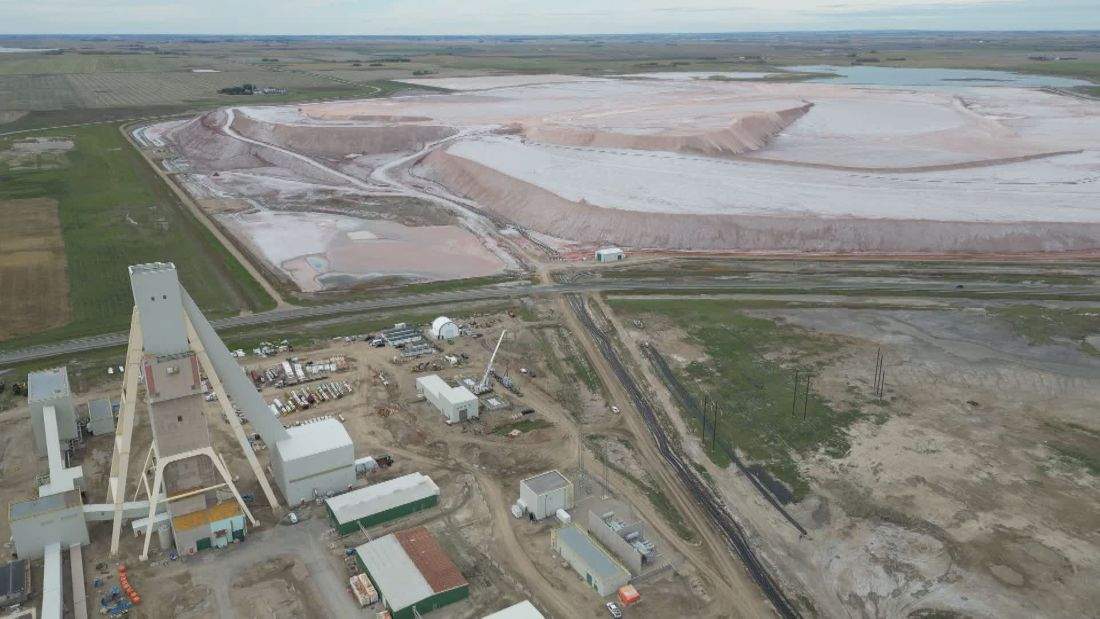
In the town of Rocanville, population roughly one thousand, the horizon stretches in every direction until the curve of the earth gently swallows it. This is a place where you can watch your dog run away for twenty minutes. It is also the epicenter of an underground universe that feeds half the globe. Two thousand feet below the frozen topsoil lies a colossal, ancient sea that evaporated hundreds of millions of years ago, leaving behind a treasure of marine minerals. Potash. Red gold. Fertilizer that keeps the wheat fields of Kansas, the rice paddies of Asia, and the corn belts of Europe breathing.
When distant politicians in Washington or trade negotiators across international borders start talking about tariffs, protectionism, and economic warfare, the sound usually arrives in small towns like this as static on a kitchen radio. Recently, the noise has centered around potential American trade threats, political posturing, and looming tariff walls. If you listen to cable news pundits, you might picture Rocanville bracing for impact, its residents wringing their hands over geopolitical crosshairs.
Step into the local coffee shop around six inpiry-cold morning, however, and you will find a entirely different atmosphere. There is no panic here. There are no emergency town halls or frantic delegations packing bags for Ottawa. There is only the steam rising from heavy ceramic mugs, the scrape of heavy work boots against rubber mats, and the quiet, rhythmic clatter of spoons stirring cream into dark roast.
The mayor of Rocanville does not blink when asked about trade threats. He has seen administrations come and go like prairie thunderstorms—loud, dramatic, and ultimately passing. The fundamental reality of the earth beneath his town remains unchanged.
Consider what actually happens two thousand feet down. Electric boring machines, massive mechanical behemoths equipped with giant rotating drums of tungsten-carbide teeth, chew tirelessly into the rock face. They carve out geometric cathedrals of pink and white salt. Conveyor belts roar through the dark, carrying the raw ore upward to the blinding Saskatchewan sun, where massive refineries crush, float, and granulate the product into a dry, rosy dust. This is not a trendy tech startup vulnerable to a sudden shift in venture capital sentiment. This is basic, biological necessity.
To understand why a potash mining
Salt Of The Earth Beneath The Prairie Wind
business
news
The wind does not ask for permission before it strips across the grid of Saskatchewan. It moves down from the Arctic, flat and freezing, scouring the black dirt and the stubborn stubble of last season's harvest until the horizon blurs into a uniform, bruised grey.
Stand on the edge of Rocanville on a Tuesday morning, and you will hear it. A low, rhythmic thrum vibrating through the soles of your boots. It is not the sound of the wind. It is the heartbeat of a mile-deep cage, hauling salt and promise out of the dark.
For generations, the people here have traded with the earth. They know the weight of a hardhat and the smell of diesel on wool. They know that when politicians four thousand miles away start rattling sabers and tossing around words like tariffs, trade wars, and economic retaliation, the dust tends to settle right here, on Main Street.
So when the headlines flashed across the diner television last week—warning of steep protectionist threats and broad political posturing aimed at Canada's southern border—the coffee cups kept moving. No one dropped their fork. No one started packing bags.
Because down where the potash lies, beneath the layers of ancient sea beds and millions of tons of stubborn Canadian shield, people understand a fundamental truth that Washington and Ottawa sometimes forget.
You can legislate a border, but you cannot legislate hunger.
Beneath the Surface
To understand why a small Saskatchewan mining town shrugs off geopolitical thunder, you have to go down.
Picture David, a thirty-year veteran of the hoist room who has spent half his life descending into a shaft deeper than the Empire State Building is tall. He drops down into the dark in a cage that groans against the stone, descending three thousand feet into an alien cathedral of pink and white crystal.
It is silent down there, save for the mechanical roar of continuous miners chewing through seams of muriate of potash that formed three hundred million years ago when an ancient inland sea evaporated under a prehistoric sun.
This is not a fragile enterprise. It is a geological titan. Saskatchewan holds nearly half of the world's known potash reserves. The world does not simply buy Saskatchewan potash because it is convenient; the world buys it because modern agriculture cannot feed eight billion people without it. Potash is potassium. Potassium is life. It is the invisible engine driving the cornfields of Iowa, the soybean rows of Brazil, and the rice paddies of Southeast Asia.
When political threats loom from the south, economists panic about supply chains. But David, wiping salt dust from his forehead under the glare of a halogen cap-lamp, sees it differently.
"Let's be realistic," he says, leaning against a steel beam. "You can put whatever tax stamp or political rhetoric you want on a piece of paper in Washington. But when the spring thaw hits Kansas, those farmers need fertilizer in the ground. And there aren't enough train cars in the world to replace what comes out of these shafts."
The Mayor and the Main Street Mindset
Up on the surface, Mayor Ron Metheral isn't losing sleep either.
In a town where every civic budget, every minor hockey jersey sponsorship, and every paved pothole traces its lineage directly back to the headframes towering over the town limits, you learn to read the difference between real danger and political theater.
When reporters called him about the latest round of protectionist threats—the bluster about 25 percent tariffs and border walls of red tape—his response was remarkably quiet.
"We've seen administrations come and go," Metheral notes, his voice carrying the steady, unhurried cadence of someone who measures time in crop rotations and collective bargaining agreements. "Leaders use big language. They talk about changing the rules of the game. But at the end of the day, food security is national security. You can't grow food out of thin air."
Consider the sheer logistics of global agriculture. It takes years to develop a new potash mine, billions of capital dollars, and complex engineering feats that few nations possess the patience or geology to pull off. You cannot simply pivot away from Saskatchewan overnight because a politician wants a soundbite for the evening news. The infrastructure is anchored in the bedrock. The railway networks, stretching south through the heartland of the continent, are iron arteries that have pumped this trade back and forth for over a century.
It is a symbiotic marriage born of necessity. The American Midwest needs high-grade fertilizer to sustain its high-yield crop yields; Saskatchewan needs a reliable, nearby market to keep its economy humming. Trade policies are written by politicians in suits, but they are ultimately governed by the unyielding laws of agronomy.
The Human Element
Walk into the Rocanville bowling alley on a Friday night, and the tension of global trade disputes feels about as distant as the rings of Saturn.
Kids chase each other around the pin-setters while their parents—men and women who rotate through subterranean shifts underground—argue over league scores and local curling bonspiels. There is a quiet confidence here. It is not born of arrogance, but of competence.
These are people who work in an environment where a single mistake can spell catastrophe, which trains the mind to separate noise from hazard. The political noise from the south? It’s just noise. A squall on the prairie. It rattles the siding, but the foundation is poured deep.
(Note: While the economic dependency on agricultural inputs provides a powerful buffer, external trade shocks can still introduce localized ripples in shipping costs and currency valuations, though the underlying demand remains largely inelastic.)
Yet, beneath the calm, there is an acute awareness of change. The world is getting noisier. Supply chains are weaponized. Every nation wants to shore up its domestic security.
Yet, as the night settles over the prairie and the lights of the mine headframes glow amber against the vast, star-pricked sky, the reality of the earth holds firm. The machines keep digging. The trains keep loading. The salt of the earth keeps moving south, carrying the lifeblood of tomorrow's harvest through a storm of words.
The wind howls against the windowpane.
The salt keeps rising.