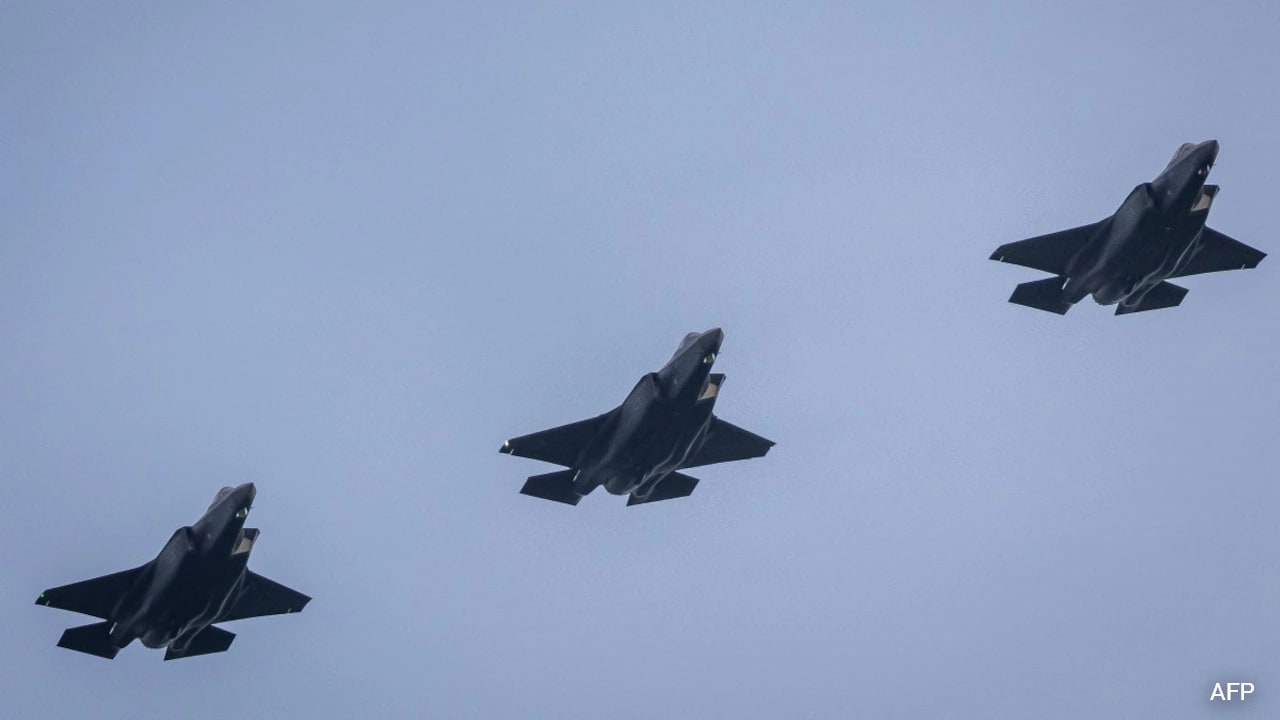
Washington just cleared the path for Riyadh to buy forty-eight F-35 Lightning II fighters. The mainstream press calls it a strategic realignment. Pundits claim it cements the American security umbrella across the Persian Gulf while checking Iranian ambition. They are dead wrong on every single count.
This transaction is not a diplomatic triumph. It is a brilliant, cynical exercise in industrial life support disguised as foreign policy. You might also find this connected article insightful: The Architecture of Impunity Why Multilateral Sanctions Enforcement Collapsed.
The lazy consensus treats multi-billion-dollar foreign military sales as trophies of geopolitical influence. If you hand a nation the most expensive stealth fighter on Earth, the theory goes, they become inextricably bound to your orbit. They buy your spare parts, they train at your bases, and they fall in line with your regional calculus.
Experience in defense procurement tells a starkly different story. When you sell a weapon system that requires an unyielding digital umbilical cord just to taxi down a runway, you are not projecting power. You are exporting a perpetual maintenance liability that hollows out the buyer's actual operational readiness while padding the profit margins of prime contractors in Virginia and Texas. As highlighted in recent articles by NBC News, the implications are significant.
Saudi Arabia does not need the F-35. And Washington knows it.
The Illusion Of Regional Deterrence
To understand why this sale is an absurdity, look at the operational environment of the Middle East. The conventional argument insists that Riyadh requires fifth-generation stealth capabilities to maintain air superiority against regional adversaries.
This argument collapses under basic scrutiny. Against whom? Yemen's Houthis operate decentralized asymmetric networks, ballistic missile arsenals, and low-cost loitering munitions. Stealth fighters costing over one hundred million dollars apiece per airframe are about as useful against insurgent drone swarms as a scalpel is at cutting down a concrete pillar.
Against Iran, the geographical distance and air defense networks present a completely different set of operational hurdles. The F-35 is a short-to-medium-range tactical strike platform optimized for high-end contested environments with dense integrated air defense systems. It is not designed to patrol the vast expanses of the Arabian Peninsula or replace the heavy, long-range payload capacity of legacy platforms like the F-15SA and F-15SI, which Riyadh already operates in massive numbers and maintains with decades of institutional knowledge.
By introducing the F-35 into the Royal Saudi Air Force inventory, Washington is not boosting regional stability. It is introducing an administrative and logistical nightmare that drains Saudi defense budgets away from practical border defense and toward maintaining hangar environments cooled to exact specifications for radar-absorbent skin maintenance.
The Software Umbilical Cord
The mainstream narrative completely glosses over the operational mechanics of the F-35 ecosystem. People think buying a fighter jet is like buying a car. You hand over the cash, take the keys, and drive off the lot.
With the F-35, you do not own the car. You lease an application on a smartphone managed entirely by the software developer.
The entire platform relies on the Operational Data Integrated Network, or ODIN, which replaced the notoriously clunky Operational Data Integrated Network predecessor, ALIS. Every single flight hour, every diagnostic check, and every maintenance log feeds back into a centralized cloud infrastructure managed by Lockheed Martin and supervised by the United States Department of Defense.
Imagine a scenario where a sovereign air force must request permission, telemetry clearance, and software authentication codes from contractors thousands of miles away just to perform routine diagnostic troubleshooting on an internal avionics bay. That is not sovereign military capability. That is digital vassalage.
If Riyadh ever decides to deploy these aircraft in a theater operation that runs counter to Washington's immediate diplomatic preferences, the kill-switches and diagnostic locks embedded in the software architecture ensure that the fleet becomes an expensive lawn ornament within seventy-two hours. American lawmakers know this. The Pentagon knows this. The Saudis suspect this. Yet the deal moves forward because the primary objective has nothing to do with Middle Eastern balance of power.
Subsidizing The Lockheed Assembly Line
Defense economics dictate modern geopolitics far more than grand strategy. The F-35 program is the most expensive weapons system in human history, plagued by decades of cost overruns, software glitches, and sustainment shortfalls.
To keep the unit cost of the aircraft from spiraling further out of reach for the US Air Force and Navy, manufacturers need volume. Foreign military sales act as the financial shock absorbers for American defense manufacturing. By locking Riyadh into a forty-eight-jet procurement order—complete with the obligatory multi-decade maintenance, training, and software upgrade contracts—Lockheed Martin secures billions of dollars in guaranteed revenue that insulates them from domestic budgetary contractions in Washington.
Look at the math. The initial procurement cost of the airframes represents only a fraction of the total lifecycle expenditure. The real financial extraction happens over the thirty-to-forty-year operational lifespan of the fleet. Spare parts pricing, engine overhauls, block upgrades, and simulator maintenance create an endless cash drain.
Saudi sovereign wealth is being tapped to subsidize the manufacturing overhead of the American military-industrial complex. It is a brilliant corporate strategy masquerading as foreign aid to domestic defense contractors. Calling this a diplomatic masterstroke is like praising a casino for convincing a customer to buy the slot machine they are currently losing money on.
The Multi-Vector Exit Strategy
The most glaring flaw in the conventional analysis of this arms sale is the assumption that Saudi Arabia has nowhere else to go.
For decades, Riyadh relied exclusively on Western hardware. Today, the Kingdom's leadership practices strategic hedging. They understand that American security commitments in the Middle East have grown conditional, hesitant, and prone to domestic political shifts in Washington.
When Washington drags its feet on arms approvals or imposes human rights conditions on military exports, Riyadh looks elsewhere. They have already established robust defense-industrial cooperation frameworks with China, Turkey, and European nations. They are investing heavily in domestic defense manufacturing through entities like the General Authority for Military Industries, aiming to localize fifty percent of their military equipment spending.
Buying F-35s is a temporary appeasement play by Riyadh to keep Washington engaged while they quietly diversify their military procurement portfolio. They want the prestige associated with fifth-generation Western hardware, but they are fully aware of the operational strings attached.
The moment the administrative friction of maintaining American stealth fighters becomes too politically costly, the Kingdom will pivot with zero hesitation toward alternative suppliers or indigenous unmanned combat aerial vehicle programs. By forcing a high-maintenance, string-laden platform onto an ally that is actively hedging against American reliability, Washington is accelerating the fragmentation of its own defense export hegemony.
Dismantling The Conventional Playbook
If you want to understand why this sale is a strategic miscalculation, stop listening to defense analysts who measure influence by the number of tactical jets parked on a tarmac. Measure it by operational autonomy, supply chain resilience, and long-term alignment of interests.
The F-35 sale to Saudi Arabia achieves none of these. It binds an increasingly independent regional power to a fragile, highly monitored logistical chain that breeds resentment rather than loyalty. It extracts massive capital from the Gulf to prop up domestic American manufacturing while failing to provide a credible operational answer to the asymmetric security threats actually facing the region.
The mainstream press will continue to report this as a monumental geopolitical chess move. Do not buy it. It is an expensive, high-stakes exercise in kicking the strategic can down the road, locking an ally into a maintenance trap, and pretending that hardware volume equals diplomatic gravity.
The real story is not that Washington is arming Saudi Arabia for the future. The real story is that Washington is selling yesterday's centralized, high-maintenance paradigms to a buyer that is already preparing for a decentralized, multi-polar world.
The jets will arrive. The maintenance bills will mount. The software locks will tighten. And the illusion of alliance will wear a little bit thinner with every diagnostic check phoned back to Texas.