The air smelled of damp earth and incoming rain the afternoon everything changed. It was a normal Tuesday. Maya, a three-year-old rescue mutt with ears too big for her head, was doing what she loved most: chasing a frayed tennis ball through the thick brush at the edge of the woods. When she emerged, she had a tiny, insignificant nick on her shoulder. A briar scratch. Nothing more.
Her owner, David, didn't think twice about it. He wiped away a single drop of blood with his thumb, gave Maya a treat, and went back inside to finish his work calls.
That was the first mistake.
Within days, that microscopic tear in the skin became ground zero for a quiet, horrifying invasion. What David didn’t know—what most pet owners don't realize until it is too late—is that the natural world contains entities that do not wait for an animal to die before they begin to consume it. They look for the living. They look for a breakthrough in the armor of the skin.
This is the reality of the New World screwworm, a parasite whose very name sounds like a relic of historical horror fiction, yet remains a vivid, modern threat to the creatures sleeping at the foot of our beds.
The Smell of a Hidden Enemy
By Friday, Maya was different. She wasn't bounding to the door when David rattled her leash. Instead, she lay curled tightly on her dog bed, her head tucked low, her tail static. When David coaxed her up, he noticed her scratching obsessively at her shoulder.
The scratch didn't look like a scratch anymore. It looked like a small, weeping puncture, surrounded by a strange, raised swelling.
Then came the smell.
It wasn't the typical musky scent of a dog who had rolled in something foul outside. It was a heavy, sweet, sickeningly pungent odor of decay. It was the smell of mortality, generated from a living, breathing animal.
David felt a cold prickle of dread. He pressed a gentle hand near the wound, and Maya let out a sharp, soft yelp, her entire body trembling. Underneath his fingers, beneath the fur, the tissue felt unusually warm. Worse, there was a subtle, rhythmic movement under the skin. A ripple.
Horrified, David grabbed his keys.
What David was witnessing wasn't a standard bacterial infection. A female blowfly, drawn by the faint scent of fresh blood from that minor briar scratch days earlier, had landed on Maya unnoticed. In less time than it takes to pour a cup of coffee, the fly had deposited hundreds of microscopic eggs directly into the margin of the wound.
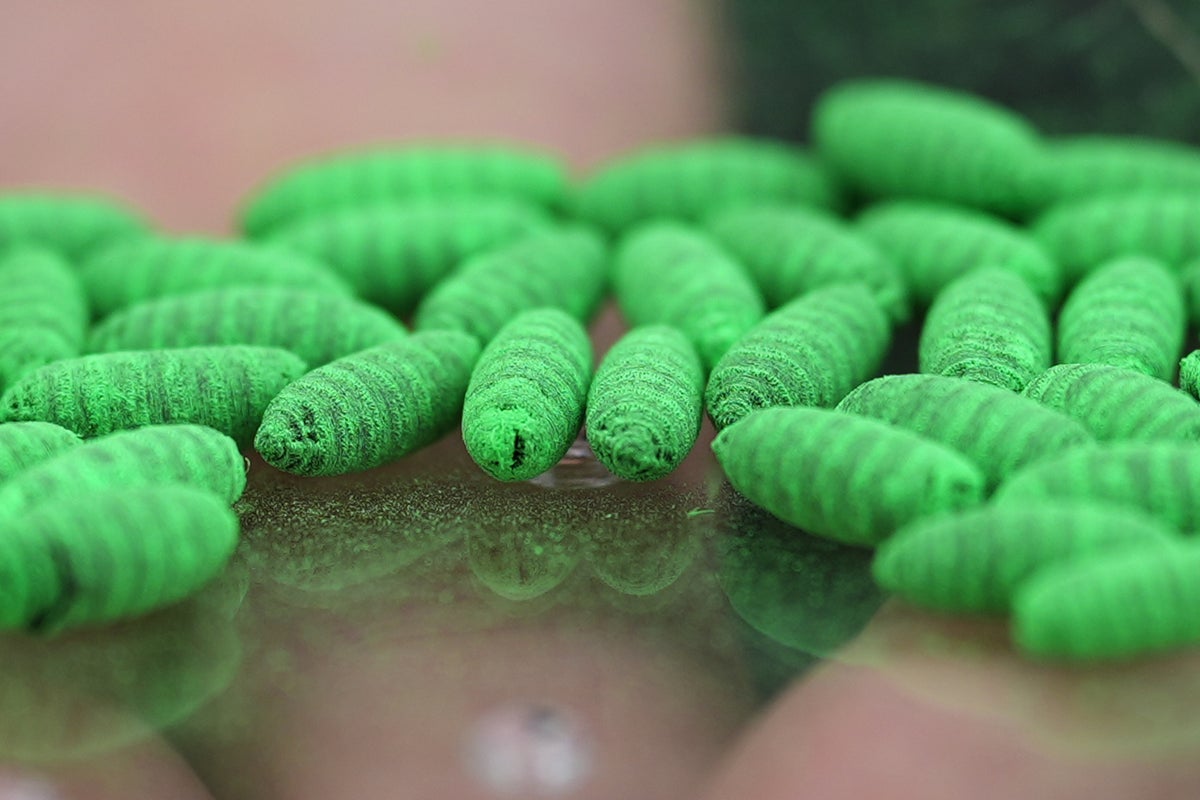
Within twelve hours, those eggs hatched into larvae. And unlike the common maggots that feed strictly on necrotic, dead tissue, these larvae possess sharp, screw-like ridges on their bodies and specialized mouthhooks designed for one specific purpose: to burrow deep into living, healthy flesh, eating their host alive from the inside out.
The Anatomy of an Invasion
To understand the threat of these parasites is to understand the terrifying efficiency of nature. When we think of parasites on our pets, we usually think of fleas or ticks—annoying, blood-sucking hitchhikers that cause itching or, at worst, transmit Lyme disease over time. They live on the surface. They are visible.
The screwworm operates in the dark.
Once the larvae enter a wound, they feed aggressively. They secrete enzymes that liquefy the surrounding muscle and tissue, creating a pocket deeper and deeper within the animal's body. As they grow, they pack tightly into the wound, tail-end out, so they can breathe through tiny spiracles while their heads remain buried in the feast.
Consider what happens next if the condition goes unnoticed: the wound enlarges, not from the outside, but from a subterranean excavation. A wound the size of a dime on the surface can mask a cavity the size of a baseball beneath the skin.
The psychological shock for a pet owner discovering this is profound. We view our homes as sanctuaries and our pets as extensions of our families. The realization that a biological invader is actively destroying your companion's body while they sit next to you on the couch is a deeply unsettling violation of that security.
Veterinarians see this shock regularly. The diagnostic process is straightforward but grim. A clinician will carefully shave the fur around the site, revealing the true extent of the damage. They look for the telltale signs: a discharge that is often bloody or pinkish-red, a profound lack of healing despite antibiotic treatment, and, most distinctively, the visible movement of the larvae when the wound is disturbed.
The Geography of Risk
For decades, many pet owners lived under the impression that these types of severe parasitic infestations were confined to tropical rainforests or distant, developing nations. That assumption is an illusion born of past successes.
Through massive agricultural eradication programs in the mid-twentieth century, the United States sterile-insect technique successfully pushed the New World screwworm population back, establishing a biological barrier at the Darién Gap between Panama and Colombia. It was one of the greatest achievements in veterinary public health.
But boundaries in nature are fluid.
With shifting global climates, erratic weather patterns, and the constant, rapid movement of people and animals across borders, the margins of safety are thinning. Isolated outbreaks have flared up in places like the Florida Keys in recent history, devastating local wildlife populations and threatening domestic pets before being aggressively contained.
The danger isn't just a distant headline. It travels in the cargo holds of airplanes, in the trailers of livestock trucks, and on the bodies of rescue dogs imported from endemic regions. If a pet has a small abrasion and spends time outdoors in areas where these flies are present, the risk shifts from theoretical to immediate.
Recognition and Response
Survival and recovery depend entirely on the speed of human intervention. Pets cannot tell us when an itch turns into an agonizing burn. They rely on our eyes, our hands, and our intuition.
Spotting the danger requires moving past casual observation. Pet owners must become fastidious guardians of their animal's skin, especially during warm, humid months when insect activity peaks.
- Inspect Every Injury: Never dismiss a scratch, a bug bite, or a surgical incision as too minor to monitor. Even a hot spot caused by allergies can become an entry point.
- Watch the Behavior: If an animal is licking, chewing, or scratching at a specific spot with unusual intensity, do not just tell them to stop. Part the fur. Look closely.
- Trust Your Senses: The human nose is remarkably adept at detecting the scent of tissue degradation. If a wound smells foul, it requires immediate veterinary evaluation.
- Look for Abnormal Discharge: Standard wounds scab over and dry out. A parasitic infestation keeps the wound open, producing a continuous, watery, or bloody fluid that stains the fur.
If you suspect an infestation, amateur intervention is dangerous. Attempting to squeeze the larvae out or applying over-the-counter flea treatments to an open, deep wound can cause the parasites to burrow deeper in distress, or worse, die inside the tissue, triggering a massive, potentially fatal systemic infection or toxic shock in the pet.
A veterinarian must meticulously clean the site, manually extract every single larva using specialized instruments, treat the underlying tissue, and administer specific systemic parasiticides to ensure no hidden invaders survive.
The Healing and the Watch
Maya survived.
Because David acted within days rather than weeks, the veterinary team was able to clear the infestation before the larvae reached vital organs or deep muscle structures. It required surgery, extensive tissue debridement, weeks of heavy antibiotics, and a long, painful recovery wrapped in a protective cone.
The emotional scar took longer to heal. For months afterward, David found himself obsessively checking Maya’s fur every time she came inside from a walk, parting the hairs on her shoulder, searching for a ghost.
The experience changed how he viewed the line between the safety of his home and the raw, uncompromising reality of nature. Our pets live in both worlds. They run through the grass, explore the undergrowth, and bring the outdoors back inside with them on their paws and in their fur.
We do not need to keep them locked away from the world they love. Adventure is part of a dog's soul. But we must open our eyes to the hidden stakes of those adventures.
The next time your dog bounds out of the brush with a minor scratch on their nose or a tiny tear on their paw, don't just brush it off. Wash it. Check it tomorrow. Check it the day after. The things that wish to dismantle the bonds we hold dearest do not announce themselves with a roar; they arrive on the silent wings of a fly, looking for a place to land.