The water at the edge of the pier did not look dangerous. It never does. To the tourists peeling sunburned shoulders in the July heat, the Mediterranean was still a postcard of sapphire and slate, a warm, bathtub-steady cradle that had welcomed swimmers for thousands of years. But down below, where the light turns the color of a bruised plum, something ancient had broken.
Listen closely.
You can hear the clicking.
It is not the familiar chatter of native wrasse or the heavy, lazy thud of a grouper turning in the kelp. It is a sharp, metallic rhythm, thousands of tiny mandibles tearing at the sea floor. Long-spine sea urchins, armored in midnight-purple needles twice as long as any native species, are chewing their way across the benthic zone. Behind them, they leave a ghost town—a white, barren expanse of pulverized rock where rich underwater forests used to sway.
Consider what happens when a climate warms by a fraction of a degree. To us, it is a mild inconvenience, an excuse to turn the air conditioning down another notch. To the organisms that built their evolutionary architectures in cold, predictable waters, that same fraction is an eviction notice.
For decades, the Suez Canal was a bottleneck, a narrow geographic gate that kept the Red Sea and the Mediterranean apart like two distinct rooms in a grand house. Then we widened it. We deepened it. We turned a locked door into an open archway. And through that archway, a silent migration began. Hundreds of invasive species, riding the ballast water of colossal container ships or simply swimming north on currents made feckless by rising temperatures, are flooding the Mediterranean.
They are not visitors. They are conquerors that do not need to fire a shot.
Meet Elena. (This is a hypothetical scenario, though drawn entirely from the notebooks of marine biologists working off the coast of Sicily.) Elena is a third-generation artisanal fisherman. When she was a girl, her grandfather would pull up nets heavy with red mullet, octopus, and occasionally a magnificent, glittering bluefin tuna. He knew every hump in the sea floor by heart.
Last Tuesday, Elena hauled in her nets and found a writhing, alien mass. Nearly half the catch consisted of silver-cheeked toadfish. Their skin is sleek and silvery, beautiful in a cold, unsettling way. They possess jaws strong enough to snap a fishhook in two like a dry twig. Worse, their flesh carries tetrodotoxin, a neurotoxin potent enough to kill a human within hours.
She threw them back, her hands shaking slightly against the salt-crusted gunwale. But she knows the math. Every toadfish she tosses overboard is one more predator that has no natural enemies in these waters. No local fish eats them. No local predator hunts them. They multiply in the warm shallows, gorging on the juvenile fish that Elena’s family depends on for their livelihood.
The sea is emptying out, even as it fills up.
We talk about invasions as if they are armies marching across a border with banners flying. We look for drama. We expect a fight. But ecological collapse is usually quiet. It sounds like the scraping of a silver-cheeked toadfish’s teeth against a coral skeleton. It looks like a fisherman staring at a net full of poison, wondering how to pay for next month’s fuel.
The migration is moving north. That is the terrifying trajectory of it all. As the Ligurian Sea warms, and as the waters off the southern coast of France begin to mimic the thermal profiles of the Red Sea, species that once perished in the winter chill are surviving. They are spawning. They are staking a permanent claim.
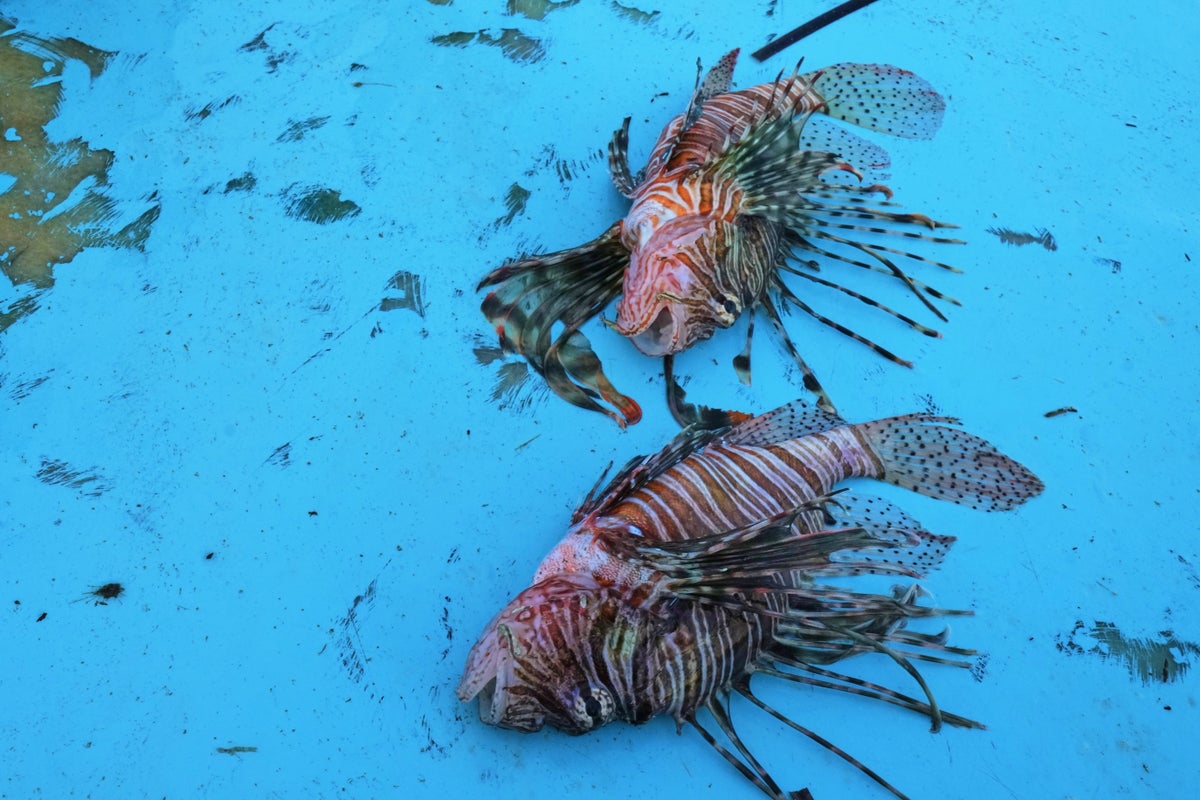
Lionfish, with their rust-colored fans and venomous spines, are drifting past the Greek islands, glowing like embers in the twilight. Nomadic jellyfish drift in massive, gelatinous swarms that choke desalination plants and turn pristine swimming coves into stinging hazard zones. Rabbitfish graze down the underwater meadows of seagrass until the sand lies exposed and helpless against the winter storms.
We made this world. We dug the canals. We pumped the carbon into the atmosphere that acts like a thermal blanket over the water's surface. And now we are forced to watch as the architecture of an entire marine ecosystem is dismantled and reassembled without our permission.
To understand this, you have to let go of the romantic notion of nature as a balanced, unchanging museum. Nature is a brawl. It is a relentless, opportunistic scramble for survival. When you throw open the doors between two ancient, separated worlds, the aggressive win. The adaptable thrive. The fragile vanish.
Is there hope?
Yes. But it is not the kind of hope that comes with a neat, happy ending.
Along the rocky coasts of Israel and Cyprus, local governments and grassroots conservation groups have started fighting back with the only tools left to them. They are paying fishermen bounties for every invasive rabbitfish or lionfish brought to the docks. They are turning the invaders into dinner, rewriting restaurant menus to encourage tourists to eat the enemy. If you cannot stop an invasion, you invite the market to consume it.
It is a desperate, makeshift strategy. It is like trying to empty an ocean with a teacup.
Yet, as the sun dips below the horizon, painting the Mediterranean in shades of bruised orange and deep violet, Elena ties her boat to the wooden cleat. She checks her gear. Tomorrow before dawn, she will go out again. The water will look the same from the surface—vast, deceptive, and blue. But beneath her hull, an entirely new world is breathing, waiting for the cold to return, a cold that may never come again.