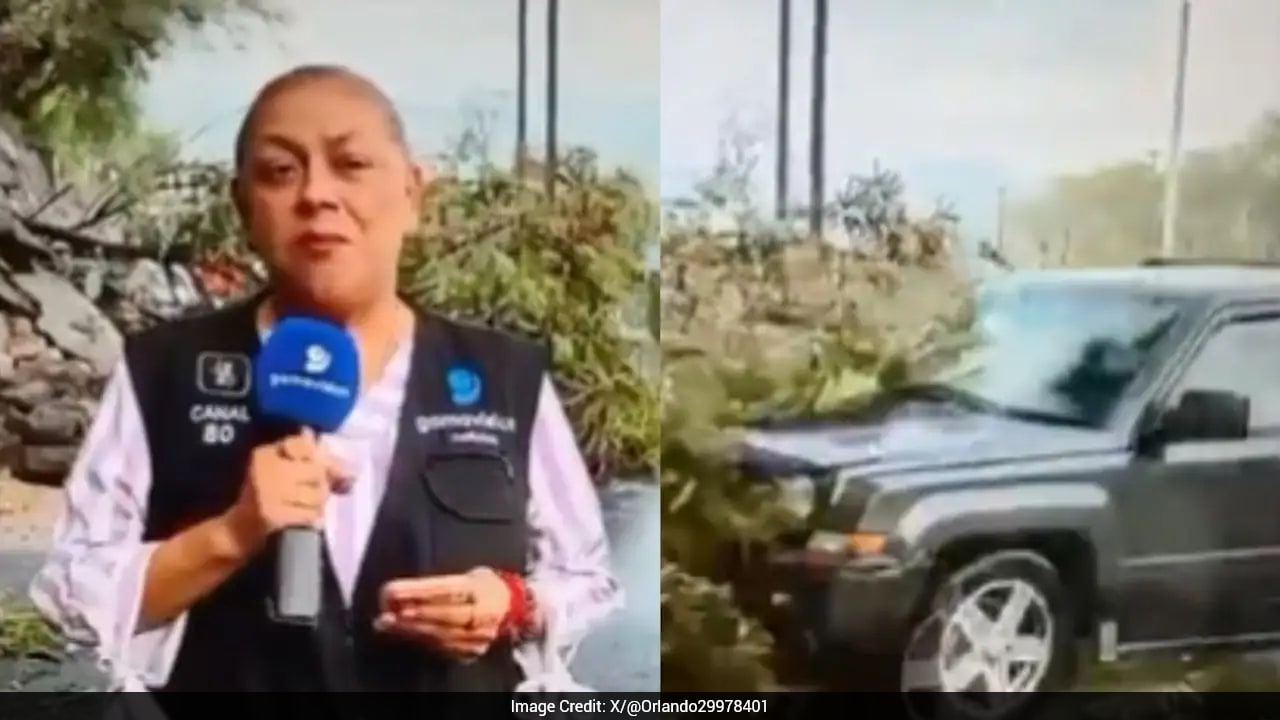
The red recording light does not blink; it stares. To anyone standing on the outside of a television screen, that tiny crimson dot is nothing more than an indicator. It means power is flowing, the sensor is awake, and the audience across the state or the country is receiving a slice of reality delivered in real time.
For the people standing behind that glass, however, the red light is a heartbeat. You might also find this related coverage interesting: The Shadow Behind the Flight Deck Background Checks and the flydubai Copilot Mystery.
Consider what it demands of you. You are on a public street in Mexico, perhaps reporting on infrastructure, municipal neglect, or a local civic disturbance. The ambient noise of passing traffic is a constant, low-frequency hum. You have an earpiece tucked into your ear, through which a producer in a distant control room is counting down the seconds to air.
Five.
Four.
Three. As discussed in detailed coverage by NBC News, the implications are worth noting.
Your posture straightens. Your shoulders drop. Your eyes find the glass eye of the camera lens, and suddenly, you are no longer just a person standing on a sidewalk. You are a conduit. You are the voice for thousands of people eating breakfast, commuting on buses, or sitting in quiet kitchens miles away.
Then, the world breaks.
It happens in a fraction of a second. There is no musical swell to warn you. There is no dramatic pause or slow-motion choreography. There is only the sudden, violent squeal of rubber meeting asphalt, the crushing crunch of metal, and a kinetic force that defies human comprehension.
A car. Coming from where it shouldn't. Moving faster than it should.
In the archived footage of that live broadcast in Mexico, the sequence unfolds with a terrifying, surreal casualness. The reporter is speaking, mid-sentence, looking directly into the camera. The cameraperson is braced, holding the heavy rig steady on their shoulder, framing the shot with practiced stability. The environment is ordinary. The danger is completely invisible.
And then, kinetic chaos.
The frame jolts violently. The image tears, tilts, and spins into a dizzying angle of sky and pavement. Shouts pierce the audio track—sharp, jagged cries of shock and pain. The live broadcast, watched by thousands in real time, becomes an unfiltered window into sudden trauma. The studio anchors back at headquarters freeze, their professional composure fracturing as they realize that the feed they are monitoring has just captured a literal collision with human vulnerability.
We consume news as if it were weather. It arrives on our screens, washed and packaged, ready for consumption. We critique the cadence of a reporter's voice, the quality of their lighting, the choice of their words. We forget the physical reality of the people who gather our stories.
Journalism is an outdoor sport. It takes place in the open air, on the edges of highways, in the middle of active intersections, beneath crumbling overpasses, and in the direct path of human unpredictability. When a news crew sets up a tripod on a public street, they are essentially erecting a small stage in the middle of a rushing river. They trust the invisible social contract that drivers will look where they are going, that brakes will hold, that attention will be paid.
That contract is broken every single day.
Distracted driving is not a statistic; it is a weapon moving at forty miles per hour. A glance at a glowing phone screen, a momentary lapse in concentration, a sudden loss of control—and a routine Tuesday morning becomes an emergency room waiting room. For the reporter and the cameraperson struck during that broadcast, the transition from observer to subject happened in the blink of an eye.
Let us talk about the cameraperson for a moment. The unsung hero of the visual medium.
A television camera is not just a tool; it is an extension of the human body. To operate a professional broadcast camera on a shoulder rig is to sacrifice your peripheral vision. You are looking through a viewfinder or at a small monitor, your world narrowed to a sharp, rectangular focal point. You see the subject, you see the framing, you see the light. But you do not see the car veering off the street behind you. You do not see the driver fighting for control over a slipping wheel.
The cameraperson is, by definition, vulnerable. They are carrying weight, tethered by cables or standing in fixed positions to maintain a steady image, trading their own physical safety for the sake of a stable frame. When disaster strikes, they cannot run easily. They cannot drop the equipment without risking their livelihood, yet holding onto it in a crisis is a physical impossibility.
And the reporter. Trained to maintain poise under pressure. Trained to speak clearly when the world is unraveling. Imagine the psychological whiplash of transitioning from delivering a prepared script to processing acute physical trauma on live television. The voice that was steady a second ago is now calling out in pain. The face that was projecting calm confidence is now turned toward the ground, searching for safety that isn't there.
This incident in Mexico is part of a broader, grim pattern that rarely makes the headlines: the occupational hazards of frontline storytelling. Reporters and crews are routinely harassed, threatened, and physically endangered simply for showing up with a camera. But physical violence is only part of the equation. Accidental hazards—errant vehicles, falling debris, structural collapses, and environmental exposure—pose an immediate, daily threat to media workers who venture outside the climate-controlled safety of the newsroom.
We must ask ourselves what we are asking these individuals to do.
We demand immediacy. We want our news live, raw, and happening right now. We want the reporter at the scene of the accident, at the edge of the storm, on the street corner where history is unfolding. We expect them to be there instantly, bringing us high-definition reality with zero delay.
Yet, every time a camera crew steps onto an open roadway without physical barriers or police escorts in hazardous zones, they are gambling with probability. They are standing in the blind spots of a distracted society.
The broadcast in Mexico cut to black eventually. The feed was pulled. The anchors stammered an apology to the audience, shifting awkwardly to a commercial break as behind the scenes, producers scrambled to call emergency services.
What remains after the feed cuts is the human aftermath. Bruises heal. Broken bones knit together over long, painful months of physical therapy. Equipment can be replaced, insured, and upgraded. But the psychological imprint of sudden, unprovoked violence on the job stays much longer. It changes how you stand on a street corner. It changes how you listen to the sound of approaching traffic. Every squeal of tires becomes a phantom reminder of the red light that kept recording long after the story stopped.
We look at the screens in our hands and living rooms every day, consuming the tragedies and triumphs of others. We scroll past the breaking news alerts with a quiet sigh before moving on to our morning coffee.
Pause for just a moment.
Remember that behind every stable frame, every clear voice, and every breaking report, there is a human being standing on the asphalt, trusting the world not to swerve out of its lane. And remember how fragile that trust really is when the lens goes dark.