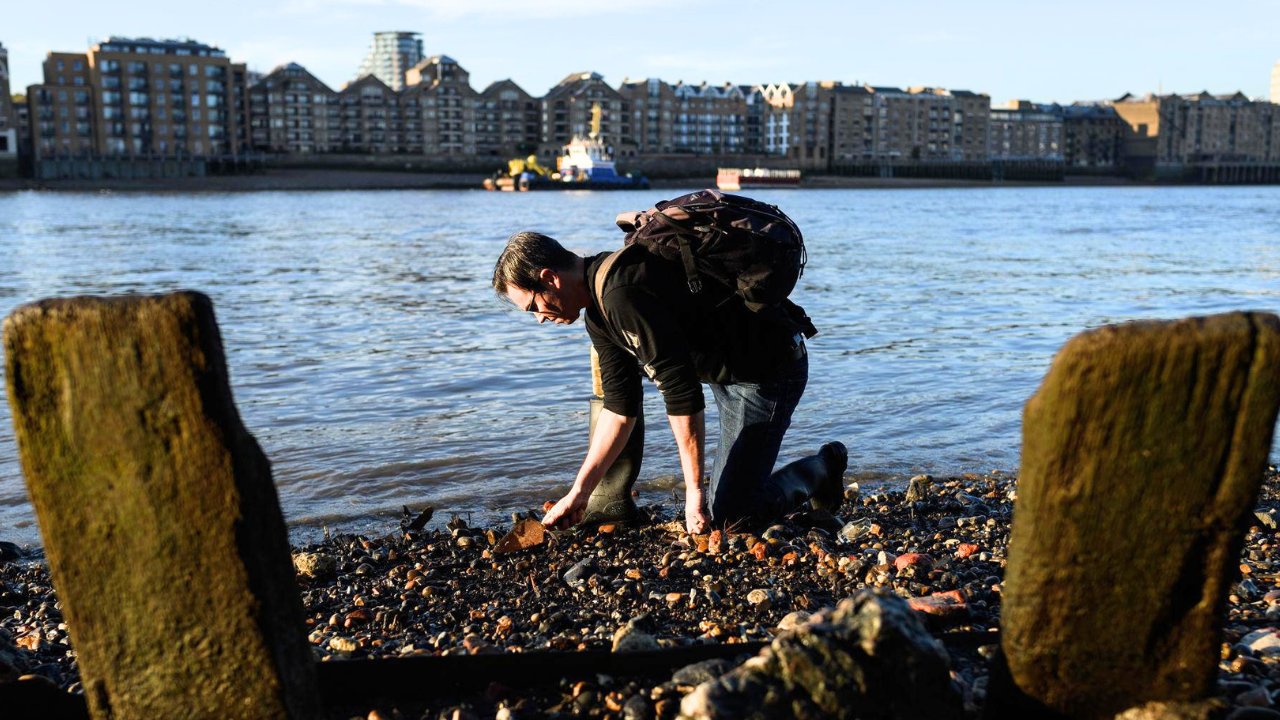
The cold sinks into your bones long before the tide even thinks about turning. It is a specific kind of chill, born of wet gray slate, biting North Sea winds, and a river that has swallowed London’s secrets for two millennia.
Your boots sink three inches into the thick, anaerobic clay of the River Thames. The air smells of salt, rotting oak, and the metallic tang of old iron. Around you, the skyscrapers of the financial district gleam in the pale morning light, glass and steel testaments to modern billionaires. But down here, on the slick, unforgiving foreshore, history is measured in fragments of clay pipes and rusted nails.
Most people look at the Thames and see a murky highway. A few look closer. They are mudlarks.
To the uninitiated, it looks like a lonely, messy hobby. To those who scrape the riverbed, it is a form of time travel. The river is a massive, liquid vault. Because the thick mud lacks oxygen, it preserves what it steals. Leather shoes from the Tudor era survive intact. Roman coins retain the sharp profile of emperors long turned to dust.
But you cannot just walk down and scoop up history. The river demands a toll. It requires patience, a licensed permit from the Port of London Authority, and an absolute respect for the water. The Thames rises and falls by up to twenty-four feet twice a day. If you lose track of time, the river will trap you against the ancient stone river walls. It is a beautiful, lethal trap.
The Anatomy of a Find
Consider a hypothetical searcher. Let us call her Sarah.
Sarah does not use a metal detector. She relies on her eyes, trained over a decade to spot the unnatural geometry of human craftsmanship against the chaos of river gravel. Today, the tide has pulled back to reveal a patch of shingle near London Bridge.
She bends low, her knees resting on a foam pad to keep from sinking into the mire. The casual observer might see nothing but stones. Sarah sees a curve. A perfect, deliberate arc of green-glazed ceramic.
With a gloved finger, she gently coaxes the shard from the suction of the mud. It is a piece of a Tudor money box. Five hundred years ago, a theatergoer probably dropped it while rushing to see a play at the Globe. To get the coins out, you had to smash the box. This piece survived the breaking. It carries the faint fingerprint of the potter who shaped it on a wheel when Elizabeth I was a young queen.
This is the true draw of the foreshore. It is not about monetary value. In fact, by law, any find of significant historical importance must be reported to the Portable Antiquities Scheme at the Museum of London. Mudlarks are not raiders; they are recovery agents for the forgotten.
The items that fill museum display cases often represent the elite—crowns, swords, gold chalices. The mudlarks find the detritus of the ordinary. They find the brass thimbles of overworked seamstresses. They find the lead tokens used by the poorest laborers to buy a loaf of bread. They find the bone dice rolled by sailors in smoke-filled taverns during the Blitz.
The Weight of the Unseen
Every object tells a story, but some stories carry an emotional weight that catches you off guard.
Two years ago, a searcher found a small pewter medallion. It was a pilgrim badge from the fourteenth century, depicting Saint Thomas Becket. These tokens were bought at shrines, souvenirs of faith and survival. The medieval Londoner who wore it likely pinned it to their cloak as a protective amulet against plague, violence, and sudden death.
Then, it fell into the river.
Imagine the gut-wrenching moment that token slipped from a cloak into the dark water. Was it a careless accident during a crowded ferry ride? Or was it thrown into the river intentionally, an offering in a moment of desperate prayer as a loved one lay dying? We can never know. But holding that small, bent piece of metal connects you directly to that ancient anxiety. The human heart has not changed all that much in seven centuries. We still look for anchors in a storm.
The river is an archive of human vulnerability. It holds thousands of bent pins. In the seventeenth century, young women would bend pins and toss them into the Thames to wish for a husband or to curse an unfaithful lover. To find one today is to touch a stranger’s secret hope, preserved in the silt.
A Changing Current
The discipline of mudlarking is changing. What used to be the domain of eccentric eccentrics and shoreline scavengers has evolved into a global community. Social media has allowed searchers to share their finds instantly, turning isolated discoveries into a collaborative mosaic of London’s past.
But the river is changing too.
The increased traffic of high-speed catamarans and river buses creates powerful wakes that wash away the protective layers of silt at an alarming rate. Archeologists worry that the riverbed is eroding faster than it can be searched. The history that has slept safely in the dark for a millennium is being uncovered, chewed up, and washed out to sea by the relentless churn of modern commute.
There is a ticking clock beneath the water. Every tide that goes out exposes new treasures; every tide that comes in threatens to destroy them forever.
The Return of the Water
The wind shifts. The gray water stops its retreat. For a few minutes, the river seems to hesitate, standing perfectly still.
Then, the first small wave laps against Sarah’s boots. The tide is coming back.
She stands up, stretching a back that aches from hours of hunching over the mud. Her pockets are heavy with small plastic bags containing today’s fragments: a hand-forged iron nail, a fragment of a Victorian clay pipe decorated with a running horse, and a tiny blue glass bead from a Roman necklace.
She climbs the slippery iron stairs leading back up to the modern street level. Within minutes, the patch of shingle she searched so intensely will be buried under twelve feet of murky, churning water. The skyscrapers reflect the gathering dusk. People hurry past, eyes glued to their phones, oblivious to the fact that beneath their feet, the river is rearranging the pieces of the world their ancestors built.
Sarah holds the small blue bead in her palm. It is cold, smooth, and entirely indifferent to the passage of time. Tomorrow, the water will recede again, and someone will be waiting at the edge, looking for what the river decides to give back.