The traditional narrative of the destruction of Pompeii attributes the catastrophic mortality rate almost exclusively to Vesuvius’s pyroclastic density currents and ashfall. This monofactorial model fails to account for the structural mechanics of the region’s building collapses and the specific trauma profiles found in recent excavations. The discovery of two male skeletons inside the Insula of the Chaste Lovers—specifically within a bakery structure—provides the empirical baseline needed to map a concurrent, secondary hazard vector: syn-eruptive seismic activity. Forensic and stratigraphic evidence demonstrates that these individuals survived the initial Plinian phase of pumice fall, only to be crushed by masonry failure induced by severe local earthquakes before the final pyroclastic surge overwhelmed the city.
Reconstructing this event requires decoupling the volcanic hazards into distinct chronological phases, measuring their specific mechanical impacts on the built environment, and evaluating the systemic failure of human mitigation strategies during the eruption sequence.
The Dual-Vector Hazard Model: Chronology and Mechanics
The 79 CE eruption was not a single, continuous event but a multi-stage thermal and kinetic crisis. To understand the vulnerability of the population, the event must be divided into two distinct physical mechanisms that operated concurrently yet produced different structural failure modes.
Phase 1: The Plinian Air-Fall Phase and Static Loading
The initial phase involved the ejection of a massive column of white and grey pumice into the stratosphere. This created a continuous deposition of volcanic material across Pompeii, accumulating at an average rate of 15 to 20 centimeters per hour.
The primary risk during this phase was static vertical loading. Roman unreinforced masonry and timber-framed roofs were designed to support standard dead loads (tiles and timbers) and minimal live loads (rain or minor wind). They were entirely unequipped for the rapid accumulation of porous pumice, which exerts an escalating load that increases significantly when exposed to atmospheric moisture or light rainfall.
Roofs began failing systematically once accumulation reached a depth of approximately one meter, creating a widespread structural hazard while the air outside remained lethal due to asphyxiation risks and falling lithic fragments.
Phase 2: Syn-Eruptive Tectonic Activity
As the magma chamber beneath Vesuvius rapidly emptied, the structural roof of the caldera underwent severe deflation and collapse. This subterranean mass movement triggered high-frequency, high-magnitude localized earthquakes.
Unlike the static load of the pumice, these seismic shocks introduced dynamic, lateral forces (shear waves) to structures already compromised by the weight of the accumulated volcanic material. Unreinforced masonry possesses high compressive strength but exceptionally low tensile and shear strength. The lateral acceleration caused immediate out-of-plane bending in walls, leading to instantaneous structural collapse.
Stratigraphic Evidence from the Insula of the Chaste Lovers
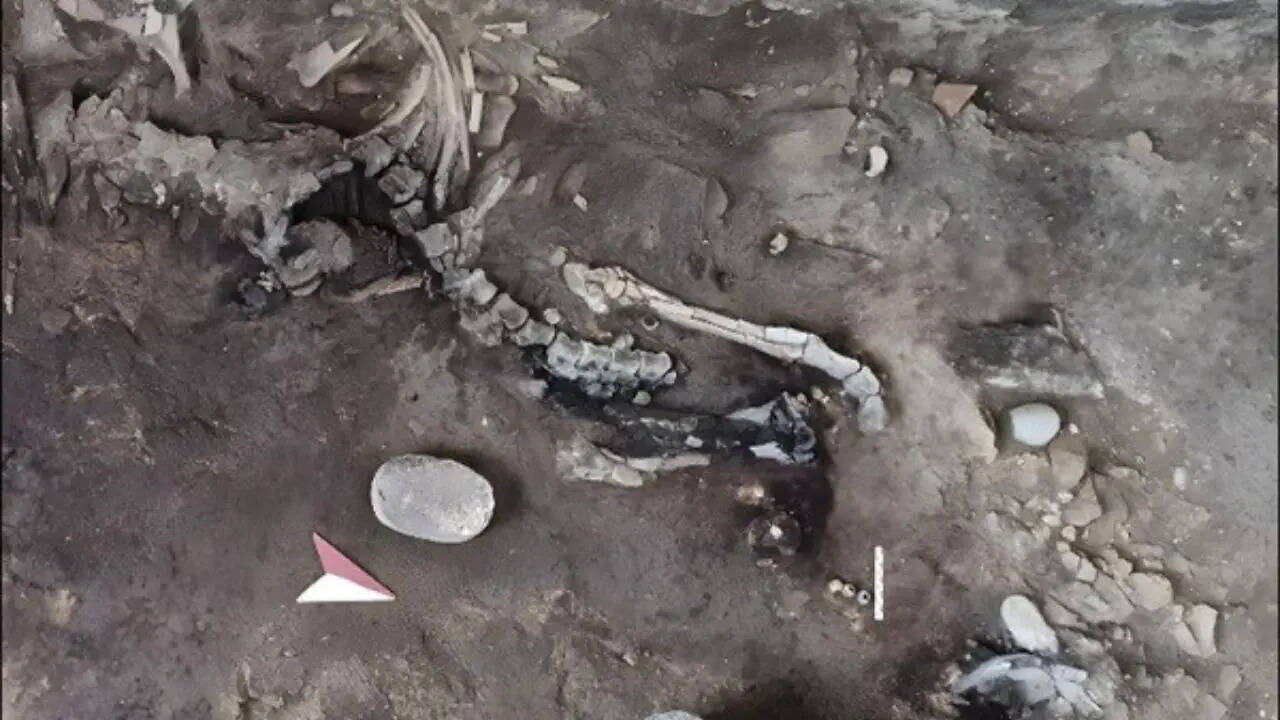
The excavation of the bakery within the Insula of the Chaste Lovers isolates these variables. The two skeletons, belonging to males aged approximately 55 years, were not found immersed in the primary pyroclastic surge layers that characterize the final victims of the eruption. Instead, their positioning and surrounding matrix reveal a precise sequence of structural failure.
- Stratigraphic Positioning: The remains were positioned on top of the initial pumice fall layer but were sealed beneath a massive wall fragment that had collapsed inward. This proves they survived the first several hours of the eruption, seeking shelter indoors as the streets filled with debris.
- Trauma Profile: Anthropological analysis reveals severe compression fractures and polytrauma consistent with instantaneous crushing injuries. There is no evidence of the thermal shock or asphyxiation signatures (such as the classic "pugilistic attitude" caused by muscle contraction in high-temperature currents) that define victims of the later pyroclastic density currents.
- Wall Failure Directionality: The masonry wall collapsed laterally, shattering the structural timber supports of the room. The fragmentation pattern of the stone and mortar indicates a sudden kinetic shock—a seismic failure—rather than a gradual deformation caused by the vertical weight of pumice.
This creates a clear cause-and-effect chain. The victims sought refuge from the atmospheric hazards of Phase 1 inside a structurally enclosed space. This defensive decision transformed into a fatal trap when Phase 2 introduced lateral seismic forces that the load-bearing walls, already stressed by roof deposits, could not withstand.
The Structural Vulnerability Index of Ancient Pompeii
To quantify why the buildings of Pompeii failed so catastrophically under this dual-vector stress, we must evaluate the building typologies and material compositions common to the city. The urban layout presented several systemic vulnerabilities.
[Volcanic Ejection Column] -> Static Loading (Pumice Accumulation) -> Roof Collapse Vector
                                                                        |
                                                                        +--> Combined Structural Failure
                                                                        |
[Magma Chamber Deflation]  -> Dynamic Loading (Seismic Shear Waves)  -> Wall Collapse Vector
Material Performance Under Combined Stress
The standard construction technique in Pompeii utilized opus incertum—irregularly shaped stones embedded in a lime mortar matrix—alongside occasional brickwork (opus latericium). While effective for standard gravity loads, this material configuration exhibits specific points of failure under volcanic conditions:
- Mortar Degradation: The lime mortar used in Roman private architecture lacked the hydraulic properties of marine concrete used in major civil engineering works. It was highly susceptible to vibration-induced micro-cracking.
- Load Distribution Anomalies: As pumice accumulated unevenly on roofs, it created eccentric loading conditions. When seismic waves shifted the ground horizontally, these top-heavy structures experienced high bending moments at the base of their walls, leading to shearing at the foundation line.
Spatial Traps and Urban Choke Points
The architecture of the Roman bakery features heavy stone mills, large masonry ovens, and confined workspace layouts. These elements restricted internal mobility, preventing rapid egress when the walls began to fail. Externally, the narrow street grids (vici) were already choked with upwards of a meter of loose pumice, reducing horizontal transit speeds to near zero and eliminating the viability of evacuation during the seismic intervals.
Analytical Limitations and Diagnostic Challenges
While the forensic data from the Insula of the Chaste Lovers clarifies the role of seismic activity, establishing a universal mortality ratio between earthquake victims and pyroclastic victims across the entire city remains difficult. Several diagnostic constraints limit definitive categorization.
The primary limitation stems from site formation processes. The initial 18th and 19th-century excavations lacked stratigraphic control, frequently mixing debris layers and clearing skeletal remains without documenting their precise relationship to wall collapses or volcanic strata.
The second limitation involves post-depositional damage. The sheer heat and velocity of the subsequent pyroclastic density currents frequently shifted shifted masonry that had already fallen, masking the original seismic fracture patterns.
Distinguishing between a wall that collapsed due to an earthquake and one that collapsed under the dynamic pressure of a high-velocity volcanic cloud requires highly precise micro-stratigraphic analysis and structural engineering modeling that can only be applied to newly uncovered sectors.
Quantifying the Survival Trade-off Matrix
The decisions made by the inhabitants of Pompeii during the first 18 hours of the eruption represent a complex trade-off matrix where mitigating one hazard vector exponentially increased vulnerability to another.
| Action Taken | Mitigated Hazard | Induced Hazard | Outcome Profile |
|---|---|---|---|
| Evacuation to Open Air | Structural collapse from roof failure or seismic activity. | Asphyxiation via ash inhalation, impact trauma from flying lithics, exposure to high-velocity pyroclastic surges. | High mortality in the later stages of the eruption; bodies found in upper ash layers along escape routes. |
| Sheltering Indoors | Direct impact from falling volcanic ejecta and immediate atmospheric toxicity. | Structural failure from static pumice accumulation and dynamic seismic lateral forces. | Immediate mortality during the mid-to-late phases due to crushing injuries; bodies found pinned beneath masonry at the base level. |
The two individuals discovered in the bakery executed a logical strategy based on incomplete information. They identified the immediate, visible threat—the falling stones and ash blocking the streets—and neutralized it by remaining beneath a structurally intact ceiling. They could not forecast that the underlying volcanic mechanism would shift from an atmospheric deposition hazard to a lithospheric kinetic hazard.
Strategic Archeological Re-evaluation
The confirmation of concurrent seismic destruction mandates a systematic overhaul of how volcanic disaster sites are analyzed globally. Investigators cannot treat ancient or modern volcanic crises as linear hazard events.
Future field protocols must prioritize the mapping of structural deformation profiles prior to clearing volcanic strata. Identifying whether a wall suffered tensile failure from a horizontal shock or compressive failure from vertical loading provides the exact timeline of the evacuation window. This data optimizes predictive modeling for modern volcanic observatories operating near active caldera systems globally, where urban density creates identical structural vulnerabilities to those that failed in 79 CE.