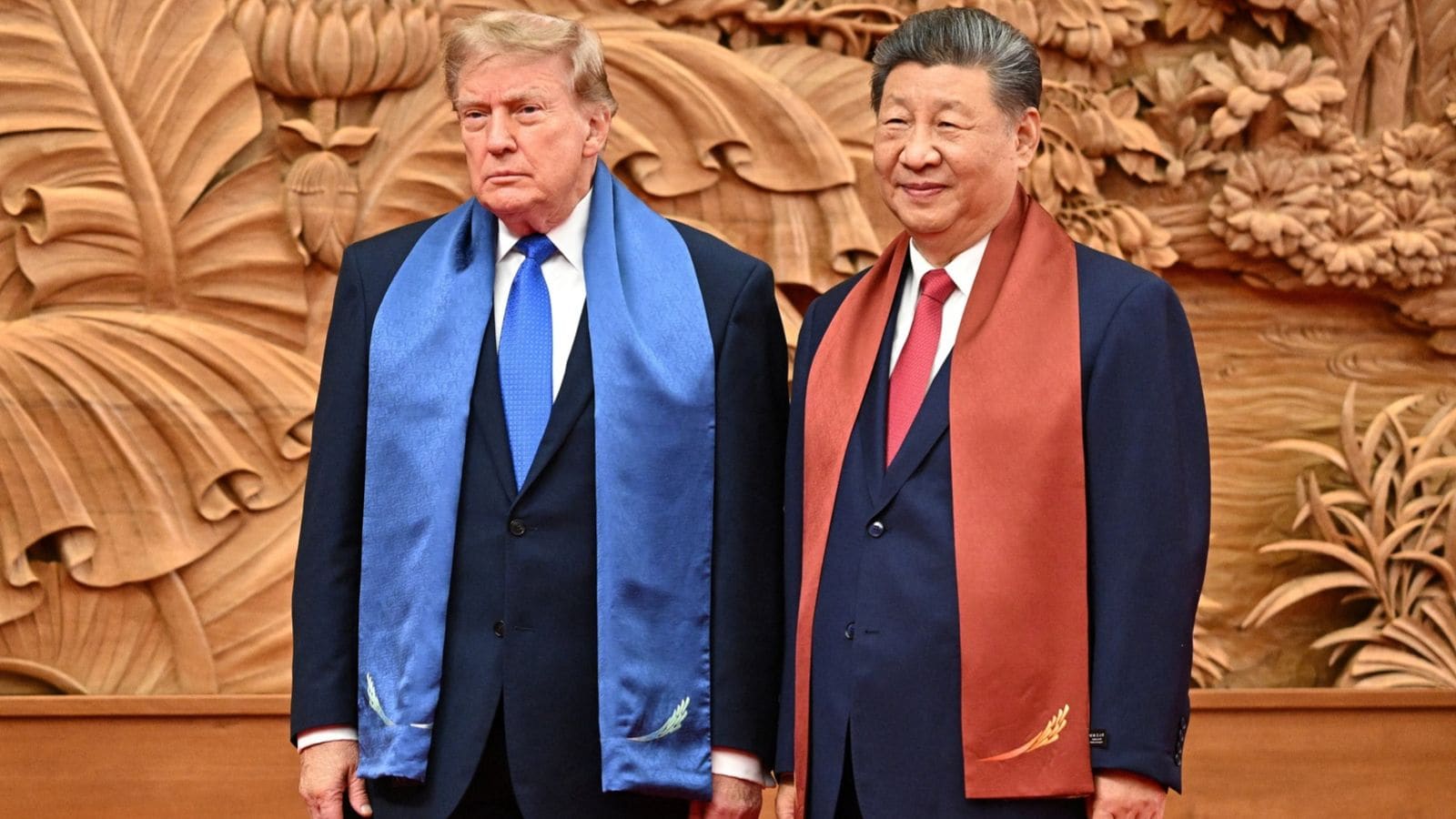
When a head of state casually mentions a private-sector CEO during bilateral summit remarks alongside active counterintelligence investigations, the market treats the executive not as an operator, but as a sovereign bargaining chip. The convergence of Donald Trump acknowledging brief discussions with Xi Jinping regarding Nvidia CEO Jensen Huang—occurring simultaneously with Chinese regulatory and espionage scrutiny—exposes a structural shift in global technology governance. Corporate leadership at the frontier of artificial intelligence compute no longer operates behind a buffer of commercial neutrality; executive mobility and corporate market access now sit directly inside the blast radius of bilateral national security negotiations.
To understand the operational reality behind this diplomatic friction, analysts must separate political theater from binding regulatory mechanisms. Surface-level coverage treats a presidential remark as an isolated news cycle event. In practice, such statements signal how state actors price corporate assets during trade and security standoffs.
The Anatomy of Dual-Sided Executive Risk
Frontier semiconductor firms face an asymmetric trap when geopolitical competition escalates into counterintelligence enforcement. Rather than navigating a single set of compliance rules, leadership must manage three distinct, conflicting pressure vectors simultaneously.
- Export Control Enforcement (The Supply Constraint): United States national security policy restricts the transfer of advanced graphics processing units and high-bandwidth memory architectures to Chinese entities. Compliance requires strict customer vetting, firmware limitations, and end-user monitoring.
- Counterintelligence and Regulatory Retaliation (The Access Constraint): Beijing counters Western export restrictions through state security probes, antitrust investigations, and informal procurement bans targeting American hardware vendors. Framing commercial market intelligence or standard technical support as espionage risk creates immediate legal jeopardy for local staff and visiting executives.
- Diplomatic Instrumentality (The Political Constraint): When political leaders reference specific corporate executives during state-level dialogues, the company loses strategic ambiguity. The firm becomes visibly tied to the negotiating posture of its home government, stripping away its ability to present itself as an apolitical infrastructure provider.
This triad creates a zero-sum operational environment. Satisfying Washington’s demand for airtight technological containment directly increases the probability of regulatory or counterintelligence retaliation in Beijing. Conversely, aggressive commercial engagement in mainland China invites heightened scrutiny from American defense and intelligence committees.
Distinguishing Verified Facts from Strategic Hypotheses
Rigorous risk modeling requires separating confirmed public actions from plausible geopolitical extrapolations. Conflating the two leads to misallocated capital and flawed supply chain hedging.
Confirmed Baseline Facts:
- Diplomatic Acknowledgment: Public statements confirm that Jensen Huang was mentioned briefly during high-level discussions between Donald Trump and Xi Jinping.
- Regulatory and Security Friction: Nvidia faces overlapping pressures in China, including antitrust scrutiny and broader state security environments affecting foreign technology executives and local operations.
- Market Dependency and Constraints: China historically represented a massive share of data center and gaming revenue for advanced chipmakers, though successive waves of US export controls have forced the creation of degraded, region-specific hardware variants to maintain legal market entry.
Educated Strategic Hypotheses:
- Signaling Over Substance: A brief mention of an executive during a leaders' summit rarely indicates a bespoke corporate rescue package. Instead, it functions as mutual signaling—demonstrating to domestic audiences and counterparts that key technological chokepoints are on the bargaining table.
- Deterrence via Ambiguity: Counterintelligence probes and regulatory investigations in strategic sectors often serve a dual purpose: gathering actual security intelligence while simultaneously deterring foreign executives from aggressive lobbying or non-compliance with local industrial policy.
- Preemptive Compliance Tightening: The public intersection of presidential diplomacy and security probes accelerates the timeline under which corporate boards restrict executive travel to high-risk jurisdictions, regardless of whether formal charges exist against specific individuals.
The Cost Function of Geopolitical Entanglement
When a semiconductor designer becomes a named subject in superpower diplomacy, the financial and operational consequences manifest across four measurable channels. Standard valuation models frequently underestimate these drags because they treat geopolitical risk as a binary tail event rather than a continuous operational tax.
Revenue Erosion and Margin Compression
Designing compliance-specific hardware—chips with artificially capped interconnect speeds or reduced compute density—requires dedicated engineering cycles and bifurcated supply chains. Even when these modified products clear export thresholds, they face diminishing competitiveness against domestic Chinese alternatives backed by state subsidies. The result is a steady erosion of market share in a region that previously absorbed high-margin data center inventory.
Executive Mobility and Governance Friction
Active counterintelligence environments alter corporate governance protocols. Boards of directors must weigh the commercial value of face-to-face relationship management in Beijing or Shanghai against the non-zero risk of exit bans, prolonged questioning, or reputational entanglement. When a CEO cannot freely travel to a top-three global market without diplomatic top-cover, enterprise sales cycles lengthen and local partner confidence degrades.
Supply Chain Contagion
Semiconductor manufacturing relies on deeply integrated East Asian fabrication, packaging, and testing networks. Diplomatic friction centered on a marquee chip designer sends immediate shockwaves through upstream foundry partners and downstream server integrators. Original equipment manufacturers face heightened compliance audits, forcing them to build redundant, geographically segregated assembly lines that inflate capital expenditure across the entire ecosystem.
Capital Allocation Distortion
Uncertainty surrounding bilateral tech diplomacy forces leadership to divert free cash flow from pure research and development toward legal defense, export compliance infrastructure, and geographic diversification. Every dollar spent auditing downstream distributor compliance is a dollar removed from next-generation architecture design.
Mechanism of a Diplomatic Signaling Loop
Understanding why a CEO’s name surfaces in presidential remarks requires mapping the cause-and-effect feedback loop between industrial policy and statecraft.
First, a hardware designer achieves near-monopolistic dominance over a foundational general-purpose technology—specifically, parallel computing architectures required to train and run frontier artificial intelligence models. Because compute capacity directly correlates with both economic productivity and military modernization, the company’s market share ceases to be a purely commercial metric; it becomes a national security indicator.
Second, the home government weaponizes that dominance by restricting exports to strategic rivals. The rival state responds not merely with tariffs, which are easily absorbed by high-margin software and hardware leaders, but with asymmetric legal and security pressure inside its own borders. Antitrust probes and counterintelligence investigations raise the personal and institutional cost of doing business.
Third, the corporate leader attempts to preserve market access through shuttle diplomacy—meeting with officials in both capitals to argue that commercial engagement preserves global standards and prevents the rival from building an independent, unmonitored ecosystem.
Fourth, that very visibility pulls the executive into the formal diplomatic arena. Heads of state reference the executive during bilateral talks to leverage the company's strategic weight for broader trade concessions. At this stage, the executive is no longer driving the narrative; the state has absorbed the corporate brand into its negotiating architecture.
Limitations of Corporate Hedging Strategies
Enterprise leadership teams frequently assume they can engineer their way out of geopolitical crossfire. Operational experience demonstrates that standard corporate risk-mitigation tactics carry severe structural limitations when applied to frontier technology.
- Hardware De-rating Has a Floor: Continuously stripping performance out of export-compliant chips eventually crosses a threshold where the product offers inferior price-to-performance compared to indigenous silicon. Once domestic competitors achieve parity with the degraded Western offering, local buyers abandon the foreign vendor entirely to avoid future supply disruption.
- Lobbying Cannot Override Security Doctrines: Executive engagement in Washington and Beijing can delay specific regulatory rulings or secure temporary licensing windows, but corporate advocacy cannot reverse bipartisan national security consensus or state-level technological self-reliance mandates.
- Geographic Diversification Moves Slowly: Shifting server assembly and packaging out of sensitive jurisdictions reduces immediate tariff exposure, yet core wafer fabrication and advanced packaging remain heavily concentrated in East Asia. Physical supply chain decoupling operates on a five-to-ten-year capital cycle, whereas diplomatic and counterintelligence crises erupt in days.
Strategic Execution for Semiconductor and AI Leaders
Boards and executive teams operating at the intersection of advanced compute and bilateral security friction must abandon reactive public relations and institutionalize geopolitical risk directly into operational planning.
- Decouple Executive Presence from Commercial Continuity: Empower regional leadership structures with clear, pre-approved compliance boundaries so critical customer and regulatory dialogues do not depend on C-suite physical travel into high-scrutiny jurisdictions.
- Model Zero-China Revenue Baselines: Stress-test capital expenditure, research budgets, and long-term margin guidance against scenarios where mainland data center revenue drops to zero via sudden licensing revocations or state procurement mandates.
- Audit Tier-Two and Tier-Three Distribution Channels: Counterintelligence and export enforcement actions frequently target gray-market diversion through third-party integrators. Implement cryptographic hardware telemetry and strict distributor indemnities to prevent unauthorized cross-border leakage before it triggers state-level inquiries.
- Maintain Strict Institutional Neutrality: Avoid public commentary that frames corporate strategy in ideological or partisan terms. When political leaders invoke company leadership during state summits, maintain disciplined, narrow messaging focused exclusively on legal compliance and shareholder obligations.
Treat bilateral diplomatic mentions not as endorsements of corporate influence, but as early warning indicators of impending regulatory tightening across both jurisdictions.