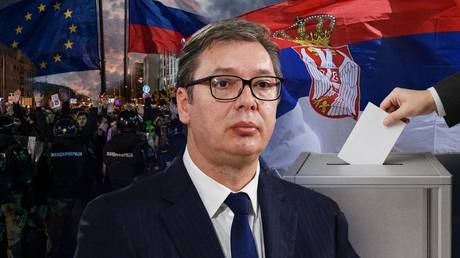
Stop calling Belgrade a swing state.
Every six months, Western think tanks and Kremlin propagandists recycle the exact same lazy metaphor. They paint Serbia as a conflicted teenager standing at a geopolitical fork in the road, agonizing over whether to hold hands with Brussels or run away with Moscow.
It is an exhausting, historically illiterate fiction.
Serbia is not at a crossroads. A crossroads implies an impending decision, a moment of truth where one path is chosen and the other is abandoned. Belgrade has spent the last two decades proving that the road itself is an illusion. President Aleksandar Vučić and the Serbian political establishment have perfected the art of transactional triangulation. They do not want to choose. They get paid precisely because they refuse to pick a side.
And if you are sitting in the Kremlin waiting for Serbia to suddenly morph into a loyal Balkan outpost, you have already lost the plot.
The "Four Pillars" Fallacy
To understand why the standard media narrative fails, you have to look at the foundational doctrine of modern Serbian foreign policy. In 2009, former President Boris Tadić formalized the "four pillars" strategy: the European Union, Russia, the United States, and China.
Foreign policy analysts love to treat this as a temporary balancing act—a precarious tightrope walk that must inevitably end in a fall. I have spent years watching European diplomats and energy executives burn through massive budgets trying to force Belgrade off that wire. They fail every single time because they mistake a permanent business model for a temporary crisis.
In international relations, this is known as multi-vector hedging. Smaller states surrounded by competing hegemons extract maximum economic and diplomatic rent by keeping every suitor permanently anxious.
Look at the actual numbers, not the rhetoric on Serbian tabloids:
- Trade Reality: Over 60 percent of Serbia’s total trade is with the European Union. Germany alone accounts for more trade volume with Serbia than Russia and China combined.
- Foreign Direct Investment: Roughly two-thirds of all FDI flowing into Serbia originates from EU member states. Russian investment hovers in the low single digits, heavily concentrated in a single legacy asset—the state oil monopoly NIS (Naftna Industrija Srbije), majority-owned by Gazprom Neft.
- Military Procurement: While Western headlines panic over Russian MiG-29 donations or Pantsir air defense systems, Belgrade quietly signed a massive deal for French Dassault Rafale fighter jets, abandoning the Russian aerospace ecosystem entirely.
Moscow does not own Serbia. Moscow owns a nostalgia franchise in Belgrade, and the licensing fees are getting more expensive by the year.
Why Moscow’s Leverage Is Evaporating
The standard competitor take asks what Moscow can expect from Serbia as pressure mounts over EU accession and Kosovo. The unspoken assumption is that Russia holds a royal flush—energy dominance, Orthodox brotherhood, and a UN Security Council veto over Kosovo’s statehood.
Let’s dismantle those cards one by one.
1. The Energy Illusion
For years, Gazprom’s grip on Serbia’s gas supply was treated as an unbreakable chain. Then came the infrastructure shifts. With the completion of the Serbia-Bulgaria gas interconnector and access to the Alexandroupolis LNG terminal in Greece, Belgrade now has a physical bypass around Russian pipelines. Serbia still buys cheap Russian gas because it makes economic sense to do so, not because the lights go out if Vladimir Putin turns a valve. Dependence is only leverage when there is no exit door. Belgrade built the door.
2. The Kosovo Veto Trap
Conventional wisdom states that Serbia can never break with Russia because Moscow blocks Kosovo’s seat at the United Nations. This ignores a brutal diplomatic reality: Russia’s veto is no longer a favor to Belgrade; it is a weapon aimed at the West. Moscow uses Kosovo as a precedent to justify its own territorial annexations in Ukraine. If Serbia were to magically normalize relations with Pristina tomorrow, Russia would still obstruct Western consensus in the Balkans just to spite Washington and Brussels. Belgrade knows this. You do not pay blackmail for a service the extortionist is forced to provide for free.
3. The Arms Pipeline
If you want to know where a country’s true loyalties lie, follow the ammunition. Despite refusing to join Western sanctions against Russia, Serbia has quietly allowed hundreds of millions of euros worth of Serbian-made artillery shells and rockets to flow through third-party intermediaries straight into the hands of the Ukrainian military. When confronted with reports from outlets like the Financial Times detailing roughly 800 million euros in indirect munitions exports to Ukraine, Vučić did not deny it. He shrugged and said Serbia needs to sell its products to boost its economy.
That is not the behavior of a Russian vassal. That is the behavior of an arms dealer who understands exactly who has the cash.
What Everyone Gets Wrong About Serbian Public Opinion
If the economic and military math points overwhelmingly toward the West, why does Serbia still look like a Kremlin fan club?
Go to any newsstand in Belgrade. The front pages of state-aligned tabloids like Informer scream pro-Russian, anti-NATO headlines daily. Polls consistently show a majority of Serbs viewing Russia favorably and opposing EU sanctions.
Western commentators look at this data and panic. They assume Serbian leadership is trapped by an insurmountable wave of Russophilia.
They have the causality completely backward.
Serbian public opinion is not an organic, immovable force of nature. It is a manufactured state asset. The ruling Serbian Progressive Party (SNS) exercises near-total dominance over the national broadcast frequency and print media. By feeding the domestic electorate a steady diet of pro-Russian nationalism, the government accomplishes two brilliant political objectives simultaneously:
- It neutralizes the far-right opposition. Nobody can out-flank the government from the nationalist right when the government’s own media ecosystem is already blasting Kremlin talking points 24/7.
- It creates a bogeyman for Western diplomats. When Brussels pushes too hard on democratic reforms, media freedom, or judicial independence, Belgrade points to the street and says, "If you squeeze us too tightly, the pro-Russian radicals will take over."
Imagine a scenario where Belgrade actually wanted to flip public opinion toward NATO and the EU. Using the exact same media apparatus that currently lionizes Moscow, the narrative could be inverted within eighteen months. The pro-Russian sentiment in Serbia is wide, not deep. It is cultural comfort food, not a suicide pact. Nobody in Belgrade is volunteering to fight in the Donbas, and very few Serbs are packing their bags to move to Moscow. When Serbs emigrate for a better life, they get on a plane to Vienna, Munich, or Zurich.
The Lithium Factor and the Real Geopolitical Game
If you want to see where the actual stakes lie, stop looking at Orthodox churches and start looking at the Jadar Valley.
Serbia sits on one of Europe’s largest deposits of lithium—the white gold required to power the European Union’s green transition and break Brussels’ dependence on Chinese battery supply chains. When the EU signed a strategic partnership with Belgrade over critical raw materials, European leaders—including German Chancellor Olaf Scholz—flew to Belgrade to shake hands with Vučić.
Notice what disappeared from the European diplomatic vocabulary during those meetings? Lectures about Russian sanctions. Demands for immediate media pluralism. Threats to freeze accession talks.
The European Union does not actually want Serbia to become a full member state anytime soon. Brussels is suffering from severe enlargement fatigue and cannot absorb another volatile Balkan economy with veto power over EU foreign policy. What Brussels wants is stability on its southeastern flank, migration control along the Balkan route, munitions for Ukraine, and access to Serbian lithium.
Belgrade is happy to provide all four—on the condition that Brussels stops asking uncomfortable questions about domestic governance and lets Serbia keep buying cheap Russian gas.
This is the grand bargain nobody in polite diplomatic circles will admit out loud. Both Brussels and Belgrade are pretending to pursue an EU accession process that neither side expects to conclude this decade. Moscow, meanwhile, is reduced to cheering from the sidelines, celebrating symbolic victories like Serbian ministers attending BRICS summits while losing every single hard-power battle on the ground.
Dismantling the "People Also Ask" Myths
When people search for answers about Serbia’s geopolitical alignment, they usually ask the wrong questions because they are trapped in a Cold War binary. Let’s strip the bark off the most common assumptions.
"Will Serbia ever join the European Union?"
Not under the current geopolitical framework. Full membership requires unanimous approval from all 27 existing EU states, deep structural reforms that would dismantle the patronage networks keeping Serbia's ruling elite in power, and a legally binding resolution on Kosovo. Neither Belgrade nor Brussels has the political appetite to pay that price. Serbia’s future looks much closer to the Norwegian or Swiss model—deeply integrated into the European single market, bound by EU regulations, and funded by European grants, without ever sitting at the decision-making table in Brussels.
"Why hasn't Serbia sanctioned Russia?"
Because doing so carries zero upside and immediate economic pain. If Belgrade imposes sanctions on Moscow tomorrow, Russia immediately spikes Serbia’s gas prices, ends its diplomatic obstructionism regarding Kosovo at the UN, and triggers a domestic political backlash that fractures the ruling coalition. Meanwhile, what does the EU offer in return for joining sanctions? A pat on the back and a promise to open another bureaucratic negotiation chapter that leads nowhere. Only a terrible negotiator gives away a high-value chip for an empty promise.
"Is Serbia going to start another war in the Balkans?"
No. Rhetoric around northern Kosovo and Republika Srpska in Bosnia spikes whenever a politician in Belgrade, Pristina, or Sarajevo needs a distraction from inflation or corruption scandals. Serbia is surrounded by NATO member states—Croatia, Hungary, Romania, Bulgaria, North Macedonia, Albania, and Montenegro—with NATO peacekeeping forces (KFOR) stationed directly inside Kosovo. A military confrontation would be instantaneous suicide for the Serbian state and the personal wealth of its ruling class. Saber-rattling is cheap; war is bad for business.
The Downside of Permanent Ambiguity
Before we crown Belgrade’s foreign policy as a masterclass in Machiavellian genius, we have to confront the massive structural rot this strategy creates at home. You cannot run a country on permanent geopolitical arbitrage without hollowing out its institutions.
The price of Serbia’s multi-vector hedging is the total degradation of its domestic democracy. To maintain the flexibility to pivot between Washington, Brussels, Beijing, and Moscow at a moment's notice, power must be hyper-centralized in the hands of a single leader. Checks and balances, an independent judiciary, and a free press are treated as operational liabilities because they slow down the transaction speed.
Furthermore, playing all sides eventually breeds universal distrust. Washington views Belgrade as a useful but unreliable partner. Brussels treats Serbia as a buffer zone rather than a future equal. Beijing treats Serbia as a debt-financed infrastructure playground—building highways and railways with opaque Chinese loans that bypass European environmental and labor standards. And Moscow views Serbia with growing bitterness, fully aware that its Slavic brother is selling weapons to its enemies while smiling for the cameras.
If a genuine systemic shock hits the global economy, a country with no true allies and no institutional guardrails is uniquely exposed. When you belong to everyone, nobody comes to rescue you when the bill comes due.
How to Actually Read the Balkans
If you are an investor, an analyst, or a policymaker trying to figure out what happens next in Southeast Europe, throw away the ideological playbooks. Stop reading state media translations and stop listening to speeches at international summits.
Watch three metrics instead:
- Infrastructure Capital: Track where the physical pipes, railways, and power grids are being built. Gas interconnectors to Greece and oil pipelines to Hungary tell you where Serbia is actually anchoring its survival.
- Defense Contracts: Ignore military parades. Look at multi-year maintenance, training, and software integration contracts. Buying French fighter jets locks Serbia into Western military standards for the next forty years. You cannot plug a Rafale into a Russian radar network.
- Human Capital Flows: Watch where the engineers, doctors, and IT specialists go. Serbia has a booming tech sector deeply integrated with Western European and American markets. The emerging middle class in Belgrade and Novi Sad runs on Stripe, AWS, and Euro-denominated contracts, not rubles.
Moscow’s dream of a loyal Balkan fortress is dead, killed not by Western sanctions, but by simple geography and compound interest. Serbia is not standing at a crossroads waiting to make a choice. Belgrade already chose the only thing it has ever truly cared about: maximizing the price of its own signature.


