The brass key turned with a heavy, oiled click that echoed off limestone walls built to outlast empires.
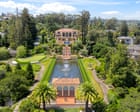
Outside, the San Francisco fog rolled lazily over the crest of the hill, blurring the iconic skyline into a watercolor wash of steel and gray. Inside, a fire crackled in a hearth large enough to stand in, casting long, amber shadows across an empty room. Seventy million dollars. That is the price tag attached to this specific patch of earth, a grand estate perched above the bay where the air smells faintly of salt and eucalyptus.
Seventy million.
Try to picture it. Not as a number on a spreadsheet, but as stacks of paper bricks filling the trunk of a sedan. Try to picture the sheer weight of what a modern gold rush looks like when it finally finds a place to sleep.
For years, the story of Silicon Valley was told in garages, in flickering fluorescent lights, in the caffeine-addled hum of late-night coding sessions where young people traded their twenties for stock options. They wore hoodies. They ate instant ramen. They talked in acronyms about disrupting industries that had stood untouched for a century. We watched them from a distance, amused or annoyed, treating them like eccentric kids playing in a digital sandbox.
Then the sandbox started minting gods.
The sale of this estate is not merely a real estate transaction. It is a loud, undeniable monument to a tectonic shift. We have crossed a invisible threshold. The code written on whiteboards a decade ago has materialized into stone, glass, and staggering amounts of private capital. This is the physical manifestation of the artificial intelligence boom, a wealth accumulation event so rapid and concentrated that it makes the dot-com era look like a cautious savings account.
Consider the mechanics of how we got here.
For the past several years, a quiet revolution took place in server farms humming in the desert. Algorithms learned to speak, to paint, to reason, to code. They swallowed the sum of human knowledge and spat out answers in milliseconds. To the casual observer, it was a neat parlor trick. A novelty. A way to generate funny images of dogs wearing Victorian hats.
But beneath the surface, the stakes were astronomical. The companies building these systems were not just launching products; they were attempting to rewrite the fundamental operating system of global commerce. And when the market realized what was happening, the floodgates blew wide open. Billions of dollars in venture capital, corporate buyouts, and public equity surged into the Bay Area like a tidal wave.
Money of this magnitude behaves strangely. It creates its own weather.
Walk through the neighborhoods surrounding this seventy-million-dollar compound, and you can feel the pressure in the air. It is palpable. It is in the quiet hum of private security vehicles parked outside modest-looking Victorians that now house founders worth nine figures. It is in the reservation-only restaurants where venture capitalists whisper over wine lists priced like used cars. It is in the exhausted eyes of the baristas and teachers who look up at the hills and wonder if they are being priced out of the very oxygen they breathe.
There is a profound disconnect between the digital abstraction of code and the hyper-tangible reality of luxury real estate. Code has no weight. It occupies no physical space. You cannot touch an algorithm or sleep inside a neural network. Yet, the invisible labor of machines has somehow generated enough gravity to bend the physical geography of Northern California to its will.
Think about the seller of this estate. Think about the buyer.
We do not know their exact names, and in a way, it does not matter. They are archetypes in a larger drama. The seller is likely someone who caught the wave a generation ago, cashing out of software or early infrastructure, leaving behind a monument of success. The buyer is almost certainly younger. A product of the current machine-learning surge. Someone who looked at the horizon three years ago, bet everything on transformer models and neural weights, and woke up to find themselves the master of a universe they barely have time to inhabit.
They bought the view. They bought the history. They bought the pedigree of old money with new money minted by silicon chips.
And yet, standing in that cavernous, empty room, surrounded by history and staggering opulence, a strange feeling settles in. Emptiness.
Wealth on this scale creates a peculiar kind of isolation. When your net worth multiplies faster than you can comprehend, the world begins to shrink. The ordinary friction of daily life disappears, replaced by a frictionless bubble of concierge services, private jets, and gated compounds. You are protected from everything. The traffic. The weather. The struggle.
But you are also detached from the soil.
The danger of this current wealth explosion is not just economic inequality, though that wound is deep and bleeding. The greater danger is narrative. We are allowing a handful of algorithms and the tiny fraction of humanity that commands them to dictate the entire story of our future. We are mesmerized by the price tag. We stare at the seventy million dollars like rabbits caught in the headlights of a Ferrari, paralyzed by the sheer velocity of it all.
We forget to ask what is being left behind in the rush.
When a city becomes a playground for the architects of artificial intelligence, it risks losing its soul. San Francisco has always been a haven for the restless, the weird, the outcasts who built counter-cultures in the fog. It was a place where failure was tolerated because the next big idea was always just around the corner. If it transforms entirely into a fortress for the tech-anointed, where a single house costs more than the GDP of a small nation, the magic dies. The garage culture suffocates under the weight of marble countertops and security gates.
The key turns in the heavy brass lock. The heavy oak door swings shut, sealing out the damp chill of the bay.
Somewhere down the hill, in a cramped apartment lit by the blue glow of a monitor, a twenty-four-year-old engineer is typing lines of code that will either change the world or amount to nothing. They do not care about seventy-million-dollar mansions. Not yet. They are chasing the ghost in the machine, unaware that the world they are building is already racing ahead to buy the ground beneath their feet.