The smell of roasting sweet potatoes and sizzling oyster omelets hangs thick over Taipei’s night markets, a warm, comforting fog that wraps around anyone walking the narrow alleys. In June 2024, that familiar, humid air became the backdrop for an entirely modern kind of drama.
A man in a black leather jacket stood near a fruit stall, laughing with vendors, signing autographs on smartphones, and posing for selfies. To the hundreds of people crowding around him, Jensen Huang was simply the hometown kid who made good, the chief executive of Nvidia returning to Taiwan during the Computex trade show like a rock star coming home.
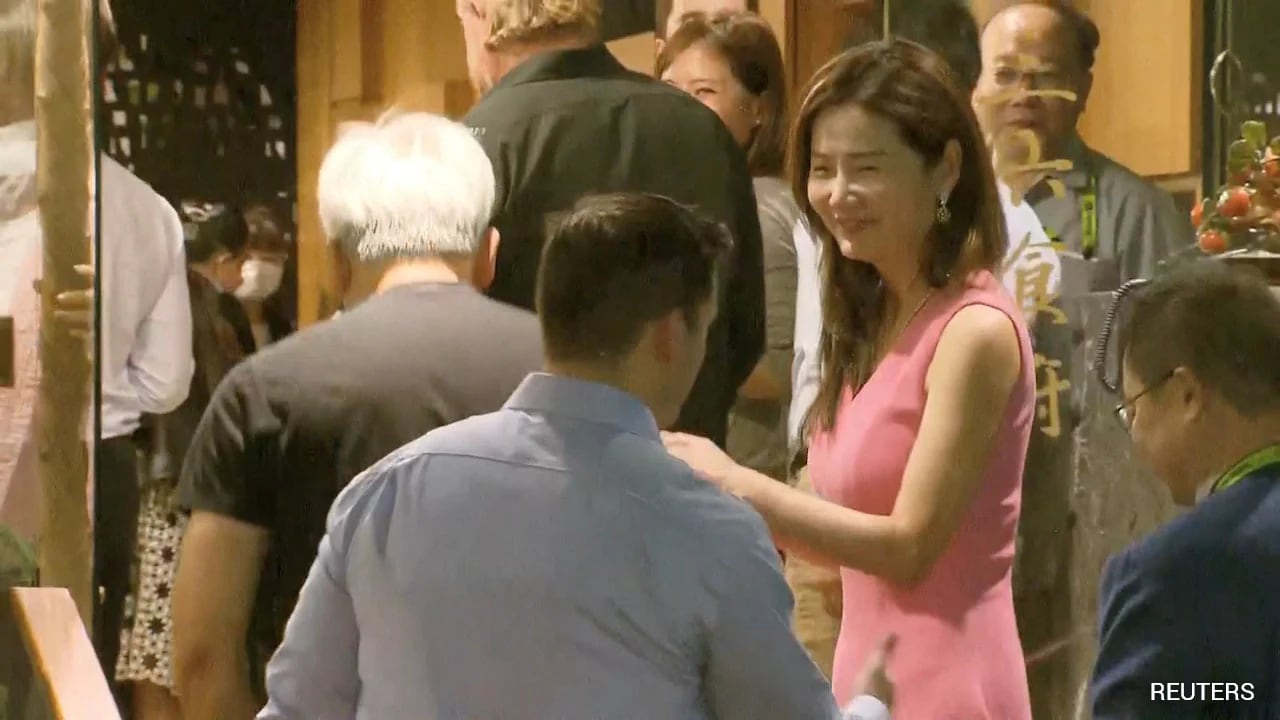
Just a few paces back, hovering near the edge of the crowd with a phone raised just a little too steadily, stood a woman who was not there for the fruit, the heat, or the autograph.
She had entered Taiwan on a Hong Kong passport. On paper, she was just another tourist or business traveler slipping through Taoyuan International Airport, blending effortlessly into the millions of visitors who cross the Taiwan Strait every year. Yet her focus never drifted from the man in the leather jacket. Every handshake, every casual conversation with a local supply-chain executive, every unscripted detour to a neighborhood restaurant was being cataloged, filmed, and tracked.
Shadowing.
When the news broke months later that Taiwanese intelligence and security officials had flagged a Chinese national using a Hong Kong travel document to monitor Huang’s movements during his Taipei visit, the headlines treated it like a fleeting curiosity. A brief blip on the wire. Most people read the summary, nodded at the mention of corporate espionage, and scrolled on to the next distraction.
They missed the point entirely.
To understand why a woman with a Hong Kong passport was trailing a tech CEO through the crowded streets of Taipei, you have to stop looking at the smartphone in her hand and start looking at the silicon inside it. We are living through a quiet, relentless war where the weapons are not missiles or tanks, but microscopic transistors etched onto wafers of purified sand. And in that war, Jensen Huang is not merely a businessman. He is the architect of the battlefield.
The Weight of a Single Supply Chain
I spent years working alongside semiconductor supply-chain analysts in East Asia, watching how entire global industries hinge on buildings you could drive past without noticing. If you have never stood outside a wafer fabrication plant in Hsinchu or Tainan at shift change, it is difficult to grasp the sheer vulnerability of our modern world. Thousands of engineers file out in cleanroom suits, carrying in their heads the proprietary secrets that allow your phone to recognize your face, your hospital to run diagnostic models, and your nation’s defense grid to function.
For decades, we operated under a comfortable illusion. We believed that global trade had softened hard borders, that commerce had made conflict too expensive to contemplate. That illusion shattered somewhere between a global pandemic and a sudden, frantic realization that nearly all of the world’s most advanced artificial intelligence chips come from one island.
Nvidia designs the brains of the AI revolution—chips like the H100 and the Blackwell architecture—that every major tech giant, from Microsoft to Meta, is desperate to hoard. Yet Nvidia does not actually manufacture a single one of those chips. Instead, Huang relies almost entirely on Taiwan Semiconductor Manufacturing Company, or TSMC, to turn his digital blueprints into physical reality.
Think of Nvidia as the master architect drawing the plans for an impossible skyscraper, and TSMC as the only construction crew on Earth possessing the tools, the cranes, and the metallurgical mastery to actually build it. Without Taipei, there is no AI boom. Without Jensen Huang’s personal relationships with the founders, engineers, and packaging suppliers scattered across Taiwan, those blueprints stay trapped on a hard drive.
This is why Beijing watches him so closely.
When the United States began tightening export controls, cutting off China’s access to Nvidia’s highest-end processors, the rules of engagement changed overnight. Suddenly, knowing who Jensen Huang meets for dinner in Taipei is no longer corporate gossip. It is strategic intelligence. If he stops by a quiet banquet hall to dine with the executives of Quanta Computer, Foxconn, or MediaTek, the seating chart alone tells a rival intelligence agency which companies are scaling up server production, where bottlenecks are easing, and which factories are gearing up for the next generation of hardware.
The Passport as a Master Key
Let us picture a hypothetical scenario to make the mechanics of this operation clear. Imagine you are an intelligence handler tasked with gathering real-time human intelligence in Taipei. You cannot simply send an operative with a mainland Chinese passport and a government background; Taiwan’s National Security Bureau scrutinizes mainland arrivals with intense, justified suspicion, especially during major events like Computex when the world’s tech elite descends on the island.
So you turn to the gray zone.
A Hong Kong Special Administrative Region passport carries a very different profile. Historically, travel between Hong Kong and Taiwan was fluid, routine, and deeply embedded in daily commerce. Millions of legitimate businesspeople, students, and families move back and forth constantly. By utilizing a Hong Kong identity—whether acquired through residency pathways, dual documentation, or local recruitment—an operative bypasses the immediate friction that greets a mainland traveler at immigration.
Once on the ground, the job does not look like a scene from a spy thriller. There are no poisoned umbrellas or midnight dead drops. Instead, it looks like fandom.
During that June week in 2024, Jensen Huang’s itinerary was practically public property. Taiwanese media tracked his favorite beef noodle shops and night markets with breathless enthusiasm, turning his culinary tour into a running joke they dubbed "Jensanity." For a tracker, this media circus was a gift. You do not need to hack a secure server to find out where the CEO of a three-trillion-dollar company is going when three dozen local reporters are already standing outside the restaurant waiting for him.
You simply step into the crowd. You hold up your phone like everyone else. You smile. You blend into the noise.
Yet while the fans around her were capturing blurry photos for Instagram, the woman from Hong Kong was reportedly doing something far more methodical. She was documenting the periphery. Who stepped out of the black vans with Huang? Which mid-level engineers stood quietly behind the executives? What time did the meetings conclude, and which hotel lobbies did the participants retreat to afterward? In intelligence work, the target is rarely the only prize; the network around the target is the real map.
Why Open Secrets Still Matter
Skeptics might ask a fair question here. If Taiwanese television crews were already broadcasting Huang’s every move live on the evening news, why bother sending someone on a Hong Kong passport to shadow him in person? What could a pair of eyes on the ground possibly catch that a telephoto lens on a news camera missed?
The answer lies in the difference between spectacle and pattern recognition.
News cameras point at the celebrity. They zoom in on the leather jacket, the smile, the plate of local food. When the cameras turn off and the crowd disperses, the journalists pack up their gear and head back to the newsroom to file their stories. That is when the real work begins.
Consider what happens next: after the public photo op at the night market ends, the black SUVs pull away from the main road and head toward a private entrance at a five-star hotel in the Xinyi District. The television crews are gone. The fans have drifted back to the subway stations. Only someone intentionally trailing the convoy sees the secondary group of executives—people whose names never appear in press releases—slipping through a side door for a midnight briefing.
In the semiconductor industry, supply-chain shifts are telegraphed months in advance by human movement. Before a new packaging facility is announced, before a billion-dollar component order hits the quarterly earnings report, engineers and executives travel. They meet in person because secure phone lines can be tapped and encrypted emails can be subpoenaed, whereas a quiet conversation over tea in a private dining room leaves no digital footprint.
I have sat in enough late-night hotel bars in Hsinchu and Taipei to know how much business gets done off the ledger. You watch two vice presidents from supposedly competing firms sharing a drink in a corner booth, and you realize six months later that their companies just signed a joint venture. Presence is signal. And when you are trying to circumvent international sanctions or reverse-engineer a rival’s supply chain, knowing who is in the room is half the battle.
The Vulnerability of Openness
There is a profound, unsettling tension at the heart of this story, and it is one that keeps security officials in Taipei awake at night.
Taiwan is a vibrant, fiercely open democracy. Its greatest strength—the very quality that allowed its tech sector to flourish into an indispensable global powerhouse—is its culture of trust, hospitality, and free movement. Jensen Huang loves walking through Taipei’s streets without a heavy ring of armed bodyguards because Taipei is safe. It is a place where a billionaire can buy fruit from a street vendor without fearing for his life.
Authoritarian intelligence services understand this asymmetry intimately. They weaponize the openness of free societies against themselves. They use commercial visas, academic exchanges, tourist passports, and fan crowds as camouflage, knowing that a democratic government cannot lock down every street corner or interrogate every traveler from Hong Kong without destroying the very freedom and economic vitality it is trying to protect.
When Taiwanese authorities finally pieced together the woman’s movements and identified the anomaly in her travel pattern, it served as a sobering wake-up call. It proved that the perimeter around the world’s most valuable technology is not just digital. You can spend hundreds of millions of dollars on cybersecurity, air-gapped servers, and encrypted communications, and still have your executive’s operational rhythm mapped out by someone standing ten feet away in a pair of sneakers, pretending to be a tourist.
We tend to think of espionage as a high-tech chess match played out in dark rooms filled with glowing monitors. Sometimes it is. More often, it is patient, mundane, and deeply human. It relies on someone willing to stand in the humid Taiwanese heat for hours, waiting for a man in a leather jacket to step out of a restaurant, quietly recording the faces of the people standing just behind his shoulder.
Long after the night market stalls have closed and the crowds have gone home, the street sweepers wash away the grease and paper wrappers, leaving the asphalt damp and empty under the streetlights—until the next morning, when the vans roll up again, and someone new steps out of the crowd with a phone already raised.