Arthur remembers when the water smelled like nothing.
That sounds impossible to anyone who has never stood on the shore of Malpeque Bay at dawn, watching the salt fog roll off the Gulf of St. Lawrence to drape itself over the red sandstone cliffs. But a dying bay has a distinct scent. It smells of stagnant mud, of quiet despair, of an ecosystem slowly holding its breath. For decades, the famous oysters of Prince Edward Island—once traded in the grand hotels of Boston and London—had been whispering a warning. The beds were thinning. The water was clouding. The bottom was turning into an empty desert.
Then came 2021.
To understand what happened next, you have to look down through three feet of choppy, iron-rich water. You have to look past the silt and the shadows to see a quiet rebellion taking shape on the seafloor.
The Silence Beneath the Surface
For generations, the rhythm of island life was dictated by the tide. You woke up when the sky turned the color of bruised slate. You pushed your dory into the chill. You dragged your tongs across the bottom, listening for the sharp, metallic clack of shell hitting shell. That sound was currency. That sound was survival.
By the late 2010s, the clack was becoming rarer.
In 2021, a coalition of researchers and local harvesters decided to stop mourning the decline and start building. They didn't rely on complex theories or expensive chemical treatments. They looked at the fundamental physics of the ocean floor and realized what was missing. Structure.
Without hard surfaces for microscopic oyster larvae to cling to, life drifted past in the current, looking for a home and finding only shifting silt. An oyster larva is microscopic, no wider than a human hair, floating aimlessly until it finds something solid—a clean shell, a rock, a home. If it lands on mud, it suffocates. If it lands on sand, it rolls away.
So, the researchers brought in concrete.
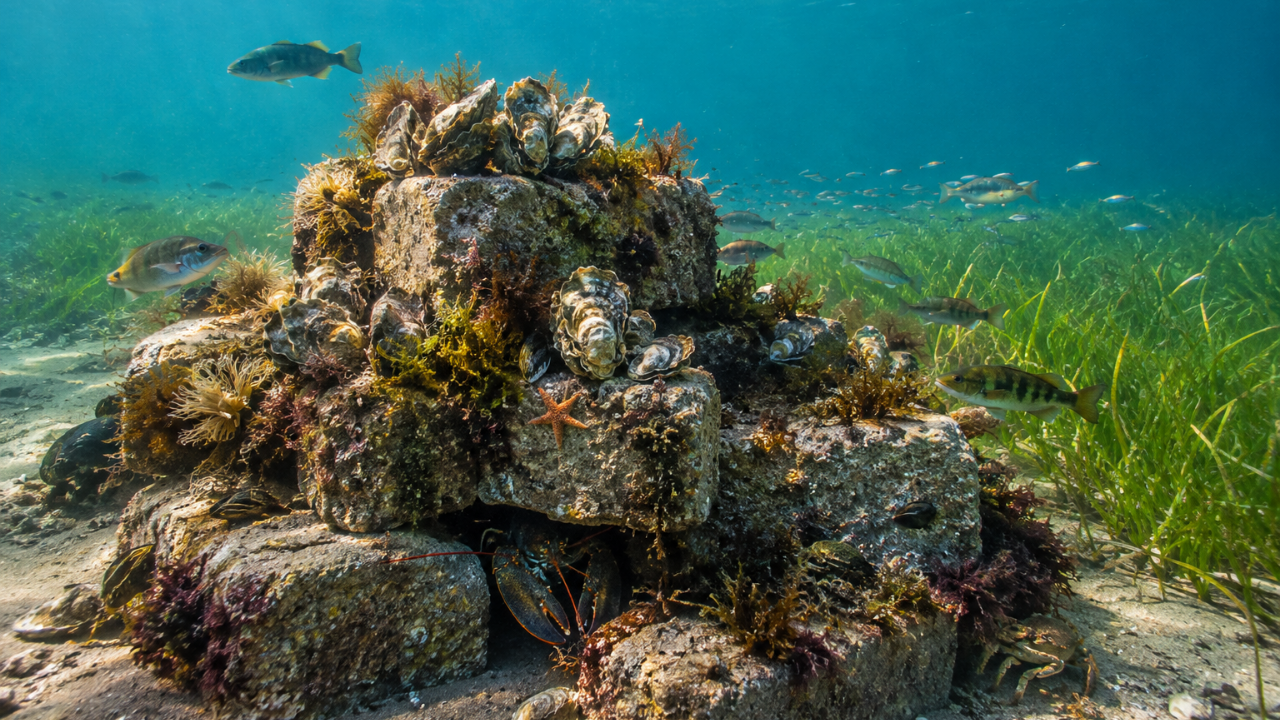
Imagine standing on the deck of a flat-bottomed barge as heavy grey blocks—molded into porous, reef-like shapes designed to mimic ancient shell mounds—are lowered over the side.
Thud.
The sound is muffled by the brine. One by one, these strange, angular monoliths settled into the red muck of the bay floor.
Critics scoffed. Conservationists crossed their arms. To the naked eye, it looked like industrial waste dumped into a pristine sanctuary. Why litter the ocean floor with concrete?
Because nature is remarkably opportunistic when given half a chance.
The Forty-Fivefold Awakening
Water remembers.
Within months of dropping those concrete blocks, the transformation began. It started invisibly. Algae clung to the porous surfaces, followed by barnacles, followed by the microscopic ghosts of swimming oysters carried on the autumn tide. When those larvae finally brushed against the concrete, they didn't sink into the mud. They locked on.
By the time marine biologists hauled up test cages to measure the results, the numbers defied ordinary biology. Biomass had surged forty-five-fold.
Forty-five times the living weight clinging to those submerged blocks compared to the barren mud flats just yards away.
Think about that scale. In the natural world, growth is a slow, agonizing crawl. Populations flicker upward by single digits, fighting disease, predators, and temperature shifts. A forty-fivefold explosion is not just recovery. It is a resurrection.
The concrete blocks had effectively transformed a watery desert into a three-dimensional metropolis. Every nook and cranny of the artificial reefs acted as a nursery. Small fish hid from striped bass. Crabs scavenged among the crevices. And the oysters—filtering up to fifty gallons of water a day each—began to clean the surrounding bay with quiet, relentless efficiency.
The water cleared. Sunlight pierced deeper into the water column, waking up eelgrass beds that had been suffocated by decades of agricultural runoff and soil erosion.
The Human Cost and the Return of the Clack
Arthur didn't need a spreadsheet to tell him the bay was healing.
One morning in late autumn, five years after the first blocks touched the bottom, he pushed his tongs into the water near a submerged reef. He pulled. The handles strained against his palms.
Clack.
Then another. And another.
When he hauled the basket over the gunwale, it wasn't filled with the sparse, stunted singles of his youth. It heaved with heavy, clustered clumps of bivalves, their shells jagged and thick, dripping with the dark, rich brine of a living ecosystem. He picked up a single oyster, brushed away a clinging tuft of seaweed, and inhaled the sharp, iodine scent of clean ocean.
The bay was breathing again.
This is what happens when we stop trying to outsmart nature and simply give it something to hold onto. We live in an era obsessed with digital solutions, algorithmic fixes, and high-tech interventions. We look at broken environments and reach for complex, multi-million-dollar apparatuses.
Sometimes, the answer is just a block of concrete dropped in the right place at the exact right time, waiting for life to find it.
The tide comes in. The tide goes out. The red cliffs stand sentinel against the gulf wind. And somewhere beneath the surface, in the cold, dark water of Prince Edward Island, millions of tiny shells are quietly doing the heavy lifting of healing the world.