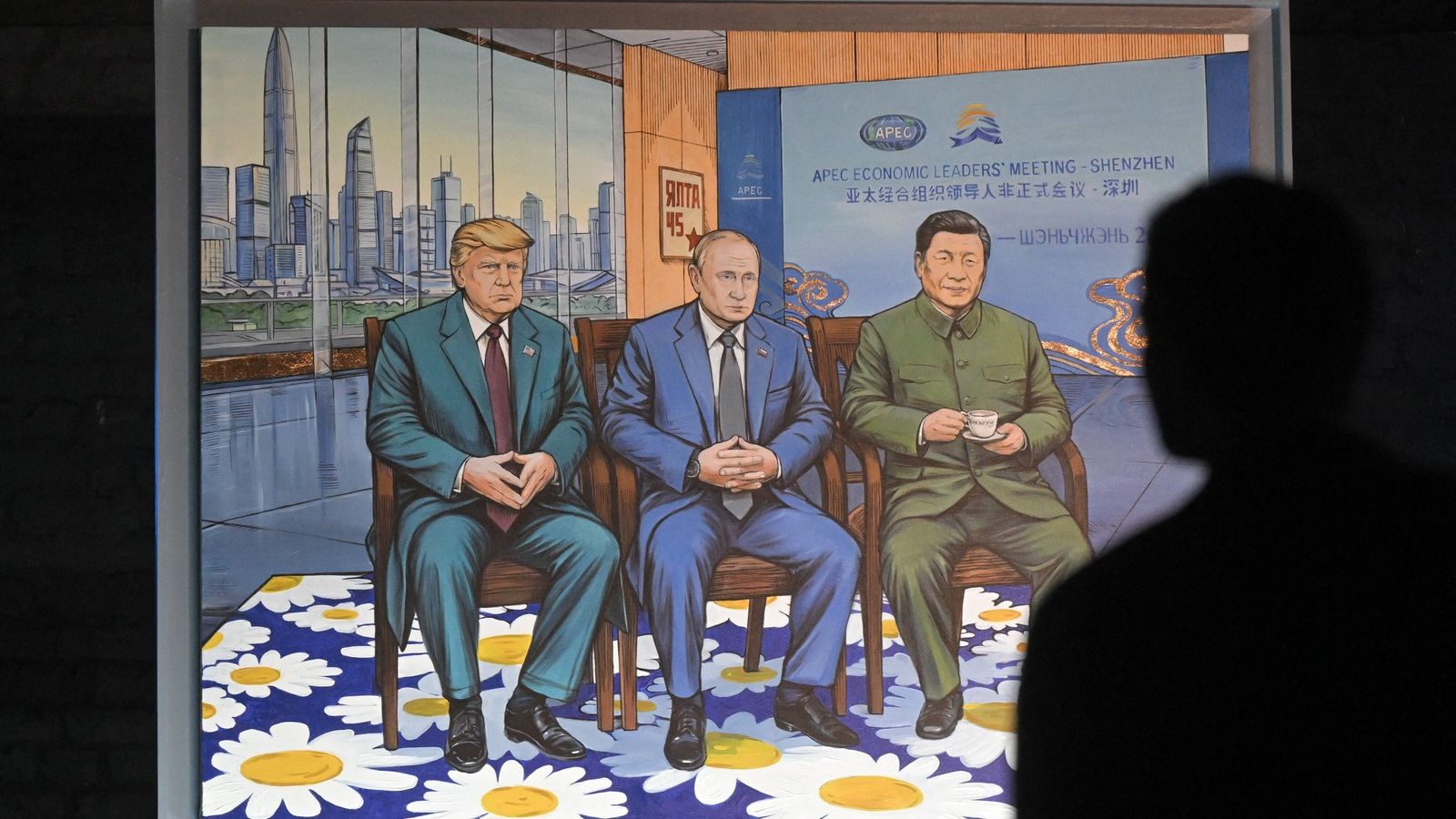
The confirmation of a trilateral summit in Shenzhen between Xi Jinping, Donald Trump, and Vladimir Putin marks a structural departure from post-Cold War diplomatic architecture. Rather than operating through multilateral institutions or sequential bilateral tracks, the three leaders are compressing nuclear deterrence, industrial supply chains, and territorial security into a single bargaining venue. Selecting Shenzhen—China’s primary hardware manufacturing hub and special economic zone—signals that industrial capacity and technological chokepoints serve as the foundational currency of this negotiation, superseding traditional ideological or treaty-based frameworks.
The Strategic Calculus of Venue Selection
Diplomatic venues function as non-verbal signaling mechanisms that establish the baseline assumptions of a negotiation before formal talks begin. Holding a summit in neutral territory, such as Geneva or Vienna, implies procedural equality and adherence to established international norms. Hosting the meeting in Shenzhen alters that dynamic entirely. Also making news lately: What Really Happened When Coles Investigated Its Cyber Attack And Apologised To Customers.
Shenzhen represents the physical manifestation of state-directed industrial policy. Within a fifty-mile radius lies the world’s densest concentration of electronics assembly, battery manufacturing, and telecommunications infrastructure. By bringing both the American and Russian executives to this specific node, Beijing anchors the dialogue in material reality. The message to Washington is that decoupling remains physically and financially prohibitive due to deeply embedded supply chain dependencies. The message to Moscow is that its economic survival relies on integration into Chinese industrial ecosystems rather than European energy markets.
This venue choice introduces three operational constraints for the visiting delegations: Further information regarding the matter are explored by NBC News.
- Asymmetric Information Control: Hosting on domestic soil grants Chinese intelligence and security apparatus complete control over the physical and electromagnetic environment, limiting the operational security bandwidth of visiting teams.
- Narrative Framing: State media apparatus dictates the visual iconography of the summit, framing Beijing as the central convener and arbiter between two competing Western and Eurasian powers.
- Logistical Leverage: Proximity to major Chinese technology firms allows Beijing to stage real-time demonstrations of indigenous capability, countering American narratives regarding the efficacy of semiconductor export controls.
Structural Mechanics of the Trilateral Bargaining Matrix
In game theory, two-player zero-sum games often reach predictable Nash equilibria through tit-for-tat escalation. Introducing a third actor transforms the interaction into an unstable triadic coalition game, where any two players can theoretically align to extract concessions from the third. Understanding the Shenzhen summit requires mapping the specific utility functions and vulnerability profiles of each participant.
The United States Utility Function
Washington enters the summit seeking to arrest the erosion of its unipolar advantages without triggering a kinetic conflict or a sovereign debt crisis. The primary objective is to decouple the Sino-Russian alignment by offering differentiated incentives.
- Trade and Tariff Calibration: The Trump administration utilizes tariffs not merely as protectionist shields, but as transactional bargaining chips. The American delegation seeks enforceable purchase agreements for agricultural and energy exports alongside restrictions on Chinese industrial overcapacity in electric vehicles and solar components.
- Strategic Stability and Arms Control: With existing bilateral nuclear treaties expiring or suspended, Washington faces the prospect of a three-way nuclear arms race. Bringing Beijing into a formal verification and warhead-cap framework is a primary security requirement, though Beijing’s smaller arsenal makes parity-based reductions non-viable from a Chinese perspective.
- Conflict Containment: Managing active proxy conflicts in Eastern Europe and the Middle East drains American munitions stockpiles and fiscal bandwidth. Securing Russian de-escalation requires offering sanctions relief that directly conflicts with European security preferences.
The People’s Republic of China Utility Function
Beijing operates from a position of domestic economic deceleration coupled with external technological containment. Its core imperative is regime stability, which depends on sustaining manufacturing output and preventing a unified Western containment bloc.
- Export Control Relaxation: American restrictions on advanced lithography equipment and high-bandwidth memory chips create severe bottlenecks for China’s artificial intelligence and high-performance computing sectors. Beijing seeks a freeze on new Entity List designations and targeted exemptions for legacy semiconductor tooling.
- Sovereignty and Perimeter Security: China demands explicit non-interference guarantees regarding Taiwan and reduced American naval patrolling within the First Island Chain. In exchange, Beijing offers diplomatic mediation leverage over Moscow and Pyongyang.
- Market Access Preservation: With domestic consumption lagging, Chinese manufacturing relies on external markets to absorb excess capacity. Avoiding punitive, across-the-board tariffs from both the United States and its allies remains an urgent macroeconomic necessity.
The Russian Federation Utility Function
Moscow enters Shenzhen as the junior economic partner to Beijing and an active belligerent against Western-backed forces. Its primary objective is to formalize territorial gains while breaking out of financial isolation.
- Sanctions Architecture Dismantling: Exclusion from Western clearing systems and secondary sanctions on non-Western banks severely restrict Russian trade settlement. Moscow requires explicit American commitments to lift financial and energy sector sanctions as a prerequisite for any ceasefire agreement.
- Security Architecture Revision: Russia seeks formal guarantees halting NATO eastward expansion and restricting the deployment of intermediate-range missile systems in Europe.
- Preventing Sino-American Collusion: Moscow’s greatest strategic vulnerability is a bilateral grand bargain between Washington and Beijing that trades Russian interests for American trade concessions. Participating directly in a trilateral format prevents Moscow from being relegated to a bargaining chip.
The Trilemma of Linked Concessions
Attempting to resolve trade deficits, nuclear proliferation, and territorial disputes simultaneously creates severe structural friction. In diplomatic negotiations, issue linkage can facilitate breakthroughs when one party trades a low-cost concession in one domain for a high-value gain in another. However, excessive linkage creates a trilemma where progress on any single vector is held hostage by deadlocks on the other two.
Consider the intersection of energy markets, sanctions, and trade balances. Washington wants Beijing to purchase more American liquefied natural gas to narrow the bilateral trade deficit. Simultaneously, Moscow relies on discounted pipeline and seaborne energy exports to China to fund its state budget. If Beijing agrees to massive American energy purchases to secure tariff relief, it directly undercuts Russian state revenues, destabilizing a critical border partner. Conversely, if Beijing maintains its current Russian energy intake, it lacks the import capacity to satisfy American trade demands without displacing domestic coal production.
A similar structural contradiction governs technology transfers and dual-use goods. Washington demands that Beijing halt the export of machine tools, microelectronics, and nitrocellulose to Russia’s defense industrial base. Yet these exact commercial flows sustain thousands of small and medium-sized enterprises in southern China, particularly in Guangdong province surrounding Shenzhen. Complying with American demands requires Beijing to impose self-inflicted economic pain on its core manufacturing base to assist a strategic competitor.
Execution Risks and Enforcement Failures
Even if the three leaders reach a broad framework agreement in Shenzhen, the structural mechanics of implementation present massive failure points. Modern great power agreements frequently collapse not from bad faith at the executive level, but from institutional friction and verification deficits during execution.
The Verification Deficit
Arms control and technology transfer bans require intrusive, continuous monitoring to remain credible. The United States and Russia possess decades of institutional muscle memory regarding on-site nuclear inspections and telemetry sharing, even if those mechanisms are currently dormant. China possesses no comparable institutional infrastructure or political willingness to accept foreign inspectors inside its military-industrial facilities. Without verifiable transparency, any cap on fissile material or warhead deployment relies entirely on national technical means—satellites and signals intelligence—which cannot detect concealed underground storage or dual-use component diversion.
Domestic Political Asymmetry
The three leaders operate under vastly different domestic time horizons and institutional constraints.
- Executive Unilateralism vs. Legislative Ratification: An American president can alter tariff schedules and modify export control licensing through executive authority, creating rapid policy shifts. However, permanent sanctions relief or formal arms control treaties require congressional action or Senate ratification, which remains deeply uncertain.
- Personalist Durability: Both Xi and Putin operate within centralized systems where executive agreements carry immediate, binding force across state ministries and state-owned enterprises. This creates a structural time-inconsistency problem: Beijing and Moscow are asked to make irreversible strategic concessions—such as halting weapons production or opening sensitive sectors—in exchange for American executive actions that a subsequent administration could reverse within forty-eight months.
Third-Party Spoiler Dynamics
A trilateral summit deliberately excludes middle powers whose cooperation is essential for enforcing any resulting agreement.
- European Security Equities: European nations hold the vast majority of frozen Russian central bank assets and control key maritime insurance and shipping choke points. An American agreement to lift bilateral sanctions in Shenzhen does not automatically unlock European financial clearing or lift EU trade embargoes.
- Indo-Pacific Alliance Integrity: Japan, South Korea, and the Philippines host critical American forward-deployed assets and control crucial nodes in the global semiconductor supply chain, particularly in lithography chemicals and memory fabrication. If Washington trades away Indo-Pacific security assurances or technology controls without consulting Tokyo and Seoul, those allies face intense pressure to hedge toward Beijing or pursue independent nuclear deterrents.
Operational Indicators to Monitor Post-Summit
To separate substantive geopolitical realignment from choreographed diplomatic theater, analysts must track specific, verifiable operational metrics in the ninety days following the Shenzhen meetings. Communiqués and joint statements carry zero predictive weight; resource allocation and regulatory adjustments reveal true intent.
- Treasury and Commerce Department Licensing Logs: Monitor the Bureau of Industry and Security for subtle shifts in export license approval rates for Chinese semiconductor entities, alongside Office of Foreign Assets Control general licenses permitting specific Russian banking transactions.
- Maritime Automatic Identification System (AIS) Data: Track shadow-fleet tanker movements in the Baltic Sea and crude oil offloading volumes at ports in Shandong province. A genuine enforcement agreement will immediately manifest as increased turnaround times and vessel detentions.
- Customs Clearance Data on Dual-Use HS Codes: Examine bilateral trade data between China and Russia specifically within Harmonized System chapters 84, 85, and 90, covering precision CNC machinery, integrated circuits, and optical instruments.
- Military Exercise Notifications and Patrol Cadence: Observe the frequency and proximity of People’s Liberation Army Navy deployments around Taiwan and Russian strategic bomber patrols in the North Pacific. A reduction in operational tempo indicates an active de-escalation protocol.
Strategic Positioning for Institutional Actors
Organizations with exposure to cross-border supply chains, sovereign debt, or commodity markets must treat the Shenzhen summit not as a resolution event, but as a volatility catalyst. The structural contradictions between American trade demands, Chinese industrial policy, and Russian security requirements preclude a comprehensive, durable grand bargain. Instead, the most probable outcome is a tactical, short-term transactional truce characterized by selective tariff pauses and informal conflict freezes.
Capital allocation and supply chain architecture must therefore remain anchored to a baseline of structural fragmentation. Multinational enterprises should utilize any temporary tariff relief or export control reprieve resulting from the summit as an operational window to accelerate inventory diversification and dual-sourcing strategies in Southeast Asia and Latin America, rather than reversing decoupling initiatives. Treating a tactical pause in Shenzhen as a return to pre-2018 globalization exposes balance sheets to severe whipsaw risk when the underlying enforcement mechanisms inevitably fracture.