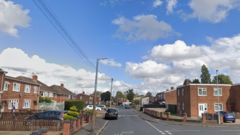
The afternoon was unremarkable, the kind of Tuesday where the sun hangs heavy and the neighborhood sounds are predictable—a lawnmower three streets over, the distant hum of the bypass, the rhythmic jingle of a dog collar. In a quiet house in Coventry, these sounds were the backdrop of a life. Then, the rhythm broke. It didn't just break; it shattered into a frantic, violent dissonance that would leave a community paralyzed and a family hollow.
A woman is dead.
That is the clinical truth reported by the sirens and the yellow tape. She was in her 30s. She was inside a property on Wexford Road. She was attacked by dogs that lived there. To the news cycle, she is a statistic in a rising trend of domestic canine fatalities. But to those who knew the sound of her laugh or the way she took her tea, she is a gaping hole in the universe.
We have a strange relationship with the predators we let sleep at the foot of our beds. We call them "furbabies." We dress them in sweaters. We forget, with a dangerous kind of collective amnesia, that every dog is a biological machine fine-tuned by millennia of evolution for specific tasks. When that machine malfunctions, or when its nature overrides its training, the results are visceral.
The Anatomy of an Instant
Imagine the kitchen. It is a place of safety, smelling of dish soap and perhaps a lingering scent of toast. The woman is there. She is familiar with these animals. They are not monsters under the bed; they are the residents of her home. There is no cinematic buildup. There is no ominous music. There is only a sudden shift in the air—a stiffening of a spine, a low vibration in a chest, a look in an eye that signifies the domestic mask has slipped.
When a large dog attacks, it isn't like a fight in a movie. It is heavy. It is fast. The sheer kinetic energy of a hundred pounds of muscle hitting a human frame is enough to disorient even the most prepared individual. Then comes the pressure.
Modern dental science tells us that certain breeds can exert hundreds of pounds of pressure per square inch. It is enough to crush bone. It is enough to sever the delicate tethers that hold a life together. In that small room in Coventry, the transition from "pet owner" to "prey" happened in the space of a heartbeat.
The neighbors heard the screams. That is the detail that sticks, the one that prevents sleep. It wasn't the barking that signaled the end; it was the sound of a human being realizing that the familiar had become fatal. By the time West Midlands Police breached the door at 12:15 PM, the silence had already returned.
The Illusion of Control
We like to believe that love is a leash. We tell ourselves that if we provide enough treats, enough walks, and enough affection, we can override the genetic blueprint of an animal. It is a comforting thought. It is also, in many ways, a lie.
The dogs involved in the Wexford Road tragedy were described as "large, powerful breeds." While the specific lineage is often debated in the aftermath of such horrors—triggering the inevitable wars between breed advocates and skeptics—the biology remains indifferent to the argument. Whether it is a Mastiff, a Bully, or a Shepherd, the physics of the attack remain the same.
The police eventually had to taser the animals. One was "contained" in a garden; the other remained inside. Later, they were humanely destroyed. The word "humanely" feels like a bitter irony when held up against the carnage they left behind. These animals weren't "evil." They didn't plan this. They reacted to a stimulus, a territorial instinct, or a neurological flicker that we may never fully understand.
But the woman is still dead.
The Neighborhood Shadow
Coventry is a city of layers, a place that knows how to rebuild after fire and steel. But a tragedy like this doesn't leave a visible scar. You can’t point to a charred beam or a crumbled wall. Instead, the trauma seeps into the pavement.
Walking down Wexford Road now, you see people clutching their leashes a little tighter. They look at their neighbors' fences with a new, sharp curiosity. They wonder what is happening behind the closed doors of the suburban dream.
Is there a dog in that house? Is it happy? Is it bored? Is it a ticking clock?
The "People Also Ask" sections of our digital lives want simple answers. They want to know "Which breeds are the most dangerous?" or "How do I stop a dog attack?" They want a checklist to keep the darkness at bay. But the narrative of Wexford Road suggests that the checklist is a fragile defense. The woman wasn't walking in a dark alley. She wasn't trespassing. She was home.
The Invisible Stakes
Every time a headline like this breaks, we retreat into our respective camps. The policy makers talk about the Dangerous Dogs Act of 1991, debating whether it’s the "deed or the breed." They shuffle papers and promise reviews. The activists argue about responsible ownership and the failures of the domestic environment.
Meanwhile, the human element is buried under the discourse.
We forget that for the officers who entered that house, the images will never leave their retinas. We forget the paramedics who arrived with bags of blood and hope, only to realize they were too late. We forget the family who now has to walk past an empty dog bowl and an empty bed, dealing with a grief that is complicated by a sense of betrayal. How do you mourn a loved one when the "murderer" was a creature they once loved?
It is a specific, jagged kind of pain. It is the realization that nature is not our friend; it is merely our guest.
The Weight of the Aftermath
There will be an inquest. There will be toxicology reports for the dogs and witness statements from the people who lived nearby. The police will issue a final report, the yellow tape will be rolled up, and the house on Wexford Road will eventually be put on the market or occupied by someone who doesn't know the history of the kitchen floor.
But the story doesn't end with the report.
It continues in the way we talk to our children about animals. It continues in the legislative halls where people try to balance liberty with safety. And it continues in the haunting realization that we are never as safe as we think we are.
We live alongside shadows. We share our sofas with creatures that possess the power to end us, trusting in a social contract that the animal never signed. Most of the time, that trust is rewarded with years of companionship and joy. But sometimes, the contract is torn to shreds.
The sun still sets over Coventry. The lawnmowers will return. The bypass will continue its low, steady hum. But for one family, the silence left behind by the dogs is the loudest thing in the world. It is a silence that carries the weight of a life cut short, a reminder that behind every gate, there is a story we only think we know.
The door is locked now. The dogs are gone. The woman is gone. All that remains is the cold, hard fact of the Tuesday that wouldn't end, and the terrifying, human truth that sometimes, the things we love are the things that break us.