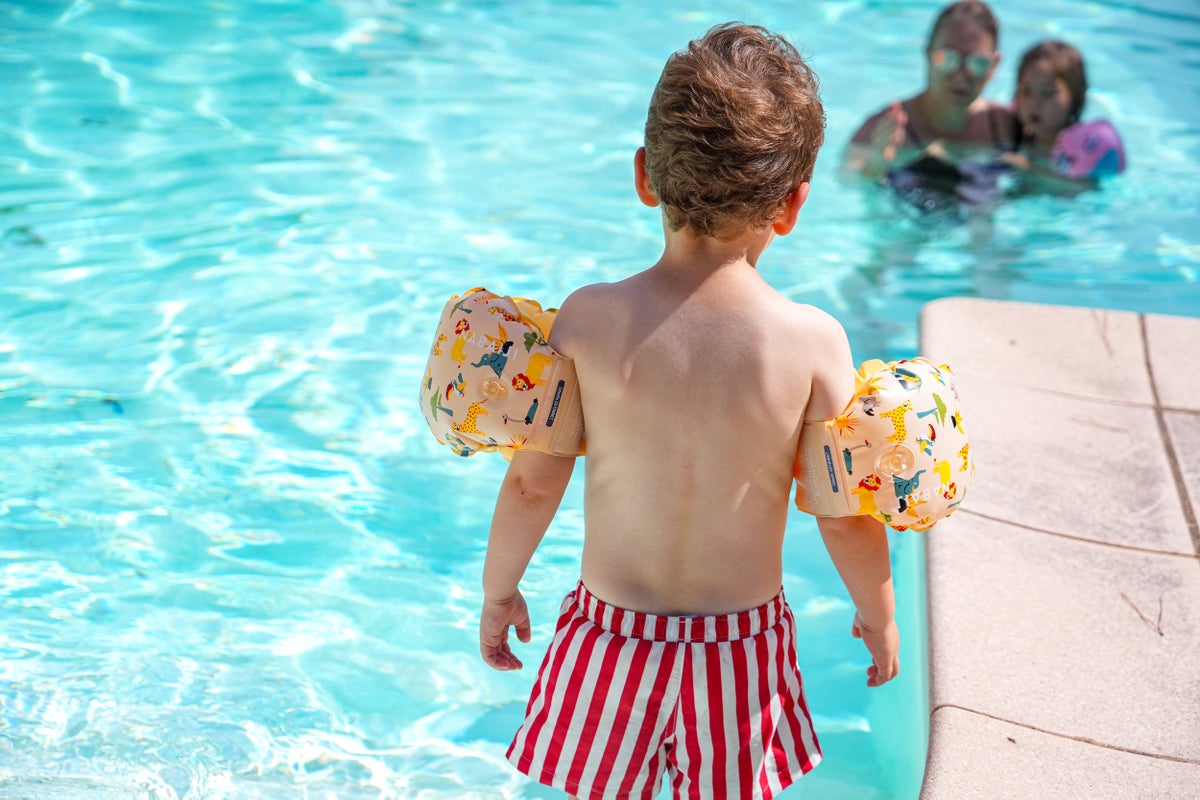
The sun was hot on the pavement. The water in the backyard pool looked like a sheet of crushed glass, glittering under the afternoon sky. It was supposed to be a normal Tuesday.
Water has a way of looking entirely harmless. It ripples. It invites us in. On hot summer days, it promises absolute relief. But underneath that calm blue surface lies a physics problem that human biology is entirely unequipped to solve on its own. In related developments, we also covered: Stop Hand Washing Your Workout Clothes You Are Ruining Them.
Let us step into a hypothetical scenario, clearly labeled as such to examine a mechanical truth. Picture a backyard barbecue. Voices overlap, music plays from a small speaker on the patio, and burgers sizzle on the grill. A four-year-old child named Leo slips out the back door. He is quiet. Children do not splash or scream when they are in trouble, contrary to what Hollywood movies teach us.
Drowning is quiet. It is fast. Psychology Today has also covered this fascinating issue in great detail.
The Physics of Silence
When a person enters distress in the water, their body undergoes a primitive, involuntary panic response. The instinctual drowning response, a term coined by aquatics expert Dr. Frank Pia, strips away a person's ability to call for help.
The mouth sinks below the surface and reappears, but never long enough to exhale, inhale, and cry out. The body stays vertical in the water. There is no kicking. The arms instinctively press down against the water surface to try to push the mouth up. To an untrained observer standing ten feet away, the child might look like they are just bobbing, playing, or vertical in the water.
It takes twenty seconds for a child to submerge. It takes two minutes for them to lose consciousness. Brain damage can occur in as little as four minutes.
Statistics from the Centers for Disease Control and Prevention tell a stark story that data tables fail to make you feel in your chest: drowning is a leading cause of accidental death for children ages one through four. Most of these incidents happen in residential swimming pools. Most of them happen during moments when adults are supposedly supervising.
The Illusion of Watchfulness
We rely heavily on our eyes. We assume that if we are sitting on the patio with a clear view of the water, our children are safe.
Consider what happens next in our scenario. The adult hosting the barbecue looks at their phone to check a text message. It takes six seconds. In those six seconds, attention shifts. The eyes leave the water. The brain registers a distraction—a question about ketchup, a ping from a screen, a laugh from a friend.
Human attention is not a continuous floodlight. It is a flickering candle. We cannot stare at a motionless surface of water for thirty minutes straight without our minds drifting. Biological fatigue sets in. The brain craves stimulation, and the moment it finds it elsewhere, the invisible safety net vanishes.
This is where the concept of designated supervision changes everything. In a group setting, everyone assumes someone else is watching. "I thought you had eyes on him," becomes the most heartbreaking sentence in the English language.
Building Layers of Defense
Relying solely on human vigilance is a losing battle because humans are flawed, distractible creatures. True safety requires systems that do not rely on constant perfection.
Think of safety as a series of overlapping chain-link fences. Each individual fence has holes, but when you stack them together, nothing slips through.
First is physical isolation. A four-sided isolation fence separating the house and yard from the pool, equipped with a self-latching, self-closing gate that opens outward, changes the entire equation. It forces a barrier between an exploring toddler and the water. It requires intention to breach.
Second is water competency. Swimming lessons do not make a child "drown-proof." That is a dangerous myth. Lessons teach children breath control, floating, and how to reach a wall. They buy precious time, but they do not replace barriers.
Third is active, uninterrupted supervision. When supervising children near water, put the phone in another room. Assign a designated water watcher—a single adult wearing a lanyard or tag who watches the pool with zero distractions for a set period, like fifteen minutes, before tagging out to someone else. No multitasking. No casual conversations while tracking the deep end.
The Weight of Awareness
The air cools as evening approaches. The barbecue winds down. The patio chairs are pushed back, and the grill cools off.
Water does not care about our intentions. It does not negotiate with our fatigue or our distractions. It simply waits, perfectly still, reflecting the fading light of the sky.
The urgent advice every parent needs is not a complex formula. It is a stark realization: vigilance is not a feeling; it is a discipline. And when we respect the sheer, silent speed of water, we give our children the one thing they cannot buy back once it is lost.
Time.


