The Sound of Two Thousand Fathoms
The deep ocean does not possess a voice. It has a weight. For the eighty-odd crew members living inside a steel tube beneath the surface of the South China Sea, existence shrinks to a rhythmic hum of air scrubbers and the faint, metallic groan of a hull holding back millions of tons of black water.
Let us call one of these crew members Chen. He is twenty-six, possesses a degree in mechanical engineering from Wuhan, and has not seen a sunbeam in forty-five days. His universe is illuminated exclusively by fluorescent tubes and the dull amber glow of terminal screens. In the quiet hours of his watch, Chen thinks about his mother’s kitchen in Hubei, the smell of fried scallions, and the sharp, clean sting of winter air.
Then, the floor shifts.
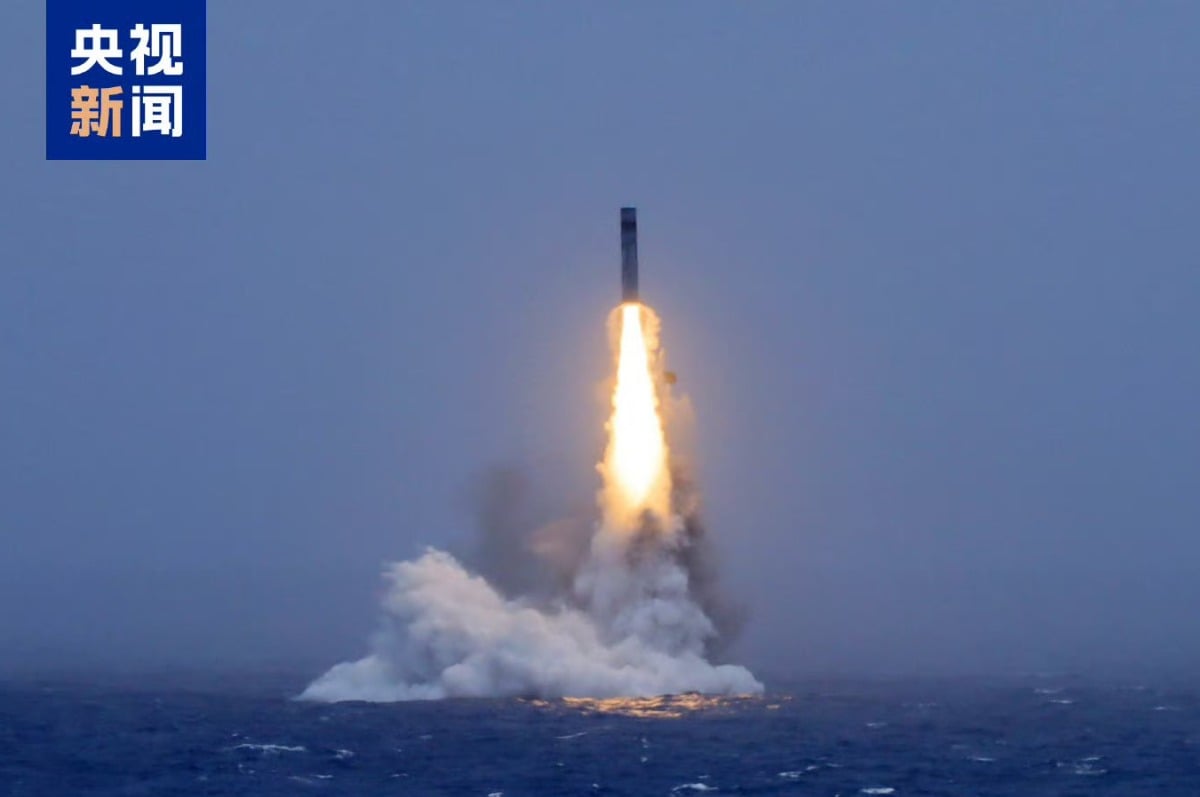
It is not the violent shudder of an engine casualty. It is a deliberate, massive redistribution of mass. Somewhere in the middle sections of the Type 094 ballistic missile submarine, a hatch opens to the freezing dark of the Western Pacific. High-pressure gas roars. A cylinder longer than a city bus is expelled upward, fighting the crushing drag of the sea. For a handful of seconds, the missile is a dead weight, ascending through the water column. Then, it breaks the surface.
The air ignites.
A pillar of fire tears open the tropical sky, pushing a multi-ton intercontinental ballistic missile into the upper atmosphere. Within minutes, it is traveling at twenty times the speed of sound, tracing a high, silent arc over the heads of unsuspecting fishing crews, cargo vessels, and island communities.
To the world, this is a line item in a defense brief: China conducts a rare, unannounced test of a submarine-launched nuclear-capable missile into the open waters of the Pacific Ocean. But to understand what this moment actually signifies, we have to look past the steel and the telemetry. We have to look at the cold, calculations made by men in bright rooms, and the quiet dread settling over the world's largest ocean.
The Horizon Beyond the Postcard
To most people, the Pacific Ocean is a vacation slide. It is a vast expanse of blue turquoise, palm trees, and honeymoon resorts. It represents an escape from reality.
But for military strategists in Beijing, Washington, and Tokyo, the Pacific is a giant chess board made of liquid. It is the arena where the next half-century of human history will be decided.
For decades, China kept its nuclear teeth hidden behind a policy of minimal deterrence. The idea was simple: maintain just enough nuclear weapons to ensure that if anyone struck first, China could strike back. It was a defensive posture born of historical vulnerability. The missiles stayed locked in deep silos beneath central China’s mountains, or crawled along remote highways on multi-axle trucks.
The sea, however, changes everything.
A missile silo on land is a fixed dot on a map. Satellites watch it constantly. If a conflict breaks out, those dots are the first things targeted. But a submarine? A submarine is a ghost. It moves through the trackless canyons of the ocean floor, invisible to the eye, detectable only by the most sophisticated sonar arrays. A nation with a reliable fleet of nuclear-armed submarines possesses the ultimate insurance policy. Even if the mainland is devastated, the ghosts in the deep can still deliver total destruction.
When that missile broke the surface of the Pacific, it was not just a technical evaluation. It was a declaration of presence. It was China telling the world that its ghosts are now fully operational.
The View from the Island
Consider another perspective, thousands of miles away from Chen’s steel tube. Let us look at a woman named Mele, standing on a concrete pier in a small island nation in Micronesia.
Mele’s grandfather remembered the flashes from the American atmospheric nuclear tests in the 1950s. He used to tell stories about suns rising in the middle of the night, and fish that turned inside out from the heat of the water. For three generations, the people of the Pacific islands have viewed the military rivalries of distant empires with a mixture of weariness and deep-seated anxiety.
When a superpower fires a missile across the ocean, the notification rarely arrives with an apology. It arrives as a notice to mariners—a dry, bureaucratic warning issued via radio bands, telling fishing boats to steer clear of a specific latitude and longitude because "falling debris" is expected.
For Mele and her community, the ocean is not a strategic buffer. It is a supermarket, a highway, and a graveyard. The realization that weapons capable of erasing entire metropolises are flying over their fishing grounds is a reminder of a harsh geopolitical truth: when giants wrestle, it is the grass that gets trampled.
The real problem lies elsewhere, far from the splash zone where the dummy warhead finally struck the water. The true danger is not that a test missile will malfunction and hit a village. The danger is the slow, grinding erosion of certainty.
The Mathematics of Mistake
Human beings are remarkably bad at managing long-term, invisible risks. We panic over sudden market crashes or viral outbreaks, but we grow accustomed to the presence of apocalyptic weaponry if it stays hidden beneath the waves long enough.
Think of nuclear deterrence as an endless game of chicken played at midnight. Each side moves its cars closer to the centerline, assuming the other driver is sober, rational, and fully in control of his vehicle.
But history shows us that systems break down precisely when everyone assumes they are working perfectly. During the Cold War, the world came within seconds of total annihilation not because of madness, but because of a sunlight reflection on Soviet satellite sensors, or a training tape accidentally loaded into a NATO computer.
The introduction of a highly mobile, stealth-oriented Chinese submarine force adds a massive variable to an already complicated equation.
- Communication Delays: Radio waves do not travel well through hundreds of meters of salt water. Communicating with a submerged submarine requires massive, very-low-frequency radio stations that can take minutes or hours to transmit simple text strings. In a crisis, minutes are an eternity.
- The Problem of Identification: If an American attack submarine detects a Chinese ballistic missile sub moving through a choke point in the First Island Chain, how do the commanders react? Does a sudden maneuver indicate an impending attack, or simply an attempt to avoid a school of whales?
- The Command Chain: On a submarine, the distance between the political leadership who holds the launch codes and the men turning the keys is stretched thin by the realities of ocean warfare. Trust becomes a heavy, terrifying burden.
When we strip away the nationalistic pride of the official press releases, we are left with a very simple, very human reality. We are placing the survival of our civilization into the hands of exhausted young men living in steel tubes, relying on data streams that can be misinterpreted in a heartbeat.
The Unseen Wake
The missile test has concluded. The warhead has splashed down into a remote pocket of the ocean, recovered or left to sink into the abyssal plain. The analysts in Washington have logged the telemetry, the diplomats in Beijing have delivered their prepared statements about peaceful development, and the news cycle has moved on to the next political scandal or celebrity divorce.
But beneath the surface, the water remains disturbed.
Chen is likely asleep now, crammed into a bunk three tiers high, while his shipmates continue their silent patrol. Mele is watching the tide come in, wondering if the fish will taste different next month. And the rest of us continue to walk through our daily lives, entirely unaware of the fires being lit beneath the horizon.
We prefer not to think about the ghosts in the deep. It is easier to focus on the screens in our pockets, the bills on our desks, and the immediate, comfortable realities of our immediate surroundings. But the fire in the Pacific sky happened. It was real. And it serves as a stark reminder that the peace we take for granted is not a permanent state of nature. It is a fragile, precarious architecture, held together by nothing more than the hope that the men in the dark never have a reason to turn their keys.