Two milligrams.
Think about the weight of that for a second, because if you drop a single grain of table salt onto your kitchen counter, you are looking at roughly twice the mass required to stop a human heart in less than four minutes.
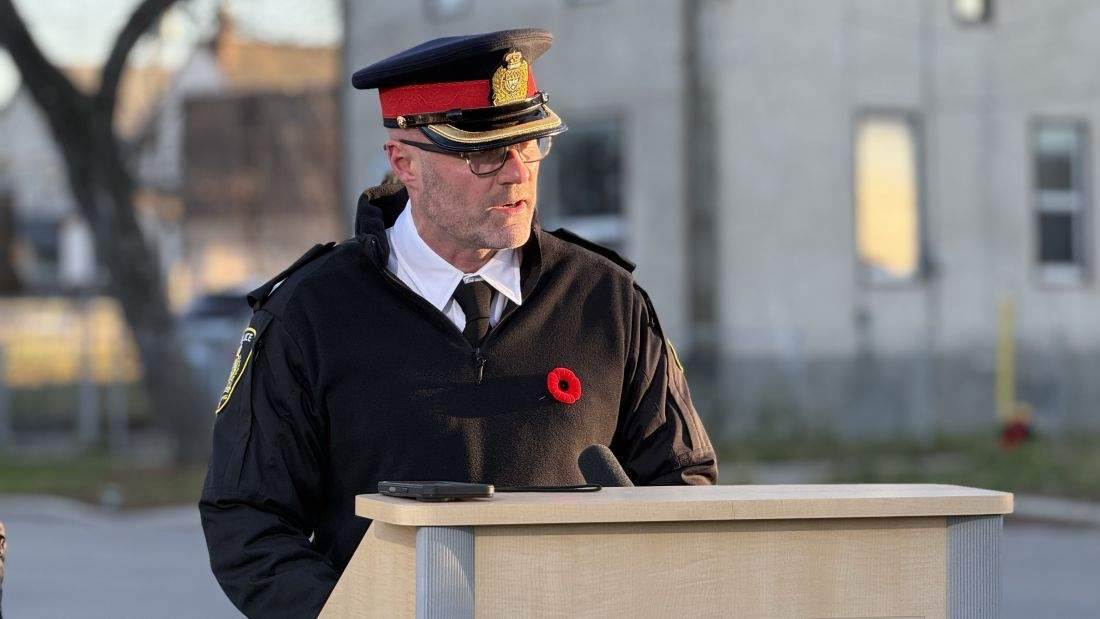
In Winnipeg, Manitoba, where the wind off the Red River cuts through a winter parka like a dull razor, that microscopic dust has become the city’s most ruthless currency. Last week, the Winnipeg Police Service stood behind a podium and delivered the kind of numbers that make for neat, reassuring headlines on the evening news. Through a targeted enforcement initiative aimed directly at the city’s toxic drug crisis, officers made more than 600 arrests. They laid over 1,400 charges. They pulled bricks of fentanyl, methamphetamine, and cocaine off the streets, alongside illegally modified handguns, machetes, and stacks of dirty cash.
On paper, it looks like a victory. Six hundred is a heavy, satisfying integer. It suggests order restored, predators removed, and neighborhoods reclaimed from the shadows of back-alley transactions.
Except anyone who has actually walked down Higgins Avenue at four in the morning, or sat in the fluorescent purgatory of the Health Sciences Centre emergency room waiting to hear if a brother’s brain went too long without oxygen, knows that numbers on a police press release only tell half the story. The other half is written in chalk, sirens, and empty chairs at Sunday dinner.
The Anatomy of a Press Release
To understand what really happened during those months of undercover stings and tactical raids, we have to look past the press conference table—the one neatly arranged with vacuum-sealed bags of white powder and seized firearms—and trace the supply chain backward into the human nervous system.
Let’s construct a composite scene, grounded entirely in the documented realities of Winnipeg’s street-level drug trade. Call him Marcus. Marcus isn’t a cartel kingpin in a tailored suit; he’s twenty-six, grew up three miles from the Forks, and started taking prescription opioids after a construction injury five years ago. When the pills dried up, he moved to street down—the local shorthand for illicit fentanyl mixtures. To pay for his own escalating tolerance, Marcus started running small bags for a mid-level supplier operating out of a rented townhouse in the West End.
When the Winnipeg Police Service launched its toxic drug enforcement project, Marcus was exactly the kind of person caught in the net.
During the operation, investigators focused heavily on the intersection of street-level trafficking, weapons offenses, and organized distribution networks. Police data from Winnipeg and across the Canadian prairies consistently shows that illicit drug markets rarely operate in isolation; they are welded directly to property crime, extortion, and violent turf disputes. When an officer puts handcuffs on someone carrying half a pound of illicit fentanyl and a sawed-off shotgun, that arrest genuinely prevents an immediate, lethal threat. Nobody who has ever had a firearm pointed at their chest during a convenience store robbery argues against taking illegal guns off the street.
Stop. Breathe. Look closer at the math.
When Marcus goes into custody at the Winnipeg Remand Centre, two things happen simultaneously. First, a dangerous combination of weapons and high-potency narcotics is removed from circulation. Second, the vacuum he leaves behind on that West End corner stays open for approximately forty-five minutes before someone else steps into his boots.
Why Supply and Demand Refuses to Break
There is a dangerous, comforting myth at the heart of every major police crackdown: the idea that if you arrest enough dealers, the drugs will simply run out.
Economics works differently when the product rewires the human brain stem. Think of illicit fentanyl not as a luxury commodity, like high-end watches or imported wine, where higher prices and scarcer supply convince customers to walk away. Think of it instead like insulin to a diabetic, or oxygen to a drowning swimmer. Once physical dependency takes hold, the brain perceives withdrawal not as discomfort, but as imminent death.
When police execute more than 600 arrests and seize kilograms of product, they trigger what public health researchers call a "supply shock." In a normal market, a supply shock raises prices and lowers consumption. In an unregulated, toxic drug market, a supply shock forces suppliers to stretch whatever remaining product they have left.
How do you make a dwindling supply of fentanyl hit just as hard? You cut it with cheaper, deadlier adulterants.
Across Manitoba, toxicology reports and street-level drug checking services have tracked a terrifying evolution over the last several years. What used to be heroin became fentanyl. What used to be fentanyl is now routinely laced with benzodiazepines—heavy sedatives that render a person unconscious for hours—and xylazine, a veterinary tranquilizer never approved for human use that causes severe, necrotic skin wounds and ignores naloxone entirely.
Consider what happens next: a user buys a bag from a new dealer because their regular contact was swept up in the police operation. They have no idea what percentage of that powder is fentanyl, what percentage is benzos, and what percentage is caffeine or drywall dust. They inject their usual dose. Because they have spent the last forty-eight hours in jail or struggling to score, their physical tolerance has dropped.
Naloxone reverses opioid overdoses by knocking fentanyl off the brain’s receptors, acting like a bouncer throwing an unruly patron out of a club. But naloxone cannot touch benzodiazepines. So paramedics arrive, administer three doses of Narcan, and watch in frustration as the patient remains dangerously sedated, their breathing shallow, their lips turning the color of a winter twilight.
What Nobody Tells You About the Aftermath
I still remember the smell of the hallway outside an addiction clinic in downtown Winnipeg during a cold snap a few winters back—wet wool, stale coffee, cheap menthol cigarettes, and the sharp, metallic tang of fear. You learn quickly in spaces like that how thin the membrane is between a "productive citizen" and a statistic in a coroner’s report.
In that hallway sat a retired schoolteacher from Transcona, twisting a knitted glove until the yarn frayed, waiting for her daughter to come out of intake. Her daughter wasn't a hardened criminal. She was a dental hygienist who had spiraled after a divorce and a bad prescription. Over three years, she had been arrested twice for simple possession and petty theft, cycled through remand, released with a court date and a bus ticket, and immediately returned to the exact same stretch of concrete because there were zero open detox beds in the province that afternoon.
This is the part of the Winnipeg toxic drug crisis that rarely makes it into enforcement summaries, yet it defines the daily reality of the city’s emergency rooms, shelters, and courtrooms.
According to data from Manitoba’s Chief Medical Examiner, drug-related deaths in the province have surged dramatically over the past decade, routinely claiming well over 400 lives every single year—more than car crashes and homicides combined. In Winnipeg alone, paramedics respond to thousands of suspected opioid overdoses annually, frequently reviving the exact same individuals multiple times in a single week.
When people ask why the crisis keeps getting worse despite record seizures and hundreds of arrests, the answer lies in the brutal asymmetry between how fast we can arrest someone and how slowly we can heal them.
Law enforcement operates on an immediate timeline: observe a crime, gather evidence, execute a warrant, lay a charge. Recovery operates on a biological and psychological timeline measured in months and years. You can lock a cell door in three seconds, yet getting a person into a medically supervised withdrawal bed followed by long-term residential treatment in Manitoba can take weeks—an eternity when the street outside is flooded with synthetic opioids fifty times stronger than heroin.
The Trap of Binary Thinking
Whenever a major police operation makes headlines in Winnipeg, the public debate instantly splits into two rigid, shouting camps.
In one corner, business owners in the Exchange District and families in the North End are exhausted. They are tired of stepping over discarded needles on their way to work, tired of smashed storefront windows, tired of watching violent gang activity spill onto residential sidewalks. To them, the 600 arrests represent long-overdue accountability. They want consequences, visible policing, and safe streets—and they have every right to demand them.
In the other corner, harm reduction advocates, frontline nurses, and grieving parents point out that we have been arresting our way through drug epidemics for fifty years, and the drugs have won every single round. They point to studies showing that incarceration dramatically increases the risk of fatal overdose in the first two weeks after release, simply because forced abstinence strips away tolerance while doing nothing to resolve the underlying trauma or addiction.
Both sides are looking at real, undeniable facts. Both sides are missing the bigger picture because they are treating enforcement and healthcare as enemies rather than incomplete halves of a single survival strategy.
Imagine a house on fire.
The arsonist is still standing in the driveway with a can of gasoline and a box of matches. You absolutely need the police to tackle the arsonist, take away the matches, and put him in the back of a cruiser. Leaving him loose guarantees more fires.
Yet once the arsonist is in handcuffs, the house is still burning. People are still trapped on the second floor choking on smoke. If you celebrate the arrest, pack up the cruisers, and drive away without ever calling the fire department, everyone inside still dies.
Winnipeg’s toxic drug crisis project tackled the arsonists. Officers went after high-harm offenders, dismantled trafficking stash houses, seized weapons, and disrupted violent networks that prey on vulnerable people. That work is grueling, dangerous, and necessary.
The danger isn’t in making those 600 arrests. The danger is believing that the arrests mean the fire is out.
Inside the Invisible Bottleneck
Let’s look at what happens to the human beings swept up in a massive enforcement wave once the press cameras turn off and the squad cars pull away.
Of the more than 600 people arrested during the project, they generally fall into distinct tiers. At the top are the organized suppliers and armed enforcers—individuals profiting off misery while carrying illegal firearms. For them, prosecution and prison are straightforward responses to predatory violence.
At the bottom, however, are hundreds of low-level runners, lookouts, and people caught in the crossfire of addiction-driven survival crime. Many of them are Indigenous Manitobans carrying generations of unresolved historical trauma, foster care displacement, and poverty. Many are suffering from severe, untreated mental illness alongside substance use disorder.
When they enter the justice system, they hit an invisible bottleneck:
- The Remand Revolving Door: Most people arrested on non-violent or low-level trafficking charges are eventually released on bail or after short sentences, returning to the exact same neighborhoods without housing, income, or stability.
- The Treatment Gap: Rapid-access addiction medicine clinics in Winnipeg do extraordinary work, offering medications like buprenorphine and methadone that cut overdose death rates in half. Yet without supportive housing and wraparound mental health care, medication alone often cannot compete with the pull of the street.
- The Poisoned Supply: Because the illicit market remains completely unregulated, every single relapse carries the statistical risk of sudden death. Unlike the alcohol prohibition era of the 1920s, where bootleg liquor occasionally caused blindness, today’s illicit supply is calibrated at the molecular level to kill.
I used to think addiction was fundamentally a failure of willpower—a series of bad choices made by people who simply refused to care about the consequences. Watching people I grew up with vanish into the grip of synthetic opioids cured me of that arrogance permanently. Willpower resides in the prefrontal cortex, the rational, planning part of the human brain. Chronic fentanyl exposure hijacks the midbrain—the ancient, survival-driven engine responsible for breathing, hunger, and fleeing predators. Asking someone in acute opioid withdrawal to simply "choose better" without medical intervention is like asking someone with a ruptured appendix to will away the infection.
What Real Progress Actually Looks Like
If six hundred arrests cannot solve Winnipeg’s toxic drug crisis on their own, what would a genuine, lasting turning point actually require?
It starts by measuring success differently. Right now, we measure policing by inputs: arrests made, charges laid, grams seized, dollars confiscated. Those are metrics of effort, not outcomes. True outcomes are measured in emergency room visits prevented, overdose deaths reduced, and neighborhoods where children can walk to school without passing someone unconscious in a bus shelter.
Achieving those outcomes requires building a bridge directly from the back of the police cruiser to the doors of healthcare—not as an act of leniency, but as an act of cold, pragmatic self-preservation for the entire city.
Cities across North America that have begun bending the curve on overdose deaths share a common blueprint. They maintain relentless pressure on violent traffickers and illegal firearms, ensuring communities are protected from predatory crime. Simultaneously, they flood the zone with immediate, on-demand treatment—meaning the exact moment someone in a holding cell or an emergency room says, "I’m ready to stop," a bed, a doctor, and a caseworker are waiting within the hour, not six weeks from Tuesday.
They pair that treatment with housing-first initiatives, recognizing that nobody successfully recovers from fentanyl addiction while sleeping under a bridge in minus-thirty-degree weather. And they keep people alive long enough to reach recovery through evidence-based harm reduction, knowing with mathematical certainty that a dead person can never enter rehab.
The Weight of a Grain of Salt
Walk down Portage Avenue on a Tuesday evening, and you can feel the tension humming beneath the city’s skin. Winnipeg is a tough, unpretentious place built by people who know how to endure brutal winters and look out for their neighbors when the snowdrifts pile against the doors.
That resilience is being tested by an adversary small enough to hide under a fingernail.
The 600 arrests announced by the Winnipeg Police Service represent months of tireless investigative work, dangerous undercover operations, and real weapons taken out of circulation. The officers who worked those cases did the job the public asked them to do. They held the line against the chaos spilling onto the streets.
Yet tonight, as the temperature drops below freezing and the streetlights flicker on along Main Street, the chemical reality of the city remains unchanged. Somewhere in a cold apartment, someone is tearing open a tiny plastic flap, trusting a stranger’s word that what’s inside won’t stop their lungs before they can even pull the needle from their arm.