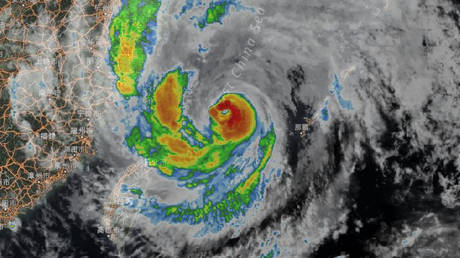
The air tasted of salt and electric copper. Before a single drop of rain struck the asphalt of the coastal highway, the atmosphere itself began to scream.
To watch a typhoon approach through a screen is to witness a spectacle of raw, indifferent physics. To stand beneath its vanguard is to realize just how fragile every concrete pillar, every glass storefront, and every human ambition truly is. Meteorologists call it barometric pressure dropping. The people living in its path simply call it the moment the world holds its breath.
Consider Kenji, a retired carpenter whose hands have shaped the cedar framing of houses built to withstand the fury of the Pacific for decades. He did not check the radar apps that morning. He didn't need to. His left knee, shattered in his youth and fused with steel pins, began to throb with a dull, predictable ache hours before the satellites picked up the spiraling vortex.
"The wind speaks first," Kenji muttered, taping the last pane of glass in his workshop. He was not afraid. Fear is a luxury for those who have never seen the ocean swallow a seawall. Respect, however, is mandatory.
When a powerful typhoon slams into the shores of Japan, it arrives not as a sudden punch, but as a slow, suffocating tightening of a fist. The Pacific Ocean, usually a vast, glittering expanse of blue horizon, turns into a churning gray beast. Swells rise higher than second-story balconies, heavy with the weight of distant tempests, pounding against breakwaters with the rhythmic violence of a battering ram.
Nature does not negotiate.
Emergency broadcasts crackled from battery-powered radios across the archipelago. Evacuation advisories scrolled across television screens with relentless urgency. But long before the first sirens wailed, the streets emptied. Convenience stores—usually bustling hubs of midnight life with their bright fluorescent hum—lowered their heavy steel shutters. The iconic vending machines, glowing beacons of modern convenience on every corner, stood silent, unplugged against the threat of electrical surges.
Then came the silence.
The eerie, deceptive calm before the eye wall hits. Birds vanished from the sky. Insects fell silent. The air grew heavy, thick with moisture so dense it felt like breathing underwater.
And then the sky shattered.
Winds exceeding one hundred and fifty miles per hour tore across the coastline, transforming falling rain into horizontal needles of ice and water. Trees that had stood for a century groaned, their ancient roots ripping free from the saturated soil with terrifying cracks. Roof tiles became projectiles, slicing through the air like thrown slate.
Power grids failed block by block. First a flicker, then a collective darkness that plunged entire neighborhoods into the shadows of the storm. In the pitch black, illuminated only by the strobe-like flash of exploding transformers in the distance, families huddled in interior hallways. They listened to the terrifying percussion of debris striking exterior walls.
This is the hidden cost of our modern geography. We build sprawling cities along volatile coastlines, trusting in engineering feats—massive sea gates, concrete tetrapods lining the shores, subterranean drainage tunnels carved deep into volcanic rock. For the most part, those systems hold. They save thousands of lives. They turn catastrophes into manageable crises.
Yet, against the raw fury of a maximum-strength tropical cyclone, human infrastructure is merely a suggestion.
By morning, the storm had pushed inland, losing its oceanic fuel, downgrading from a terrifying titan to a weeping, exhausted tropical depression. The clouds began to tear apart, revealing patches of pale, bruised blue sky.
Kenji stepped out onto his porch, his boots sinking into a thick carpet of fallen leaves, shredded branches, and sea salt. His workshop stood. The glass he had taped remained intact. Down the road, however, a neighbor's tin roof lay crumpled in a rice paddy like discarded paper.
He looked out toward the horizon, where the Pacific resumed its eternal, quiet breathing, completely indifferent to the terror it had unleashed just hours before. The cleanup would take weeks. The power would take days to restore. Life, stubborn and irrepressible, would stitch itself back together.
A lone seagull drifted over the wreckage, searching for the sea.

/cdn.vox-cdn.com/uploads/chorus_asset/file/22155007/doc_ock.jpg)