Silence.
That is the first thing you notice when a winter weather alert stops being a yellow triangle on a smartphone screen and becomes the reality outside your bedroom window. Before the traffic reports begin on the radio, before the council gritters scrape their orange blades against the tarmac, there is a strange, heavy muffling of the world, as if someone has pulled a thick wool blanket over the rooftops of the United Kingdom and tucked the edges down tight against the hills. For an alternative view, check out: this related article.
I remember waking up to that exact quiet in a terraced house in West Yorkshire a few winters back, staring at a frost-ferned windowpane while my kettle clicked off in the kitchen below. A yellow snow and ice warning had been issued the night before—the kind of routine meteorological bulletin that millions of Britons swipe away between checking emails and setting their morning alarms. Two centimeters of slush, maybe five on the higher ground. Nothing dramatic. Nothing to cancel a shift over. Yet by seven in the morning, the milk float had abandoned its route halfway up the hill, a jackknifed delivery van was blocking the A629, and my neighbor, an elderly retired machinist named Arthur, was standing in his slippers on the front step wondering how his district nurse would ever make it up the untreated cobbles.
When meteorological forecasters issue a snow warning for parts of the UK this morning, the official language is brisk, clinical, and calibrated for institutional caution. They speak of "wintry showers," "accumulations over high ground," "icy stretches on untreated surfaces," and "potential travel disruption." It is the language of probability matrices and regional grids. What those bulletins rarely capture is the fragile choreography of British daily life—a nation whose infrastructure, schedules, and social safety nets are engineered for damp gray mildness, and how quickly a few inches of frozen water exposes every hidden seam in the system. Further insight regarding this has been shared by TIME.
The Architecture of a British Freeze
To understand why a modest morning snowfall in Britain triggers a cascade of anxiety that would baffle a commuter in Oslo or Montreal, you have to look at the geography of our air. The UK sits at a meteorological crossroads, caught between the warm, moisture-laden breath of the North Atlantic Drift and the sharp, dry teeth of polar air masses sliding down from the Arctic or spilling westward from the continent.
Think of the atmosphere above the British Isles on a morning like this as a crowded hallway where two stubborn strangers refuse to step aside for one another. When cold Arctic air pushes south across Scotland, Northern Ireland, northern England, and the Welsh hills, it collides with Atlantic moisture that is still carrying the residual warmth of the ocean. That collision does not produce the dry, powdery snow of continental winters—the kind you can sweep off a porch with a kitchen broom. Instead, it creates a heavy, wet, clingy precipitation that falls right around the freezing mark, hovering between zero and two degrees Celsius.
That narrow temperature window is the real culprit.
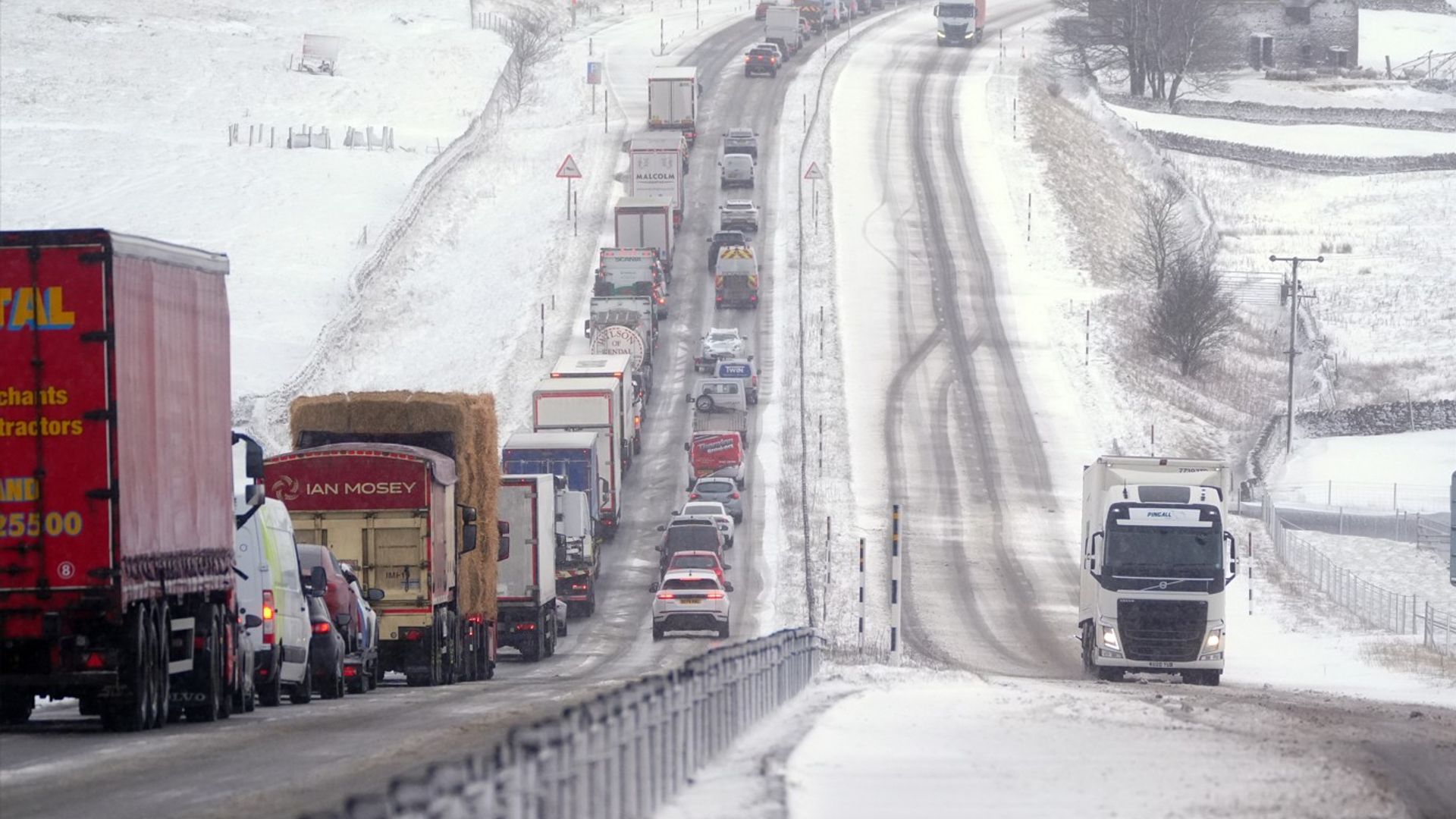
Wet snow lands on asphalt that was dampened by rain just hours earlier. As temperatures dip toward freezing around dawn—the exact hour when night-shift nurses are driving home and delivery drivers are starting their engines—that slush freezes from the bottom up. Beneath a deceptive layer of white fluff lies a sheet of clear, frictionless black ice. It coats power lines, adding hundreds of kilograms of dead weight to cables stretched across rural valleys. It clogs rail points on the East Coast Main Line and turns steep Pennine lanes into toboggan runs.
Britain does not lack gritters or snowplows; local authorities stockpile hundreds of thousands of tonnes of rock salt every autumn. The problem is economics and physics. Maintaining a permanent fleet of heavy snow-clearing machinery for storms that might happen three days a year makes little sense to cash-strapped councils. Even more critically, rock salt requires traffic to crush it into brine before it can melt ice effectively. When snow falls heavily before the morning rush hour begins, the salt lies inert beneath the white blanket, waiting for tires that are already spinning helplessly at the bottom of the hill.
Three Mornings Behind the Curtains
Consider a hypothetical morning across three different postcodes as a snow warning takes hold—a composite drawn from the thousands of quiet emergencies that unfold whenever the gritters fall behind.
In a semi-detached house outside Leeds, Sarah, a community midwife, is staring at her car keys on the kitchen table. Her shift starts at eight. The arterial road into the city has been treated, a dark ribbon of wet tarmac cutting through white fields, but the half-mile of residential cul-de-sacs between her driveway and that main road is untouched. She knows that if she leaves now, she might make it. She also knows that a single abandoned hatchback blocking the junction at the bottom of the hill will trap her for two hours, while a mother in active labor waits on the other side of town. For Sarah, the weather warning is not a meteorological curiosity; it is a math problem measured in minutes and traction.
Two hundred miles north, in a stone cottage in the Scottish Borders, sixty-eight-year-old Malcolm is checking the thermostat. When a snow warning coincides with dropping temperatures, the invisible threat is not on the roads—it is inside the walls. Energy costs have turned winter heating into a quiet rationing exercise for millions of households. Malcolm has laid rolled-up towels along the bottom of the hallway doors and confined himself to the front room with a single electric bar heater. When snow weighs down overhead lines in rural districts, the power cuts that follow are rarely measured in minutes. A fallen branch on a remote transformer can leave a village in darkness for twelve hours, turning a chilly morning into a medical hazard for anyone whose body struggles to regulate heat.
Meanwhile, in a distribution depot off the M6 in Staffordshire, a logistics coordinator named Tariq is watching red dots multiply across a digital map of the Midlands. Modern retail operates on just-in-time delivery; supermarket shelves hold barely forty-eight hours of fresh produce, and hospital pharmacies rely on daily van runs for temperature-sensitive medications. When a snow warning shuts down a single high-altitude stretch of motorway like the A66 across the Pennines or the M62 over Saddleworth Moor, the knock-on delays ripple southward by lunchtime. Bread doesn't arrive in Carlisle. Surgical dressings are delayed in Preston. The map looks calm, almost pretty, dusted in white—until you trace the supply lines straining underneath it.
Why the Warning System Feels Confusing
If you have ever looked at a Met Office weather map and wondered why a yellow warning seems to cover half the country while your own street has nothing more than cold rain, you are not alone. The color-coded system—yellow, amber, red—is frequently misunderstood because it does not measure how much snow will fall. It measures impact and likelihood.
A yellow warning is an alert to pay attention. It means meteorologists are confident that wintry weather will arrive, and that there is a genuine chance of localized disruption—delayed buses, slippery pavements, slower rail journeys—even if the worst conditions hit only a fraction of the highlighted zone. Because Britain's topography is so fractured, elevation changes everything. A shift of one hundred meters up a hillside can mean the difference between a soggy commute in four-degree drizzle and ten centimeters of drifting snow at minus one.
Amber warnings raise the stakes from "be aware" to "be prepared." They signal that severe disruption is likely: road closures, stranded vehicles, canceled trains, and potential interruptions to power and mobile phone coverage. Red warnings, reserved for the rarest and most dangerous events—like the 2018 anticyclonic freeze that Britain remembers as the Beast from the East—mean an immediate threat to life, an explicit instruction to stay indoors and abandon travel altogether.
The confusion arises because people naturally look out their own window to judge the accuracy of a regional forecast. If the grass in the valley is green, the warning feels like alarmism. Five miles away, on an exposed moorland road where crosswinds are whipping loose snow into two-foot drifts, drivers are abandoning their cars in zero visibility. Both realities exist inside the same yellow polygon.
The Human Habit of Underestimating Familiar Weather
There is a particular stubbornness in the British temperament when it comes to cold weather. Unlike regions where winter arrives with an unambiguous calendar deadline—where snow tires go on in October and stay on until April—Britain experiences winter as a series of brief, unpredictable ambushes. Because the snow rarely lasts more than a few days before an Atlantic front sweeps in to wash it away, we treat every snowfall as a temporary inconvenience rather than a structural shift in our environment.
We drive on summer tires engineered for wet grip at ten degrees, whose rubber compounds harden into something resembling hockey pucks once the mercury drops below seven. We wear smooth-soled leather shoes to the train station and walk with the same brisk, forward-leaning stride we use in July, forgetting that black ice punishes momentum. Emergency departments across the UK see a predictable spike in wrist fractures, hip injuries, and concussions every single time a morning frost catches commuters off guard—not during blizzards, when people stay home, but during those deceptive, bright mornings after a light overnight dusting when everyone assumes the worst has passed.
Historically, Britain's most disruptive winter events have rarely been the ones with the deepest snowdrifts. The notorious winter of 1962–63 buried villages for months, yet communities adapted because the freeze was continuous and undeniable. Far more treacherous are the volatile, borderline freezes—like the sudden snowfalls of December 2010 or the March cold snaps that catch spring commuters unprepared—when rain turns to ice within an hour, trapping thousands of motorists overnight on motorways because no one believed a morning flurry could bring a modern transport network to a standstill.
Navigating the Hours Ahead
When a snow warning is active this morning, surviving it gracefully has less to do with heroic preparation and more to do with small, deliberate adjustments to how you move through the day.
Before turning a key in the ignition, the most useful step is checking hyper-local conditions rather than national headlines. National Rail Enquiries, Traffic England, Traffic Scotland, and Traffic Wales update route-by-route blockages in real time, often revealing that a primary motorway is flowing smoothly while a single hillside feeder road has become impassable. If you must drive, leave far more space than feels natural—stopping distances on snow and ice can stretch up to ten times longer than on dry tarmac. High gears, gentle throttle inputs, and zero sudden braking keep tires gripping rather than sliding. And tossing a warm coat, a bottle of water, a phone charger, and a torch onto the back seat takes thirty seconds in the hallway, yet transforms a potential roadside crisis into a manageable wait if traffic grinds to a halt ahead of you.
For those staying closer to home, the quietest act of resilience is neighborly awareness. Checking in on an older resident whose garden path turns into an ice rink, clearing a narrow strip of pavement before the midday sun melts the top layer into afternoon black ice, or keeping a single living space warm at a steady eighteen degrees rather than letting the whole house chill down—these are the small, unglamorous habits that absorb the shock when a routine morning forecast turns serious.
By mid-afternoon, the sun may break through the cloud deck, turning the snow on south-facing roofs into steady drips along the guttering. Tomorrow, the gritters may sit idle in their depots again, and the yellow triangle will vanish from the weather apps. Yet out on the high passes, in the shaded lanes where the winter sun never quite reaches the tarmac, and behind the curtains of houses waiting for a nurse or a delivery van to climb the hill, that morning silence leaves its mark—a reminder of how thin the margin really is between an ordinary Tuesday and a world brought suddenly, completely, to a stop.