The smell hits you before the sound does.
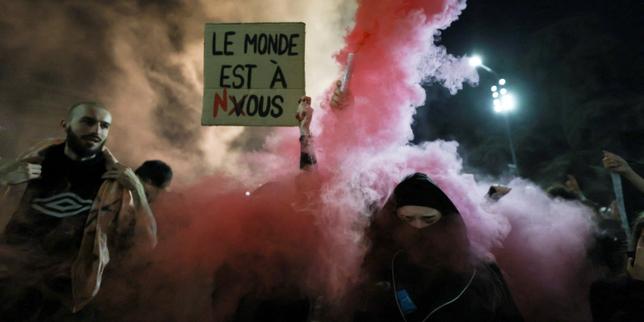
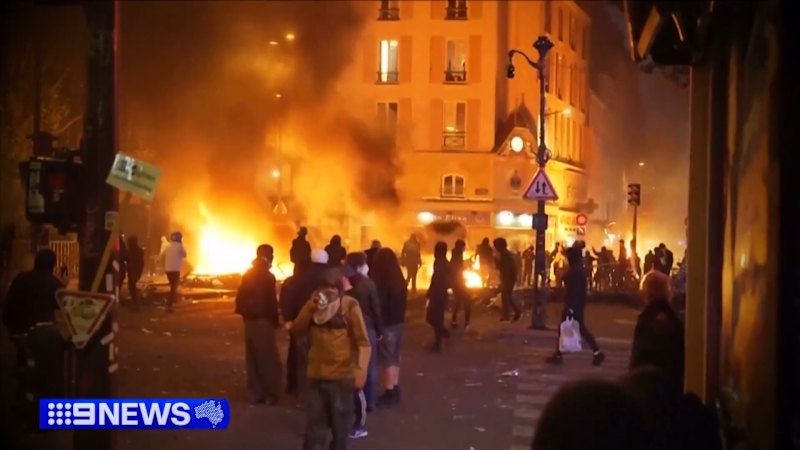
If you have ever stood three blocks downwind from a major Parisian boulevard at midnight, you know that tear gas does not smell like smoke. It smells like burnt pepper mixed with wet asphalt, a sharp chemical sting that grabs the back of your throat and forces your eyes to water before your brain even registers the shouting. Then comes the low, rhythmic thud of boots on cobblestones, followed by the metallic shatter of a bus shelter giving way, and finally, the wail of sirens bouncing off limestone facades built centuries before modern policing existed.
On morning news broadcasts across the globe, those chaotic hours get compressed into a tidy, digestible headline. Nearly 1,000 arrested as protests flare in France. It sounds clinical. It reads like a box score from a sporting event—a tally of broken windows, deployed officers, and handcuffs snapped shut before dawn.
Numbers, however, have a way of flattening human desperation into mere statistics. When a country arrests nearly a thousand of its own citizens in a single night of unrest, the story is never really about the arrests. It is about the invisible pressure cooker that finally blew its lid, the quiet humiliations that preceded the noise, and the ordinary lives caught between a furious street and an unyielding state.
The Anatomy of a Spark
To understand why French streets ignite with such sudden, terrifying velocity, you have to stop looking at the flames and start examining the dry kindling.
Consider a hypothetical composite character—let us call him Marc—a thirty-four-year-old delivery driver living in the banlieues, the sprawling, concrete-heavy suburbs ringing Paris. Marc is not an ideological revolutionary. He does not spend his weekends reading political manifestos or plotting civil disobedience. He spends them calculating whether the price of diesel and groceries will leave enough room in his bank account to buy his daughter new winter boots without dipping into his overdraft.
For months, maybe years, Marc absorbs the friction of modern economic and social life. He watches his commute grow longer while public transit tickets grow pricier. He sees local clinics close, school classrooms overcrowd, and political debates in the National Assembly sound increasingly like arguments happening on another planet. He feels the subtle, unspoken barrier every time he hands over his identification at a train station or applies for an apartment closer to the city center.
Psychologists and sociologists who study civil unrest often compare social tension to geological fault lines. Plates grind against each other silently for decades, building immense kinetic energy beneath the surface, completely invisible to anyone walking on the grass above. When an earthquake finally strikes, observers point to the exact second the ground shook, ignoring the twenty years of silent grinding that made the rupture inevitable.
In France, that spark might be a sudden legislative decree bypassing a parliamentary vote, a steep hike in retirement age, a spike in fuel taxes, or a tragic, fatal encounter between a young citizen and law enforcement. Whatever the immediate trigger, it acts like a match dropped into a room already thick with fumes. Marc does not wake up wanting to overturn a trash bin or scream at a wall of riot shields. He wakes up feeling that the social contract—the unspoken promise that if you work hard and follow the rules, society will protect your dignity—has been torn up in front of his face.
Inside the Kettle
Once the protests spill onto the avenues, the geography of the city changes entirely.
I remember walking through central Lyon after a night of heavy demonstrations a few years ago, stepping over melted plastic cones and blackened patches of pavement where pallets had burned. What struck me most was not the violence of the aftermath, but the eerie, fragile normalcy sitting right beside it. Two meters away from a shattered bank window, an elderly baker was calmly sweeping flour off his threshold, opening his doors at 6:00 AM just as he had done for forty years.
That juxtaposition defines the French protest experience. Most demonstrations begin in broad daylight with families, nurses, teachers, students, and retirees marching behind union banners, blowing whistles, sharing thermoses of coffee, and singing old anthems. There is an almost festive solidarity in those early hours, a collective exhale among strangers who realize they are not suffering alone.
Nightfall, however, brings a completely different choreography.
As the permitted marches disperse, smaller, faster, and far angrier groups emerge from the side streets. Some are black-bloc anarchists dressed identically to evade facial recognition; others are furious teenagers from marginalized neighborhoods who view the state not as a protector, but as an occupying force. Facing them are the Compagnies Républicaines de Sécurité—the CRS—France’s specialized riot police, clad in heavy black armor, carrying plexiglass shields and launchers loaded with sting-ball grenades and tear gas canisters.
Here is where the numbers climb toward a thousand.
To clear crowds rapidly, police frequently deploy a tactic known as "kettling"—encircling a square or a stretch of boulevard, sealing off every exit, and arresting everyone trapped inside the perimeter. If you are a twenty-year-old student who stayed ten minutes too late to film the crowd on your phone, you go into the back of a police van. If you are a veteran activist throwing cobblestones, you go into the van. If you are a bystander trying to find an open metro station to get home to your kids, you go into the van.
Inside those precincts, holding cells overflow within hours. Air grows stale. Phones are confiscated. Young people sit shoulder-to-shoulder on concrete benches for twenty-four or forty-eight hours, waiting for overworked prosecutors to decide whether they will be released without charge, handed a fine, or fast-tracked into an immediate court appearance.
Why France Burns Differently
Observers outside Europe often look at footage of burning cars in Paris or Marseille and ask a straightforward question. Why does this keep happening in France, and why does it escalate so quickly compared to neighboring countries?
The answer lies deep in the nation’s political DNA. Unlike nations built around consensus, compromise, and decentralized local power, modern France was forged through centralization and revolution. Since 1789, the street has never been viewed merely as a place for traffic; it is an unofficial fourth branch of government. When the presidency—an office vested with extraordinary executive authority under the Fifth Republic—pushes through unpopular policies without parliamentary consensus, citizens instinctively take to the avenues because they feel no other lever of power remains available to them.
At the same time, a troubling feedback loop has hardened over the past decade.
Think of an immune system that has become so hyper-reactive that every minor infection triggers a life-threatening fever. On one side, a population increasingly alienated from traditional unions and political parties expresses its rage without clear leaders or negotiable demands. Without leaders, there is no one for the government to sit across a table from and broker a truce. On the other side, a state determined to project absolute authority responds with massive police deployments, pre-emptive arrests, and aggressive crowd-control munitions that frequently injure peaceful protesters and journalists alongside violent rioters.
Every bruised protester radicalizes three friends. Every injured police officer—and hundreds suffer burns, fractures, and concussions during these flare-ups—hardens the resolve of the precincts. Both sides end the night convinced they are fighting for survival.
The Invisible Bill Nobody Counts
By the time the morning headlines announce the arrest tally, the political spin machine is already running at full speed.
Government ministers appear on morning television to condemn the "thugs" and praise the restraint of security forces, promising swift judicial punishment for anyone caught vandalizing public property. Opposition politicians take to the same airwaves to accuse the executive branch of authoritarianism, economic cruelty, and losing control of the republic.
Both narratives miss the quieter, heavier toll unfolding away from the cameras.
Consider a second hypothetical figure—let us call her Nadia—a forty-eight-year-old owner of a small dry-cleaning shop on a corner in Marseille. Nadia has no interest in political theater. She spent her life savings to buy her storefront, pays her taxes on time, and employs two young women from her neighborhood. When protests flare on her street, rioters smash her front display window—not out of personal malice toward Nadia, simply because glass breaks easily when anger needs an outlet.
The next morning, Nadia sweeps up the shards. Her insurance deductible will wipe out her profit margin for the next four months. Meanwhile, three blocks away, a nineteen-year-old apprentice mechanic named Lucas sits in a holding cell after being swept up in a police kettle while walking home from a friend's apartment. Even if a judge drops the charges tomorrow, the terror of that night—the zip-ties cutting into his wrists, the shouting in the dark, the mugshot—will permanently alter how he views the flag flying above his town hall.
We rarely measure the cost of civil unrest in lost trust, fractured neighborhoods, or the quiet trauma carried home by ordinary people. Yet those are the exact currencies a democracy spends every time it relies on riot shields to solve a political failure.
Beyond the Morning After
I admit that watching these cycles repeat year after year leaves a heavy sense of uncertainty. There is no simple policy switch a prime minister can flip to erase decades of economic stagnation in the suburbs, nor is there an easy way to police a crowd when thousands of people decide they have nothing left to lose. Anyone claiming to have a clean, painless solution to social fracture is selling fiction.
What remains undeniable, however, is that arrests are a symptom, never a cure. You can detain a thousand people on a Friday night, clear the boulevards by sunrise, scrub the graffiti off the limestone walls, and restore the commuter trains by Monday morning. From the window of a government ministry, the city looks calm again.
Down at street level, the air still smells faintly of burnt pepper. People walk past the boarded-up storefronts with their eyes fixed on the pavement, carrying their grievances back into their apartments, their workshops, and their classrooms, waiting quietly until the next time the pressure becomes too heavy to hold.