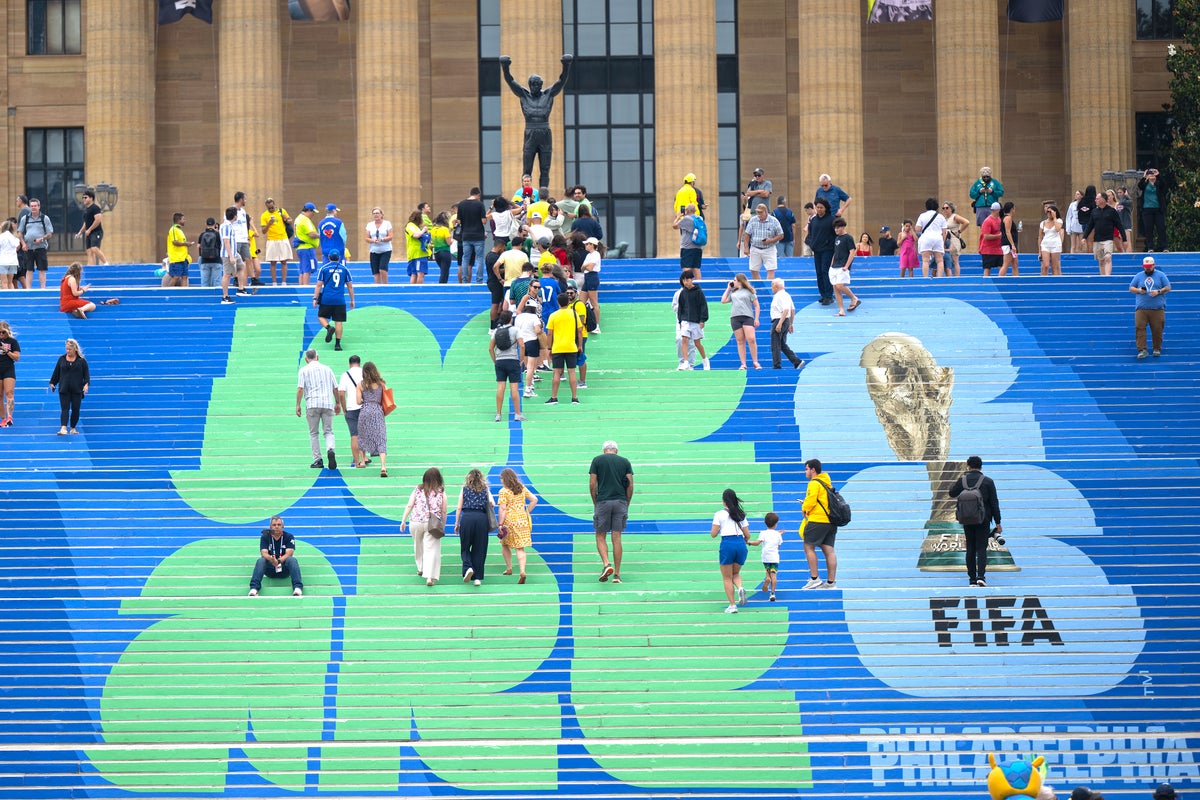
The air inside Lincoln Financial Field during a massive international match does not just rumble. It vibrates. It is a wall of sound built from fifty different dialects, laced with adrenaline, panic, joy, and confusion.
For a police officer standing on the concrete concourse outside the gates, that wall of sound can feel like a fortress.
Picture a warm summer evening. A frantic soccer fan from Buenos Aires separates from his young daughter in the crushing swarm of sixty thousand people moving toward the turnstiles. He does not speak English. He approaches a Philadelphia police officer, his chest heaving, words spilling out in a rapid, terrifying blur of Argentine Spanish.
The officer hears the terror. But she does not understand the words.
In that single, agonizing pocket of time, the distance between safety and disaster is measured not in miles, but in syntax. For decades, this has been the unseen nightmare of policing global events. The city opens its doors to the world, the world arrives with all its beautiful complexity, and the people charged with keeping the peace are left to rely on frantic hand gestures, bad translation apps on personal phones, or the desperate hope that a bilingual passerby will stop to help.
Something fundamental is changing on the streets of Philadelphia.
The High Cost of the Silenced Word
To understand why the Philadelphia Police Department is fundamentally altering its approach to communication, you have to look at the sheer scale of what is coming. The World Cup is not just a sporting event. It is a geopolitical shift that temporarily relocates whole populations into a single metropolitan area.
When hundreds of thousands of international visitors descend upon a city, standard municipal infrastructure strains. Most of those strains are visible. We see the packed trains, the crowded hotels, the long lines at restaurants. But the most dangerous strain happens in the quiet spaces between a public servant and a citizen.
Imagine the vulnerability of being in a foreign country, experiencing a medical crisis or a crime, and realizing that the person with the badge and the radio cannot comprehend your plea for help.
Historically, police departments have tried to bridge this gap with telephone-based translation services. An officer dials a hotline, waits for an operator, requests a specific language, and passes the phone back and forth. It works in a quiet room during a controlled interview. It fails utterly on a chaotic street corner when a crowd is surging and every second matters.
The reality of human panic demands immediacy. If a mother cannot explain that her child has an allergy or that someone stole her passport with her life-saving medication inside, the system breaks.
Moving Beyond the Screen
The solution being deployed on the streets of Philadelphia does not live on a phone screen. It lives on the officer’s chest.
The department is integrating real-time, artificial intelligence-driven translation software directly into standard-issue body-worn cameras. The technology is designed to detect and translate roughly fifty languages on the fly, turning a device that was originally built solely for accountability into an active tool for human connection.
Consider how the interaction changes.
The Argentine father approaches the officer. As he speaks, the camera on her vest captures the audio. Within seconds, a synthesized voice or a clear text display translates his frantic Spanish into English for the officer. When she responds in English, the camera broadcasts her instructions back to him in his native tongue.
The barrier vanishes. The panic recedes. The search for the child begins instantly.
This is not about tech-industry showmanship. It is about reducing the cognitive load on officers who are already operating under immense pressure. When you remove the frustration of a language barrier, you drastically lower the probability of a misunderstanding escalating into a use-of-force incident.
Fear looks a lot like non-compliance when you cannot understand the commands being shouted at you. A command to "stop" or "show me your hands" delivered to someone who only speaks Mandarin or Arabic is just terrifying noise. By translating those directives instantly, the technology protects the citizen from accidental escalation and protects the officer from making a catastrophic misjudgment.
The Friction of Trust
It is easy to get swept up in the magic of a device that speaks fifty languages. But anyone who has ever used an automated translator knows the stakes are incredibly high when precision matters.
A misplaced verb or a poorly translated idiom can change the entire meaning of an interaction. In legal terms, the difference between "I want to go" and "I need to leave" can be monumental.
The Philadelphia Police Department is deploying this system with a healthy dose of skepticism. The initial rollouts are focused heavily on high-traffic tourist zones, transit hubs, and the immediate perimeters of the stadiums. Officers are being trained to recognize the limitations of the software. It is a tool for immediate, tactical communication, not a replacement for certified human translators during formal legal proceedings.
There is also the question of cultural nuance. A word that means one thing in Mexico City might mean something entirely different in Madrid. The software must be intelligent enough to parse regional dialects and slang under the worst possible acoustic conditions—amid the blare of sirens, the roar of stadium horns, and the chant of thousands of fans.
Despite these uncertainties, the alternative is far riskier. The alternative is silence.
The Legacy of the Global Stage
When the final whistle blows and the crowds pack their bags to leave Pennsylvania, the true value of this experiment will begin to show.
Philadelphia is not a monoculture. It is a city of neighborhoods, many of which are home to vibrant immigrant communities where English is not the primary language spoken at home. From the Spanish-speaking corridors of North Philadelphia to the Vietnamese markets of South Philly, the language barrier is a daily reality, long before the World Cup ever selected its host cities.
The infrastructure being built for a month-long soccer tournament will remain on the uniforms of the officers who patrol these neighborhoods every single day.
The true victory of this technology will not be measured by how smoothly a tourist finds their way to a stadium gate. It will be measured months later, on a rainy Tuesday night, when a local resident can look an officer in the eye, speak their truth in their native tongue, and know without a doubt that they have been heard.


