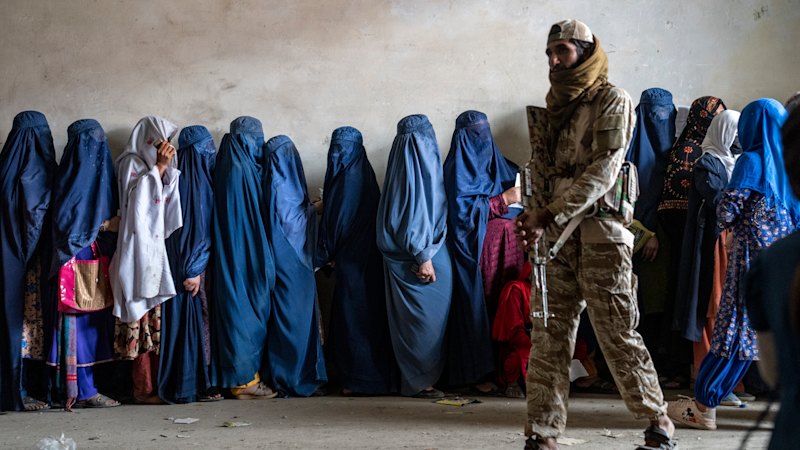
The hinge of a metal gate doesn't just swing; it screams. It is a high-pitched, rusting protest against the air, a sound that signifies the exact moment a world shrinks from the size of a city to the size of a courtyard. For the women in Kabul, that sound has become the rhythm of their lives.
Laila is not a real name, but the woman she represents is as real as the dust on the roadside. Three years ago, Laila was a law student. She spent her mornings arguing over the nuances of international jurisprudence and her afternoons drinking tea with friends, discussing a future that felt, if not easy, then at least possible. Today, Laila’s world is the four walls of her family’s kitchen and the narrow view from a window she is often afraid to look out of.
When we talk about "gender apartheid," the term feels clinical. It sounds like a white paper or a legal brief sitting on a mahogany desk in Geneva. But on the ground, it isn't a term. It’s a theft. It is the systematic removal of a human being from the public record. It is the slow, deliberate erasing of a face, a voice, and a soul from the collective memory of a nation.
The Anatomy of Disappearance
The process started with whispers and ended with decrees. First, it was the schools. The gates were locked "temporarily" for girls over the age of twelve. Then came the parks. Imagine a mother being told she cannot take her toddler to sit on a patch of grass because her presence is inherently provocative. Next, the gyms, the beauty salons, and the very right to work.
Consider the economic math of a household where the primary breadwinner is suddenly told her skills are illegal. In many Afghan homes, women were the doctors, the teachers, and the NGO workers keeping the gears of a shattered economy turning. When you remove 50% of the workforce, you aren't just enforcing a moral code; you are engineering a famine.
The hunger in Afghanistan right now is not just a food shortage. It is a policy. By banning women from working for international aid organizations, the authorities didn't just target women; they targeted the very mechanism of survival for millions of people. It is a calculated, slow-motion catastrophe where the most vulnerable—mothers and children—are the first to feel the weight of a dying currency.
The physical landscape has changed, too. In the vibrant markets of Kabul, the women used to be the color. Now, they are the shadows. They move in silence, wrapped in blue or black, eyes darting between the sidewalk and the horizon. A woman's voice in public is now a legal offense. To sing, to laugh, or even to speak above a certain decibel is to invite a lash or a lecture from a man who believes he is doing God’s work by silencing a person.
The Invisible Stakes
Why should a person living in London, or New York, or Sydney care about a closing door in Kabul? It’s a fair question, and one that many are asking as the news cycles move on to the next conflict. But the answer is written in the historical record of every society that has ever tried to segregate its humanity.
The systematic oppression of women in Afghanistan is a laboratory for global extremism. It is a proof of concept. If the world can watch a nation of 20 million women be stripped of their basic rights and do nothing but issue a few sternly worded press releases, then the precedent is set.
What happens in Kabul never stays in Kabul. It becomes the blueprint for any regime that wants to control its population by targeting the most fundamental unit of freedom: the individual’s right to exist in the public sphere. We are watching the trial run for a new kind of 21st-century tyranny, one that uses modern surveillance and traditional brutality to enforce a social hierarchy that should have died centuries ago.
The Resistance of a Whisper
Underground, the sound of the closing door is being challenged by the sound of a pen. In basements and backrooms, the schools that the state banned have simply moved. They are small, they are dangerous, and they are beautiful.
A former teacher, who we will call Malalai, runs one of these secret classrooms. She has twenty girls who arrive at different times, tucked into shawls, carrying groceries to hide their notebooks. If the authorities found them, the consequences would be severe.
Why do they risk it? Why does a fourteen-year-old girl risk a beating to learn the Pythagorean theorem or to read a poem by Rumi? Because education is the only thing that cannot be un-done. Once you know that the world is larger than your kitchen, you can never truly be trapped. The mind is the only territory that hasn't been fully occupied.
Malalai describes the atmosphere in her classroom as "electric." There is no boredom there. No one is checking their phone or wishing they were somewhere else. Every word spoken is an act of defiance. Every sentence written is a victory over a system that wants them to be illiterate and invisible.
The Mirror of Our Indifference
The tragedy isn't just what is happening in Afghanistan; it’s what isn't happening in the rest of the world. After the fall of Kabul in August 2021, the headlines were a scream. Now, they are a mumble. We have developed a collective fatigue, a "compassion exhaustion" that allows us to scroll past the images of starving children and veiled women as if they were just another data point in an unfortunate world.
This indifference is a form of complicity. When we stop talking about the women of Afghanistan, we give the regime what they want most: silence. They are betting that the international community will eventually get bored, that the trade deals and the geopolitics will eventually outweigh the human rights concerns, and that we will all just move on.
The reality is that "gender apartheid" is a term that needs a legal home. It needs to be recognized by the United Nations with the same gravity as racial apartheid. It isn't just a local cultural preference or a religious interpretation. It is a crime against humanity. To treat it as anything less is to insult every woman who has ever fought for the right to vote, to work, or to simply walk down the street without a chaperone.
The Cost of a Life
Laila, our law student, recently had a birthday. She turned twenty-four. In another world, she would be preparing for her bar exams or starting her first job at a firm. In this world, she spent the day teaching her younger sister how to bake bread.
She told me, in a voice that was both steady and heartbreaking, that the hardest part isn't the lack of food or the lack of light. It’s the lack of a tomorrow. "When I wake up," she said, "I have to find a reason to get out of bed. Because today will be exactly like yesterday, and tomorrow will be exactly like today. They haven't just taken my school; they have taken my time."
Time is the most valuable thing any of us has. To have years of your life stolen by a decree is a theft that can never be repaid. Every day that passes is another day of potential lost—a doctor who won't exist, a teacher who won't inspire, a leader who won't emerge.
The story of the women of Afghanistan is often framed as a story of victimhood. But that is a lazy interpretation. It is actually a story of incredible, quiet strength. It is a story of women who are holding their families together with nothing but grit and a few cups of flour. It is a story of girls who are learning to read by the light of a single candle while the world outside is shrouded in darkness.
The Sound of the Door Opening
One day, that metal gate will scream again. Only this time, it will be swinging the other way.
The history of the world is a long, messy, often bloody struggle between those who want to close doors and those who want to open them. No regime, no matter how brutal, has ever successfully erased the human desire for freedom. You can ban the books, you can burn the schools, and you can hide the women, but you cannot kill the idea that a human being has a right to their own life.
The question for us is not whether the women of Afghanistan will eventually find their way back into the light. The question is whether we will be there to meet them when they do, or if we will have spent the intervening years looking the other way.
The sound of a closing door is a warning to all of us. It is a reminder that rights are not a permanent gift; they are a constant struggle. If we forget the women of Kabul, we aren't just failing them. We are failing the very idea of a world where everyone, regardless of their gender, is allowed to breathe the open air and dream of a tomorrow that is different from today.
The light in Malalai’s basement is still flickering. The girls are still writing. The pen is still moving across the page, scratching out a future that the world says doesn't exist. It is a small sound, almost a whisper, but it is louder than any decree. It is the sound of a human being refusing to be erased.
Laila looks out her window at the mountains that ring the city. They are purple and jagged, indifferent to the laws of men. She remembers a line from a poem she learned in school, back when the gates were open. It said that the dawn doesn't ask for permission to break the night. It just does.
She closes her eyes and waits for the sun.
Would you like me to create a detailed timeline of the specific decrees issued against Afghan women since 2021 to help you understand the legal landscape of this situation?