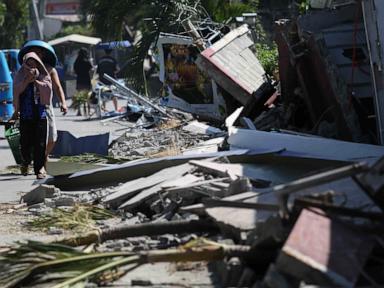
The silence that follows a major earthquake is never truly silent. It is a thick, heavy quiet, punctuated by the sound of shifting gravel, the drip of severed water pipes, and the low, collective murmur of a community realizing they are entirely on their own.
When the earth buckled across the mountainous province of Abra in the northern Philippines, the immediate terror lasted less than a minute. The ground shook, concrete cracked, and the ancient hills groaned. But the true crisis did not begin until the dust settled and the roads disappeared.
In the remote, upland villages of this region, survival is an intricate dance with geography. The mountains are breathtakingly beautiful, rising like jagged emerald walls against the sky. They are also brutal barriers. When landslides triggered by the tremor obliterated the narrow, winding dirt tracks connecting these isolated communities to the lowlands, they did not just move earth. They cut a lifeline.
Suddenly, hundreds of families were trapped in a vertical wilderness. No trucks could get up. No one could walk down without risking their lives on unstable, crumbling cliffs. The local markets were empty. The backyard gardens were buried under tons of rock.
Hunger does not wait for heavy machinery to clear a road. It begins as a quiet ache in the morning and grows into a desperate, hollow panic by nightfall.
The Isolation of the Uplands
To understand why a town mayor would frantically beg the national government for an immediate airlift of food, you have to understand the anatomy of a mountain village. These are not suburbs. These are ancestral lands where life is lived close to the soil.
Consider a father in one of these cut-off hamlets. Let us call him Eduardo—a name shared by many resilient men in these highlands. Eduardo survives on subsistence farming. He grows what he can, and every couple of weeks, he travels down the mountain to buy rice, sardines, and medicine.
The morning after the quake, Eduardo looked at his kitchen. Three cups of rice left. A single tin of fish. He has a wife and three children. The math of survival in a disaster is simple, cruel, and immediate. Three cups of rice do not stretch across a week of isolation.
He looked out at the only road leading to the town center. It was gone, replaced by a raw, brown scar where the mountainside had simply slid away.
This is the hidden face of natural disasters. The world watches the footage of collapsed buildings in the cities, but the slow-burning catastrophe happens where the cameras cannot go. It happens in places where the infrastructure was already fragile, where a single landslide can turn a thriving village into an island in the sky.
The Limits of Earthbound Relief
Down in the municipal halls, the local government leaders face a different kind of agony. They have the food. The warehouses in the lowlands are stocked with relief packs—bags filled with rice, canned goods, and clean water. The tragedy is not a lack of supply; it is a total failure of access.
Volunteers and local officials stood at the edge of the landslides, looking at boulders the size of houses blocking the mountain passes. Heavy excavators were deployed, but clearing roads in a disaster zone is a agonizingly slow process. Every time the earth aftershocks—and it does, repeatedly, a terrifying reminder of the unstable ground below—more rocks come tumbling down, erasing hours of clearing work in seconds.
The realization sets in quickly: the roads will take weeks to open. The people up there have days, maybe hours, before the hunger becomes critical.
When a small-town mayor makes the public, urgent plea for an airlift, it is an admission of human limitation. It is a declaration that the earth has won the first round, and the only way to save lives is to take to the air.
The Logistics of the Air Bridge
An airlift sounds simple on paper. You load a helicopter, you fly over the mountains, and you drop the food.
The reality is a high-stakes logistical nightmare. The weather in the Cordillera region is notoriously fickle. Clouds can roll in over the peaks within minutes, dropping visibility to zero and turning narrow valleys into death traps for pilots. Helicopters are expensive to run, complex to maintain, and limited in number.
Every flight is a calculation of weight, fuel, and time. How many bags of rice can a single chopper carry without compromising its ability to clear a 5,000-foot ridge? Where can it land? In many of these villages, there are no flat concrete pads. Pilots must hover inches above muddy school fields or clearings on a ridge, relying on local villagers to quickly unload the cargo while the rotors whip up a blinding storm of dust and debris.
But the real problem lies elsewhere. It is the agonizing process of prioritization. If you only have two helicopters and twenty isolated villages, who gets the first delivery? Do you fly to the furthest hamlet first, or the one with the highest population? Every choice means one community eats while another spends another night watching the horizon.
The Anatomy of an Emergency Plea
The urgent call for air support from the local leadership is more than just a bureaucratic request. It is a psychological tool. In the chaos of a national disaster, many regions compete for attention and resources. The capital is often hundreds of miles away, insulated from the immediate panic of a starving village.
By framing the situation as an impending hunger crisis rather than just a logistical delay, local leaders force the hand of central authorities. They change the narrative from "we are working on the roads" to "people are starving today."
It is a necessary friction. Without these vocal, desperate demands, remote areas are easily swallowed by the larger shadow of a national emergency. The squeaky wheel gets the rotor blades.
But even when the government responds, the gap between the promise of help and the sound of an engine overhead can feel like an eternity to those waiting on the ridges.
What Happens When the Helicopters Arrive
When the distant, rhythmic thumping of rotor blades finally echoes through the valleys, the atmosphere in an isolated village shifts instantly. It is a sound that translates directly to survival.
Villagers run toward the open spaces, waving bright cloths to guide the pilots. The dust kicks up, blinding and fierce, but no one turns away. The side doors slide open, and the green bags of government relief are passed down in a human chain.
There is no ceremony. The engine roars, the wind howls, and the anxiety that has tightly gripped the community for days suddenly eases, if only for a moment. They have rice for another week. They have clean water. They know they have not been forgotten by the world below.
Yet, as the helicopter lifts off, its nose dipping as it heads back toward the lowlands for another load, the dust settles back onto a sobering reality.
The airlift is a tourniquet. It stops the immediate bleeding of a hunger crisis, but it does not heal the wound. Below the hovering aircraft, the mountain remains fractured. The roads are still buried under tons of shale and earth. The fields are ruined, and the rainy season is looming on the horizon.
An airlift can sustain life, but it cannot rebuild it. As the sound of the engine fades into the distance, returning the mountains to that heavy, post-quake silence, the people of the highlands look down at their supplies and then up at the broken hills, knowing that the long, quiet work of truly returning home has barely even begun.


