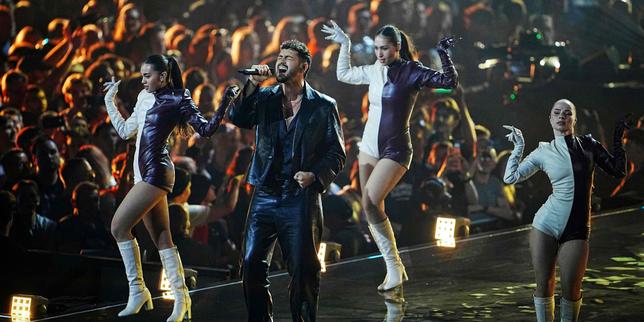
The air inside the Malmo Arena didn't smell like a song contest. It smelled like high-voltage ozone, floor wax, and the metallic tang of adrenaline. Above the stage, thousands of lights pulsed in a rhythmic, synthetic heartbeat, casting long, frantic shadows across a crowd that had come to forget the world outside. But the world outside has a way of screaming through the cracks, even when the music is at its loudest.
On that Thursday night during the second semi-final, the glitter was a mask. Security personnel stood like statues in the wings, their earpieces buzzing with the kind of chatter that doesn't happen during a routine pop performance. They weren't watching the pyrotechnics. They were watching the hands. They were watching the eyes.
When the Israeli delegation took the stage, the atmosphere shifted. It wasn't a slow fade; it was a sudden drop in pressure, the kind that precedes a massive storm. For a few minutes, the contest’s mantra of "United by Music" felt less like a promise and more like a fragile glass vase teetering on the edge of a marble pedestal.
Then, the movement started.
The Anatomy of a Disruptor
Imagine being one of the four. You aren't there for the melodies. You aren't there to judge the vocal range of a power ballad or the choreography of a synth-pop routine. You have a different script. In your pocket, or perhaps hidden beneath a jacket, is a symbol—a piece of fabric, a sign, a physical manifestation of a conviction that the bright lights of the Eurovision stage are a distraction from a darker reality.
As the performance reached its crescendo, these four individuals rose. It wasn't a coordinated ballet, but a jagged, desperate attempt to pierce the bubble. One moment they were part of the anonymous mass of fans; the next, they were outliers. They were the friction in the machine.
Security moved with a clinical, practiced efficiency. There was no hesitation. In the world of live broadcasting, where seconds are worth millions and reputations are built on the illusion of seamlessness, a disruptor is a glitch to be deleted. Within moments, the four protestors were intercepted. The struggle was brief, muffled by the sheer volume of the sound system, but for those standing nearby, the illusion of the "song contest" vanished.
They were not just escorted out. They were expelled.
The Invisible Perimeter
The EBU (European Broadcasting Union) operates on a philosophy of strict neutrality, a policy that often feels like trying to hold back the tide with a plastic shovel. Their rules are clear: the Eurovision stage is a non-political zone. No flags other than those of participating nations and the rainbow flag are permitted. No political gestures. No statements.
But how do you define the border between art and the world that creates it?
For the organizers, the expulsion of the four individuals was a matter of safety and contract. When you buy a ticket to Eurovision, you are entering a private space with specific terms of engagement. You are agreeing to be part of the broadcast, a pixel in a grand, colorful image of continental unity. When you break that agreement, you lose your seat.
Yet, the removal of those four people didn't end the protest. It merely moved it. As they were led through the tunnels of the arena and out into the cool Swedish night, the silence they left behind in their seats was louder than any shout. It was a reminder that even in a temple of pop music, the echoes of distant conflicts are never truly silenced. They are just managed.
The Weight of the Lights
Consider the perspective of the performer on stage. You are standing in the center of a literal sun, blinded by spots, focused entirely on the pitch of your voice and the placement of your feet. You know the tension exists. You felt it during the rehearsals. You heard the boos during the soundcheck, muffled but unmistakable. You are a lightning rod for a storm you didn't start, representing a nation in a contest that claims to be about songs but is always, inevitably, about identity.
The four people in the crowd saw the performer as a symbol. The security saw the protestors as a breach. The cameras, meanwhile, saw nothing. The broadcast stayed steady. The wide shots focused on the waving flags of approved colors. The audio mix favored the backing track.
This is the curated reality of modern entertainment. We have become masters at cropping the frame to remove the parts of the picture that make us uncomfortable. But the edges of that frame are fraying.
The expulsion of the four protestors wasn't just a security footnote; it was a microcosm of our current era. It was the clash between the desire for a collective, joyful experience and the individual's refusal to let the world look away. It was a battle over who gets to own the narrative of a three-minute song.
The Aftermath in the Dark
Outside the arena, Malmo was a city under watch. Thousands of police officers, some brought in from as far away as Denmark and Norway, patrolled the streets. Snipers sat on rooftops. Helicopters beat a rhythmic tattoo in the sky. It was the most heavily guarded musical event in the history of the region.
The four individuals who were removed disappeared into this larger machinery. Their names didn't make the headlines, only their actions. They became a statistic—a brief mention in a security report, a "disturbance" that was "handled."
But the tension didn't leave with them. It stayed in the lobby. It sat in the press center. It lingered in the green room where artists from dozens of countries sat in sequins, wondering if the "United by Music" slogan was a bridge or a barricade.
We often talk about Eurovision as a "campy" or "frivolous" event, a relic of a post-war dream that Europe could sing its way to peace. We laugh at the over-the-top costumes and the occasional off-key note. But when you strip away the glitter, you find something much more raw. You find a place where we try to negotiate our differences through the medium of a chorus and a bridge, and when that negotiation fails, we fall back on the old ways. Walls. Security. Expulsions.
The four protestors were a crack in the glass. You can sweep up the shards, and you can replace the pane, but everyone who was in the room knows the glass is gone.
The lights eventually went down. The crowds drifted away toward the train stations and the hotels, their ears ringing with the remnants of a dozen different hooks. The stage was swept. The ozone smell faded. But as the trucks packed away the wires and the LED screens, the question remained, hanging in the air like the smoke from a spent firework.
If the music is loud enough, can we really claim we didn't hear the shouting? Or are we just getting better at pretending the silence is the song?