Smoke Over the Boulevard
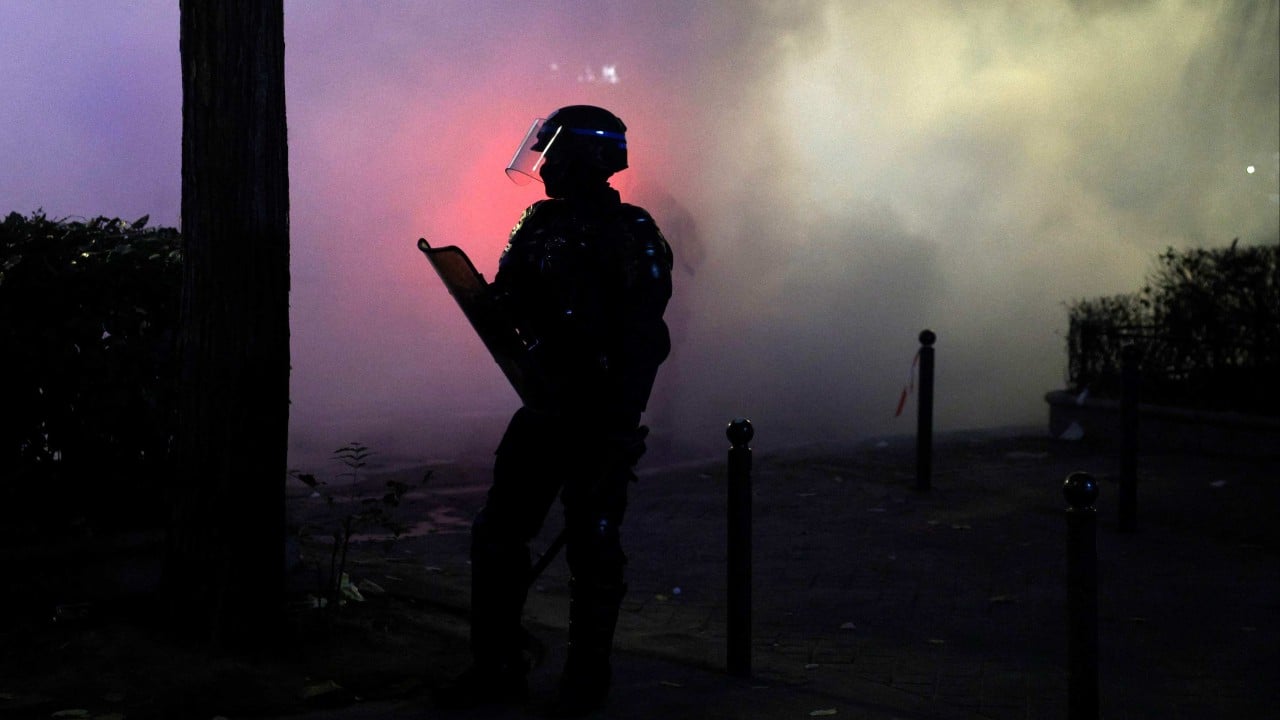
Tear gas does not drop in silence. It arrives with a hard, metallic crack that bounces off the limestone facades of Haussmann-era apartments, followed instantly by a hiss like water hitting a white-hot skillet.
Then comes the sting. First in the eyes, a sudden, blinding heat that turns the grand avenues of Paris into a watercolor smudge. Then in the back of the throat, sour and metallic, stripping away breath until instinct takes over and the crowd surges backward.
On the paved streets surrounding the Place de la République, thousands of people learned that sound again today.
To read the international press wires is to consume a mechanical accounting of friction: police counts, turnout estimates, broken windows, the precise number of canister deployments, and a list of detained protestors. But numbers are cold ledger entries for a burning city. They reduce the fracture of a society to a routine statistical update.
What is actually happening in France is not merely a clash between riot armor and cobblestones. It is a fundamental breakdown in the implicit social contract between the state and the people who keep its gears turning.
The Chemistry of Discontent
To understand why a routine march devolves into burning trash barricades, you have to look past the violent fringes and focus on the hands holding the cardboard signs.
Consider a hypothetical mid-level transit worker—let us call him Antoine. He is forty-eight years old, his knees sound like gravel when he climbs the stairs to his third-floor apartment, and he has spent twenty-six years navigating the underground veins of the Paris Metro. For decades, the bargain was clear: modest pay in exchange for security, dignity, and a predictable horizon. You give your youth to the city, and the city grants you your twilight years.
When that horizon suddenly moves back by two years—or when inflation quietly erases the margin of your monthly wage—it does not feel like an abstract fiscal adjustment devised by economists in Saint-Germain. It feels like theft.
That is the hidden stake of the current protests. When citizens take to the streets, they are not fighting over a line item in a government ledger. They are fighting over time. They are fighting over the quiet promise that hard work retains its value in a world that feels increasingly volatile.
The tear gas clears for a moment, revealing a cross-section of the French working class: nurses in blue scrubs, teachers holding handwritten banners, unionized dockworkers alongside university students who have never held a full-time job but already dread the architecture of the modern workplace.
How the Streets Become a Stage
Protest in Paris is not an anomaly; it is an institution, refined over two centuries of political theater. The geography of the city is designed for it. The wide boulevards, carved out in the nineteenth century partly to prevent citizens from barricading narrow medieval alleys, have paradoxically become the world's most famous amphitheaters for public rage.
Here is how a afternoon of protest actually unfolds.
It starts almost like a festival. By noon, the air near the marching head smells of grilled merguez sausages from union food carts, tobacco smoke, and cheap beer. Brass bands play jazz standards. Old friends greet each other with double-cheek kisses while clutching rolled-up banners.
Then the energy shifts.
The movement slows as the column reaches a police perimeter. You feel the change in your chest before you see it. The noise of the crowd tightens, losing its chaotic warmth and sharpening into rhythmic chants. On the flanks, figures dressed in dark clothing—the blocs—move to the front, carrying makeshift shields.
A projectile arcs through the grey air. A trash bin is tipped and set ablaze. The black smoke rises against the elegant grey slate roofs of the capital.
And then comes the response.
The heavy boots of the Compagnies Républicaines de Sécurité (CRS) hit the pavement in unison. Shield to shield, visor down, they advance through the haze. The collision is violent, sudden, and terrifyingly efficient.
The Distance Between the Elysee and the Street
The central tragedy of French political life has always been the immense distance between those who govern and those who are governed. The French presidency is often described as a republican monarchy, gifted with executive powers that can bypass parliament when political gridlock threatens the executive's agenda.
When a government uses constitutional mechanisms to force through unpopular reforms without a parliamentary vote, it may win the legal argument, but it loses the emotional one.
Citizens feel erased. And when people feel erased in the voting booth, they seek visibility on the asphalt.
The violence that erupts at the end of these marches is easy to condemn. It is destructive, frightening, and often harms the very small business owners who are struggling under the same economic pressures as the protestors. A smashed storefront on the Boulevard Voltaire does not rebuild a social safety net; it simply leaves a local shopkeeper with an uninsured loss and a board over their window.
Yet focusing exclusively on the broken glass misses the larger pattern. The glass breaks because the pressure inside the container has surpassed what the structure can hold.
Beyond the Barricades
As twilight settles over Paris, the rain begins to fall, washing the blue chemical residue off the sidewalks and into the gutters. The sirens retreat into the distance. Cleaning crews in bright green vests move in with power washers and brooms, sweeping up shattered glass, melted plastic, and abandoned placards before the morning rush hour.
By morning, the cafes will reopen. Customers will sip their espresso at tiny round tables, stepping around the scorched patches on the pavement as if they were nothing more than autumn leaves.
Paris is adept at erasing the marks of its own fury.
But the wash of the rain cannot clean the invisible ledger. The anger does not dissipate when the smoke clears; it simply settles deeper into the marrow of the city, waiting for the next spark, the next bill, the next crack of a canister on the cold stone.