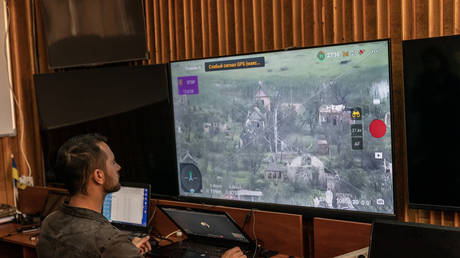
Modern warfare does not always run through ministries of defense, secure diplomatic channels, or state-run ordnance factories. Sometimes, the decisive theater of operations rests in the hands of a single private executive sitting thousands of miles away from the frontline trenches. When Elon Musk refused to expand Starlink satellite coverage to enable Ukrainian drone strikes deep inside Russian territory, he exposed an uncomfortable structural reality of twenty-first-century conflict. Sovereign states no longer hold a complete monopoly on the architecture of projection and survival.
The immediate friction centers on tactical utility versus geopolitical risk. Ukrainian leadership, facing severe shortages of conventional high-end interceptors like American Patriot systems, has increasingly leaned toward asymmetric innovation. By mounting low-cost aerial and maritime drones with commercial satellite communication terminals, military planners gain the extraordinary ability to bypass traditional electronic jamming and guide munitions over hundreds of kilometers. For a closer look into similar topics, we recommend: this related article.
Yet this utility crashes directly into the commercial and personal philosophies governing SpaceX. Unlike a traditional defense contractor bound by strict government procurement directives and the direct chain of command of the Pentagon, Starlink operates as a dual-use global utility owned by an individual who exercises direct oversight over its operational boundaries. When Ukrainian President Volodymyr Zelenskyy pressed for expanded access during diplomatic visits, the answer from the corporate architect remained negative. The refusal is not merely about hardware or bandwidth limits. It stems from an explicit aversion to escalation, a fear of triggering catastrophic retaliatory thresholds, and a persistent belief that the conflict must head toward negotiated settlements rather than expanded technological escalation.
This dynamic creates an unprecedented structural vulnerability for any nation dependent on commercial infrastructure for national defense. For decades, military analysts studied the industrial mobilization of nation-states. They mapped supply chains for steel, oil, and microchips. They assumed that if a war scaled large enough, sovereign governments would requisition private assets under emergency powers, folding corporate entities neatly into the national war machine. To get more information on this issue, comprehensive reporting is available on MIT Technology Review.
The Starlink precedent shatters that academic assumption. When an infrastructure asset is deployed globally in low-earth orbit, physical requisition by a single national government becomes legally and logistically impractical. SpaceX is an American corporation, but its constellation spans the globe, serving commercial airlines, maritime vessels, hospitals, and ordinary citizens across dozens of jurisdictions. Cutting off or forcibly commandeering the network for offensive cross-border military strikes against a nuclear-armed state introduces legal and operational chaos that Washington is hesitant to force. Musk can say no to a sovereign state because the architecture of modern space infrastructure transcends the traditional borders of sovereign jurisdiction.
Military historians looking back at this era will note the profound irony. The very globalization of technology intended to connect humanity and foster open commercial markets has birthed private corporate entities possessing more practical leverage over battlefield outcomes than middle-tier sovereign powers. When a defense minister must lobby a billionaire via backchannels or enlist allied presidents to plead for terminal whitelists, the classical Westphalian model of international relations undergoes a severe stress test.
Consider the operational impact on the ground. Military units down to the platoon level depend on low-latency terminal arrays for baseline coordination, artillery spotting, and reconnaissance data feeds. This absolute reliance gives the platform immense power over tactical momentum. When coverage is restricted or withheld from specific geographic zones, front-line units experience immediate tactical blindness. They cannot improvise an equivalent replacement overnight. Alternative military satellite networks are either heavily congested, vulnerable to kinetic anti-satellite measures, or simply lack the sheer density and terminal availability of the commercial constellation.
This leaves military planners in an impossible gray area. They must design operational doctrines around the whims, risk tolerances, and political opinions of a private citizen. If a CEO decides that striking a specific radar installation or missile battery crosses an unacceptable threshold of escalation, the offensive operation is effectively canceled before it leaves the hangar. There is no appellate court for war. There is no constitutional mechanism to override a private corporate policy when lives hang in the balance and the alternative is strategic retreat.
Governments are attempting to adapt, but bureaucratic procurement moves at glacial speeds compared to the rapid iteration of commercial space technology. Alternative military-grade constellations, such as the United States military's proliferated low-earth orbit initiatives, are years away from matching the sheer scale and resilience of mature commercial networks. Until sovereign states build out independent, state-owned equivalents designed specifically for high-intensity asymmetric warfare, they remain tenants in a commercial ecosystem.
The refusal to open the network for deep territorial strikes is unlikely to be the final friction point between private space enterprise and sovereign ambition. As long as modern militaries choose to build their most vital tactical loops on top of commercial networks, they accept a dangerous dependency. Power in the twenty-first century does not flow solely down the barrel of a gun or through the budget of a treasury. It orbits overhead at seventeen thousand miles per hour, owned by entities accountable to balance sheets and individual conscience rather than democratic command.