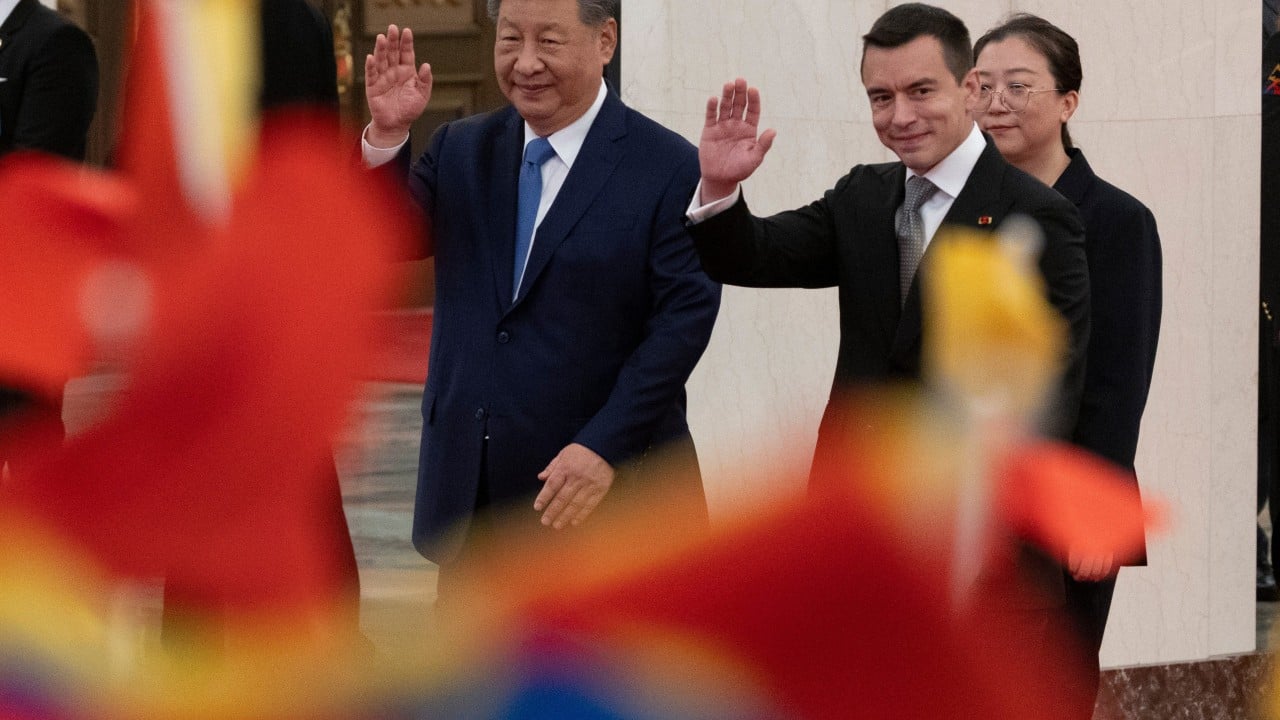
Geopolitical alignment rarely happens in a vacuum of pure diplomacy. When Chinese President Xi Jinping met with Ecuadorian President Daniel Noboa in Beijing, the diplomatic discourse centered on Latin America as a protected zone of peace. Beneath standard diplomatic phrasing lies a complex economic and strategic calculus. The bilateral trade volume, sitting at approximately $17.33 billion, serves as the financial anchor for a much broader institutional realignment. To understand why this meeting matters, one must deconstruct the structural mechanics driving Chinese statecraft and Andean foreign policy within an increasingly polarized global economy.
The Tripartite Framework of Transpacific Statecraft
Beijing approaches its relationship with Quito through three distinct operational vectors: infrastructural integration, resource extraction, and multilateral insulation. Each vector addresses specific constraints faced by both governments.
- Infrastructural Integration: Long-term capital deployment via the Belt and Road Initiative embeds Chinese engineering firms directly into domestic supply chains, transforming raw transit corridors into predictable export channels.
- Resource Extraction: Energy and mining investments secure essential commodities for industrial consumption in Asia while providing immediate foreign exchange reserves to stabilize Ecuador's domestic fiscal balance.
- Multilateral Insulation: Diplomatic signaling regarding regional autonomy provides smaller economies with an alternative counterweight against Western financial conditionality and security demands.
This architecture shifts traditional dependency models. Rather than relying solely on legacy multilateral lenders headquartered in Washington, developing economies now operate within a dual-track financial system. This transition alters the bargaining power of sovereign states during debt renegotiations and trade negotiations alike.
The Economic Cost Function of Sovereign Diversification
For Quito, managing foreign policy requires navigating acute domestic security crises alongside severe fiscal constraints. President Noboa's administration faces the dual pressure of combating organized crime syndicates domestically while maintaining macroeconomic stability. Accepting foreign security assistance from Western partners—such as status-of-forces agreements and joint naval operations—creates friction with Beijing's strategic doctrine, which views militarized regional footprints with acute suspicion.
To offset this friction, the state visit yielded signed cooperation documents spanning the digital economy, green industries, and sustainable infrastructure. This represents a calculated trade-off. By anchoring economic diversification in Chinese technological and industrial ecosystems, Ecuador maintains policy space. However, this strategy introduces long-term structural dependencies. The cost function of this alignment involves locking domestic digital and energy infrastructure into proprietary standards that are difficult to unwind once implemented.
Geopolitical Friction Points and Non-Interference Doctrine
When Xi warned against outside interference and the disruption of Latin America's status as a zone of peace, the message targeted extra-hemispheric security pressures. Traditional powers have long treated the Western Hemisphere through an exclusionary strategic lens. Beijing's counter-strategy relies on the principle of non-interference as a marketing tool for commercial expansion.
This creates a structural paradox for nations like Ecuador. On one hand, Quito requires external security partnerships to neutralize domestic internal threats. On the other hand, Quito relies on non-conditional capital from Beijing to fund public works and maintain export revenues. Balancing these competing vectors requires institutional dexterity. When external security demands clash with commercial partnerships, sovereign states absorb diplomatic fallout from both sides.
Strategic Execution and Operational Horizon
Navigating dual-hegemonic pull requires a disciplined policy approach for emerging economies caught in great-power competition.
- Audit all critical infrastructure contracts to isolate telecommunications and energy grids from single-source vulnerabilities.
- Enforce strict local-content and environmental transfer requirements on foreign mining concessions to capture domestic value-add rather than raw commodity rents.
- Maintain institutional transparency in bilateral debt restructuring to prevent asymmetric default penalties during macroeconomic downturns.
/https://i.s3.glbimg.com/v1/AUTH_59edd422c0c84a879bd37670ae4f538a/internal_photos/bs/2025/r/d/qLf9ppQoCgPRfYpZ7dwA/54880379716-8dbc544fe0-k.jpg)