The Spatial Audio Bottleneck in Combat Aviation An Operational and Cognitive Breakdown
Modern military aviation operates under an acute cognitive deficit. While visual displays have evolved from analog dials to heads-up displays (HUDs) and helmet-mounted symbology, the auditory channel of a combat pilot remains trapped in a monaural, flat-plane architecture. A U.S. Army helicopter crew operating in a high-threat environment processes simultaneous inputs—missile warning systems, air traffic control, ground command, and inter-cockpit comms—through a single, flattened audio stream. This design forces the brain to rely entirely on cognitive filtering to separate critical data from background noise.
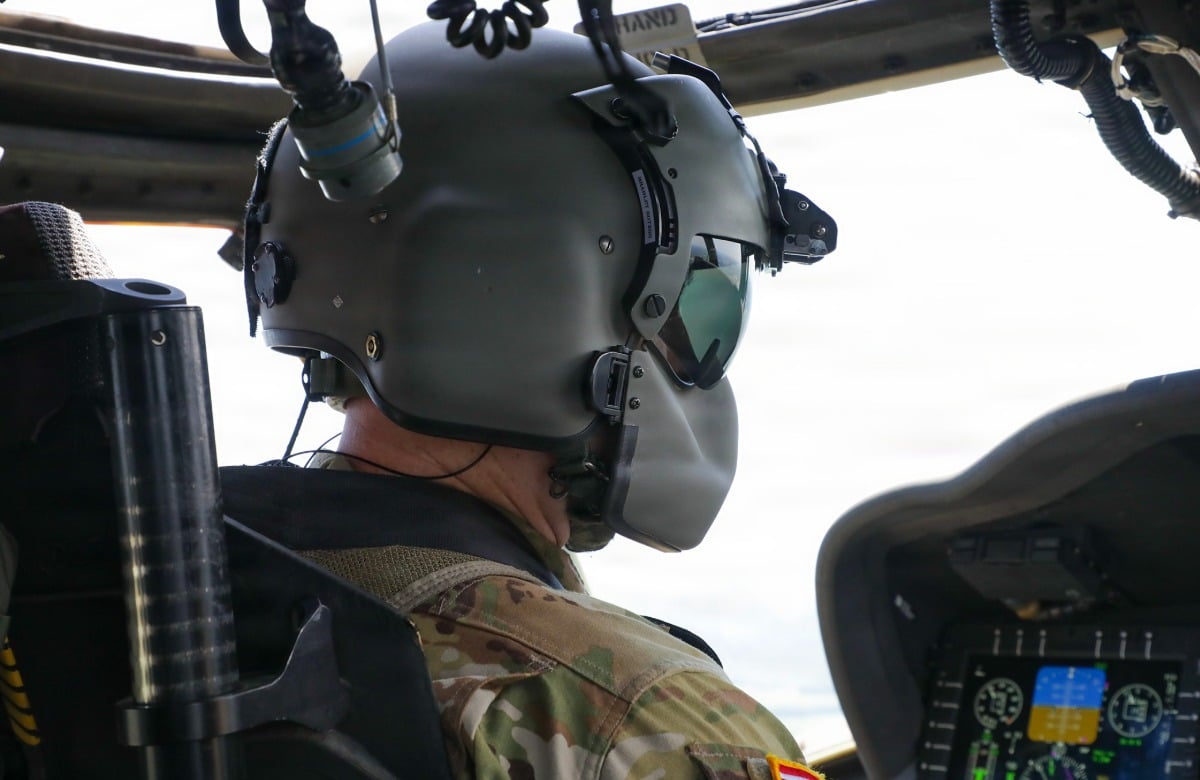
The implementation of 3D spatial audio by the U.S. Army is not an incremental comfort upgrade; it is a fundamental reconfiguration of human-machine interface (HMI) bandwidth. By mapping sound to specific three-dimensional coordinates in a pilot’s headset, this technology addresses a critical failure point in tactical situational awareness. To understand its impact requires breaking down the human auditory system, the physics of sound localization, and the operational constraints of the modern cockpit. Don't miss our earlier post on this related article.
The Three Pillars of Auditory Localization
To replicate a 3D battlespace in a standard military flight helmet, engineering systems must manipulate the three primary cues the human brain uses to determine the origin of a sound.
Interaural Time Difference (ITD)
The physical distance between human ears introduces a time delay when a sound originates from one side of the body. If a surface-to-air missile radar locks onto a helicopter from the front-right quadrant, the sound pressure wave reaches the right ear fractions of a millisecond before the left. The brain calculates this microsecond delta to instantly plot an azimuthal angle. If you want more about the background of this, Ars Technica offers an excellent breakdown.
Interaural Intensity Difference (IID)
The human head acts as an acoustic shadow for high-frequency sounds. A audio alert coming from the left will sound louder in the left ear because the acoustic energy is attenuated by the mass of the skull before reaching the right ear. This amplitude differential allows the central nervous system to confirm the directional vector established by the ITD.
Head-Related Transfer Function (HRTF)
The complex geometry of the outer ear (pinna), head, and torso alters the frequency spectrum of incoming sound waves. These physical structures filter the audio based on its angle of elevation and approach. HRTF is the mathematical formulation of this filtering process, allowing a pilot to distinguish whether a threat is above, below, behind, or in front of the aircraft.
Conventional cockpit audio strips away ITD, IID, and HRTF, delivering all warnings and radio traffic directly to the center of the pilot's skull. Spatial audio algorithms reconstitute these three pillars digitally in real-time, fooling the brain into perceiving a highly accurate, spherical audio field.
The Cognitive Cost Function of Monaural Flight Operations
When multiple audio signals are multiplexed into a single channel, the pilot's brain must execute continuous auditory scene analysis. The mental workload required to isolate a specific voice or warning signal can be quantified as a drain on total cognitive capacity.
Total Cognitive Capacity = Flight Control + Tactical Decision Making + Auditory Filtering Cost
When Auditory Filtering Cost spikes—such as during a multi-threat engagement—the capacity remaining for flight control and tactical decision-making drops dangerously. This phenomenon manifests in several distinct operational failure modes.
Change Blindness and Auditory Tunneling
In high-stress environments, the human brain naturally narrows its focus to the channel it perceives as most critical. If a pilot is overwhelmed by a chaotic, multi-party radio conversation on a flat channel, they frequently suffer from auditory tunneling. They may completely fail to register a critical system failure tone or a automated missile alert because the brain lacks the structural cues needed to prioritize the warning sound over the voice traffic.
The Cocktail Party Effect Failure
In civilian environments, humans can focus on a single conversation in a noisy room by using spatial separation; you listen to the person standing to your left while tuning out the person on your right. In a standard military cockpit, this natural mechanism is disabled. Because every radio channel and warning system occupies the exact same acoustic space, the pilot must decode the language of multiple overlapping speakers purely through pitch and cadence. This increases the time required to process a message and drastically escalates the probability of missed or misinterpreted commands.
Architectural Mapping of 3D Audio Integration
Integrating spatial audio into an existing military airframe requires more than swapping a headset. It demands a tightly coupled loop between onboard sensors, flight computers, and the pilot's survival equipment.
[Threat Sensors / Comm Radios]
             │
             ▼
[Aircraft Data Bus / Mission Computer] ──► [Inertial Spatial Mapping]
             │                                         │
             ▼                                         ▼
[Digital Audio Engine] ◄───────────────────────────────┘
             │
             ▼
[Headset Driver Transducers]
The system relies on a continuous loop of spatial orientation data:
- Sensors and Telemetry: Onboard survival equipment detects an incoming radar tracking signal or an incoming projectile. Simultaneously, tactical data links track the positions of wingmen and friendly ground units.
- Inertial Spatial Mapping: A magnetic or optical head-tracking sensor mounted on the pilot’s helmet continuously measures head orientation relative to the aircraft chassis.
- Dynamic HRTF Processing: The mission computer combines the absolute vector of the external threat with the real-time position of the pilot's head. If a threat is at 90 degrees relative to the aircraft, but the pilot turns their head 45 degrees to the right to look out the window, the digital audio engine instantly recalculates the HRTF, shifting the audio warning 45 degrees to the left of the pilot's current gaze.
- Transducer Output: The processed audio is delivered via high-fidelity, noise-attenuating helmet speakers, providing an immediate, intuitive directional cue.
Operational Impact and Quantifiable Benefits
Shifting from flat audio to a spatial matrix yields measurable performance gains across three primary vectors: reaction latency, spatial orientation, and cognitive fatigue.
Reaction Latency Reduction
In a traditional cockpit, when a missile warning sounds, the pilot must glance at a threat warning receiver (TWR) display, locate the visual strobe, interpret the angle, and then execute an evasive maneuver. This serial processing chain takes valuable seconds. Spatial audio converts this into a parallel processing chain. The sound comes from the exact direction of the threat, initiating an immediate, subconscious physical reaction to orient the aircraft or deploy countermeasures before the visual confirmation is even processed.
Spatial Disorientation Mitigation
Spatial disorientation remains a leading cause of controlled flight into terrain (CFIT), particularly in degraded visual environments (DVE) like brownouts or whiteouts. By anchoring audio cues to the earth rather than the airframe, spatial audio can provide an auditory artificial horizon. If a pilot loses visual reference during a landing, a rhythmic spatial tone anchored to the ground plane can immediately signal a dangerous bank angle or drifting trajectory without requiring the pilot to look down at their instruments.
Radio Channel Differentiation
Military operations frequently utilize separate radio nets for internal crew coordination, joint air-ground operations, and command-and-control. Spatial audio permits the separation of these nets into distinct physical sectors around the pilot's head.
- Internal crew communications can be positioned at the 12 o'clock position (dead ahead).
- Tactical air-ground command can be mapped to the 9 o'clock position (left).
- Wingman-to-wingman traffic can be placed at the 3 o'clock position (right).
This structural distribution allows pilots to monitor multiple frequencies simultaneously with minimal interference, drastically improving command-and-control efficiency during high-tempo operations.
Engineering Limitations and Systemic Vulneracies
While the benefits of spatialized audio are pronounced, implementation introduces complex technical constraints and physiological points of failure that must be engineered out of the deployment path.
The Generalized vs. Individualized HRTF Dilemma
The exact way a human ear distorts sound waves is as unique as a fingerprint. For optimal 3D audio precision, every pilot would require an individualized HRTF profile created by placing microphones inside their ear canals and measuring acoustic sweeps in an anechoic chamber.
Because mass military deployment makes individual profiling logistically impossible, systems must rely on a generalized HRTF model based on statistical averages. This compromise creates localization errors, particularly front-back confusion, where a pilot cannot immediately determine if a sound originates directly ahead or directly behind them.
Latency and Spatial Drift
The human brain is incredibly sensitive to mismatches between visual and auditory inputs. If the head-tracking sensor or the audio processing engine introduces a latency greater than 30 to 50 milliseconds, the sound will lag behind the pilot's physical head movements. This latency causes a phenomenon akin to motion sickness, inducing nausea, spatial disorientation, and cognitive dissonance, which completely invalidates the safety benefits of the system.
Ambient Cockpit Noise Interference
Helicopter cockpits are environments characterized by extreme low-frequency acoustic energy from rotor blades, transmissions, and engine exhaust. This high ambient noise floor can mask the subtle high-frequency cues embedded in an HRTF algorithm, particularly those responsible for elevation perception. Advanced active noise cancellation (ANC) must be integrated directly into the flight helmet shell for the spatialized audio cues to remain perceptible under operational conditions.
Tactical Implementation Matrix
The deployment of 3D audio requires clear operational rules defining how different data types are mapped within the pilot's auditory sphere. High-priority survival data must take precedence over routine communication data to prevent acoustic saturation.
| Priority Level | Audio Data Type | Spatial Mapping Rule | Audio Characteristics |
|---|---|---|---|
| Priority 1: Critical | Missile Warnings, Proximity Alerts, Ground Proximity Warning System (GPWS) | Exact geometric vector of threat origin, dynamically updated with head movement. | High-amplitude, pulsed frequency tones that cut through all voice traffic. |
| Priority 2: Tactical | Intra-flight Comm (Wingmen), Tactical Data Link Warnings | Sector-mapped based on relative position of the friendly unit or target zone. | High-fidelity voice, spatially isolated to the left or right hemispheres. |
| Priority 3: Operational | Air Traffic Control, Command and Control (C2) Net | Fixed virtual location (e.g., permanently docked at 10 o'clock or 2 o'clock). | Standard voice bandwidth, lower amplitude relative to Priority 1 and 2. |
| Priority 4: Internal | Intercom (Crew-to-Crew) | Centered or localized to the actual position of the crew member in the airframe. | Unfiltered, natural acoustic profile to maintain immediate proximity awareness. |
Strategic Implementation Framework
For aviation commanders and procurement officers looking to integrate spatial audio into existing or next-generation fleets, execution must bypass the trap of viewing this as an isolated electronics upgrade. The system must be treated as a core component of the aircraft's defensive survivability suite.
The initial phase requires upgrading the core mission computer's digital signal processing (DSP) architecture. Adding spatial audio algorithms to an overloaded, legacy data bus will cause the system latency to exceed the critical 30-millisecond threshold, rendering it unusable. Hardware procurement must prioritize low-latency, dedicated audio processing units capable of handling multiple high-bandwidth radio streams and sensor feeds concurrently.
Flight training curricula must be updated in parallel. Pilots who have spent thousands of hours conditioning themselves to look at visual displays for threat validation must be retrained to trust their auditory instincts. This requires extensive simulator integration where visual cues are completely removed, forcing pilots to execute evasive maneuvers and threat identification solely through spatialized audio triggers. Only when this sensory cross-training is complete will the true reduction in reaction latency be realized in live combat operations.