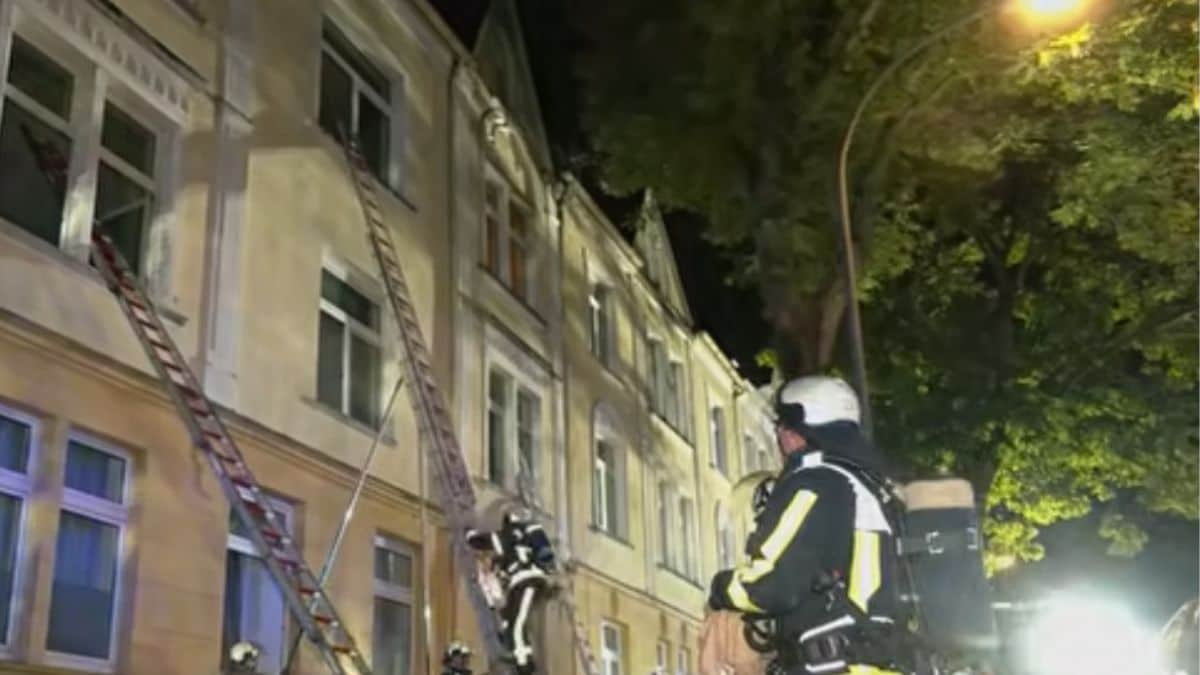
Standard breaking-news dispatches on the October 2026 Bochum residential fire report a fatal tally—three young Indian nationals dead, five injured, a 41-year-old resident arrested on suspicion of murder—yet treat the building's geometry and the victims' housing context as incidental background details. Treating a multi-fatality residential fire as a simple headcount plus a suspect arrest misses the exact structural and operational mechanisms that turned an early-morning ignition into a lethal trap. When a vertical circulation shaft fails under thermal and smoke load while occupants are asleep on an upper floor, survival ceases to be a matter of individual alertness and becomes a race against fire dynamics, egress bottlenecks, and exterior rescue capacity.
Deconstructing Competitor Logic and Structural Blind Spots
Wire-service reports on the incident follow a predictable chronological template: time of alert, casualty count, rescue equipment deployed, police suspicion of arson or murder, and diplomatic outreach. That structure establishes basic accountability, yet it leaves three analytical gaps that obscure why this specific incident produced three deaths in a single second-floor unit while five other occupants survived with smoke-inhalation injuries.
First, standard reports list rescue tools—two people rescued via turntable ladder, two via portable ladders, one via a safety cushion—without connecting those numbers to compartmentation failure. A safety cushion or aerial ladder is an emergency fallback, not a baseline exit path; its deployment signals that primary interior egress was already compromised or blocked by heat and smoke. Second, early dispatches note that victims' names and home states were initially withheld, then later reports identify three young students from Kerala—Sivin Johny, Nova Sabu, and Sheela Joy—assisted by Indian missions in Berlin and Frankfurt. Grouping young international students in multi-family housing carries distinct socioeconomic and housing-market dynamics that flat wire copy never examines. Third, wire reports mention that investigators suspected arson, ruled out a technical defect, and detained a 41-year-old building resident on suspicion of murder, yet they do not separate confirmed investigative actions from unproven criminal liability.
To analyze this event with rigor, the facts must be sorted into two tiers:
- Verified facts: The fire occurred in a multi-family residential building in Bochum's Hofstede district in North Rhine-Westphalia, with emergency services alerted around 4:15 a.m. local time on Tuesday, October 13, 2026. Three Indian nationals—two women aged 25 and 27 and a 26-year-old man, identified in subsequent reporting as students from Kerala—were found dead in a second-floor apartment. Five other people were hospitalized for smoke inhalation, five were rescued using a turntable ladder, portable ladders, and a safety cushion, the wooden stairwell was destroyed, investigators ruled out a technical defect while probing suspected arson, a 41-year-old resident was arrested on suspicion of murder, and Indian diplomatic missions engaged with families and authorities.
- Educated hypotheses and open questions: Why the second-floor apartment suffered three fatalities while five other residents were rescued likely reflects an interaction between early-morning sleep onset, vertical flame and smoke spread through the compromised stairwell, and differential proximity to exterior rescue access. Specific prosecutorial evidence, exact point of origin inside the building, and whether any apartment entry doors or smoke alarms slowed or accelerated smoke migration remain subject to ongoing German criminal and fire-safety investigation.
The Four Failure Modes of Vertical Egress in Multi-Family Fires
In multi-family residential buildings, survival during a nocturnal fire depends on keeping three variables decoupled: fuel load, vertical smoke transport, and horizontal-to-vertical egress time. When those variables couple early in an incident, occupant exposure spikes sharply.
1. Stairwell Integrity and the Stack Effect
A residential stairwell acts as both primary evacuation route and a vertical chimney. Fire science describes the stack effect as buoyant hot gases rising through vertical shafts, drawing cooler replacement air at lower levels and driving smoke, carbon monoxide, and radiant heat into upper stories. Reports from Bochum indicate that the wooden stairwell was completely destroyed and that fire spreading upward through the stairwell hampered firefighters reaching upper floors. Once a single shared stairwell loses structural or smoke-containment integrity, interior escape from upper levels collapses, forcing occupants toward windows or balconies where exterior rescue reach becomes the limiting factor.
2. Nocturnal Detection Lag and Smoke Toxicity
An alarm triggered around 4:15 a.m. hits during deep sleep cycles, when arousal thresholds are elevated and decision-making time is compressed. In residential fires, toxic combustion gases—especially carbon monoxide and irritants—typically incapacitate occupants well before flames enter a room of refuge. Five other residents required hospitalization for smoke inhalation, demonstrating that hazardous combustion products spread beyond the immediate fire zone.
3. Exterior Rescue Bottlenecks
Fire departments operate under a hard physical constraint: ladder reach, apparatus positioning in urban streets, and sequential rescue cycles. Rescuing five people via a combination of a turntable ladder, portable ladders, and a safety cushion shows active exterior intervention, yet every exterior rescue takes time and depends on clear facade access and window geometry. If an upper-floor apartment lacks direct exterior rescue reach or occupants are already overcome by smoke before a ladder reaches the sill, exterior apparatus cannot offset lost interior egress.
4. Criminal Ignition Versus Accidental Fault
Investigators reportedly ruled out a technical defect, pursued a suspected arson inquiry, and arrested a 41-year-old resident on suspicion of murder. From a risk-engineering standpoint, intentional ignition alters timeline dynamics because accelerants or deliberate placement can bypass early-stage smolder and accelerate rapid fire growth near key choke points such as entryways or stair bases. Legally, however, an arrest on suspicion of murder marks an investigative threshold rather than a verdict; guilt, intent, and causation must still be established in court.
Student Housing Economics and Cross-Border Crisis Friction
The human profile of the victims—young adults in their mid-twenties studying abroad from Kerala—points to a second operational layer that standard news briefs rarely unpack: the structural trade-offs faced by international students in tight European housing markets.
International students typically operate with tight budgets, limited local family support networks, and high sensitivity to rent levels and lease flexibility. In university-adjacent cities across Germany, affordable shared or multi-family units frequently sit in older housing stock that may feature timber framing, shared stairwells, or older compartmentalization standards compared with newly constructed student residences. That is not an accusation of code violation at the Bochum property—building compliance is a matter for German authorities—but a structural explanation of why young foreign students disproportionately cluster in older, lower-cost multi-family buildings where fire-load and egress risks can be higher.
When a fatal incident strikes foreign students, response complexity also multiplies across jurisdictions:
- Identity and family notification lag: Confirming identities, verifying next of kin across continents, and notifying families before unverified details circulate create early information friction.
- Consular and legal coordination: Missions such as the Indian Embassy in Berlin and the Consulate General in Frankfurt must coordinate simultaneously with local police, prosecutors, hospitals, and grieving families while respecting ongoing criminal investigations.
- Repatriation and administrative overhead: Moving mortal remains across borders involves forensic clearance, documentation, travel logistics, and financial coordination at a moment of acute family shock.
Operational Playbook for Reducing Multi-Family Fire Exposure
No single safety measure eliminates every risk in a multi-family building, particularly in cases involving suspected arson. Smoke detectors can fail or be disarmed, older buildings face physical constraints on retrofitting fire-rated stair enclosures, and criminal acts can overwhelm standard passive protections. Even with those limitations, disciplined operational habits materially improve survival odds for students and residents in shared buildings.
- Map two exit paths on day one. Upon moving into any multi-family building, identify the primary stairwell, check whether a second staircase exists, and verify which windows can be opened quickly for exterior rescue or temporary fresh air if the hallway fills with smoke.
- Treat stairwell smoke as a hard stop. If opening an apartment door reveals heavy smoke or heat in the corridor or stairwell, close the door immediately, seal gaps around the frame with wet towels or fabric if available, move to a room with an exterior window, and signal emergency responders rather than entering a smoke-logged shaft.
- Audit room-level detection and clutter. Confirm working smoke alarms in sleeping and living areas, test them regularly, and keep hallways, foyers, and shared landings free of bikes, storage boxes, or combustible clutter that can fuel fire or block movement.
- Maintain a cross-border readiness packet. Students living abroad should keep digital and physical copies of passport data pages, local address details, university emergency contacts, consular numbers, and family next-of-kin contacts easily accessible to trusted peers so response teams are not delayed during an emergency.
Strategic Action for University Housing and Consular Networks
Universities hosting international cohorts and diplomatic consular networks should establish a joint pre-incident housing and crisis-response protocol before the next academic intake, pairing practical fire-safety onboarding for newly arrived students with a standardized rapid-response checklist connecting local emergency services, student housing offices, and consular officers.
Three Keralam Natives Killed in Apartment Fire in Germany, Victims Identified
This video directly covers the Bochum apartment fire tragedy and identifies the three Indian victims from Kerala, providing relevant context alongside the structural analysis above.