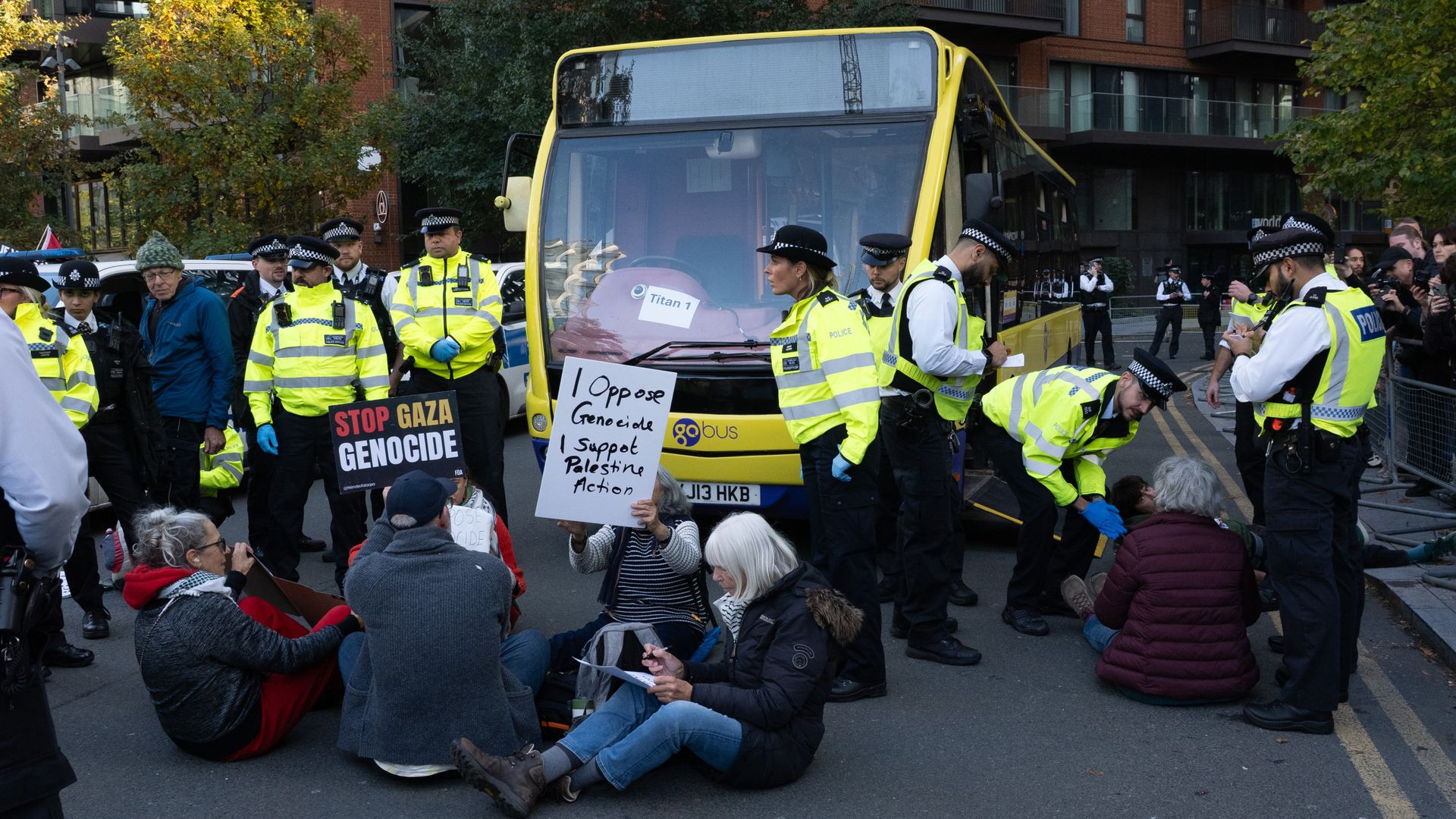
Mass arrests at demonstrations supporting Palestine Action illustrate the immediate operational collision between UK counterterrorism legislation and domestic protest policing. When the state designates a direct-action network as a proscribed organization under the Terrorism Act 2000, the legal threshold for criminal liability shifts from physical property damage to passive verbal or visual endorsement. Understanding these mass detention events requires examining the statutory triggers of proscription, the tactical execution of public order containment, and the downstream friction placed on courts and civil liberties frameworks.
The Statutory Mechanism of Proscription
Under Part II of the UK Terrorism Act 2000, the Home Secretary holds the authority to proscribe an organization if they reasonably believe it is "concerned in terrorism." Historically, UK governments applied this designation to armed insurgent groups, paramilitary factions, and transnational militant networks. Extending or debating the application of this framework to domestic direct-action groups—organizations like Palestine Action that primarily target defense manufacturing facilities, supply chains, and corporate offices through property damage, blockades, and occupations—alters the enforcement calculus for frontline police officers.
Once an entity is added to Schedule 2 of the Terrorism Act 2000, Sections 11, 12, and 13 create strict-liability or near-strict-liability offenses that do not require proof of violent intent or material contribution to an attack:
- Membership and Affiliation (Section 11): Belonging or professing to belong to a proscribed organization becomes a criminal offense carrying a maximum sentence of up to 14 years imprisonment.
- Inviting Support (Section 12): Expressing an opinion or belief that is supportive of a proscribed organization, while being reckless as to whether a person to whom the expression is directed will be encouraged to support it, triggers arrestable liability.
- Uniform and Display of Articles (Section 13): Wearing an item of clothing or carrying, displaying, or publishing an article—such as a placard, banner, flag, or digital graphic—in such a way as to arouse reasonable suspicion that the individual is a member or supporter of a proscribed organization constitutes a summary offense.
In standard public order scenarios, police must establish specific criminal acts such as aggravated trespass, criminal damage, or obstruction of the highway. Under proscription protocols, the evidentiary burden drops to visual or auditory documentation of a prohibited symbol or slogan. A demonstrator holding a printed sign or chanting an explicit endorsement supplies the complete actus reus required for immediate detention.
Tactical Execution in Protest Environments
Standard news reporting often describes mass arrests at solidarity demonstrations simply as police "cracking down" on protesters. In practice, law enforcement commanders deploy a specific operational sequence designed to isolate speech-based offenses from broader crowd dynamics while minimizing physical escalation.
- Intelligence Gathering and Evidence Collection: Forward Intelligence Teams (FIT) and Evidence Gathering Teams (EGT) operate on the perimeter and within the crowd using high-definition body-worn video and handheld cameras. Their primary objective is linking specific individuals to specific placards or chants before intervention occurs, ensuring prosecutorial viability later.
- Public Warnings and Deterrence: Before initiating mass detentions, Public Order Commanders typically issue loud-hailer warnings or distribute leaflets informing the assembly that expressing support for a proscribed entity constitutes a criminal offense. This step establishes mens rea (knowledge or recklessness) and undercuts subsequent defense arguments regarding ignorance of the law.
- Targeted Extraction vs. Containment: When dozens of individuals simultaneously display prohibited messaging as an act of coordinated civil disobedience, police cannot rely on discreet snatch-squad extractions without risking crowd surges. Instead, commanders deploy Police Support Units (PSUs) to establish cordons—commonly referred to as containment or "kettling"—to compartmentalize the group, systematically process detainees, seize physical banners as exhibits, and transport individuals to custody suites across the metropolitan area.
This tactical shift creates a predictable resource bottleneck. Processing dozens of arrests under counterterrorism provisions requires specialized custody officers, Counter Terrorism Command (SO15) consultations, and extended detention reviews, pulling significant policing capacity away from routine municipal operations.
The Strategic Calculus of Civil Disobedience
From the perspective of protest organizers and participants, mass arrests under speech and display provisions are rarely an unintended consequence; they are frequently an intentional component of a broader political and legal strategy. Civil rights advocates, legal observers, and activists utilize coordinated non-violent defiance to test the boundaries of state power and force institutional friction.
Civil liberties organizations, including Liberty and Amnesty International, have repeatedly argued in public briefings and parliamentary submissions that applying counterterrorism statutes to direct-action protest networks conflates property damage and political disruption with lethal violence. Critics of the legislation contend that Sections 12 and 13 create a chilling effect on legitimate political discourse, as protesters and journalists struggle to determine where criticism of foreign policy or defense contractors ends and unlawful "reckless support" for a proscribed group begins.
Conversely, government ministers, national security officials, and defense industry representatives maintain that sustained, coordinated campaigns targeting critical defense infrastructure undermine national security and public safety. Proponents of robust enforcement argue that when an organization systematically uses intimidation, criminal damage, and operational disruption to coerce government policy or halt lawful manufacturing, traditional public order fines and community orders fail to deter repeat offenders. In this view, proscription and the resulting arrests of vocal supporters are necessary to dismantle the organization's fundraising, recruitment, and public legitimacy.
Downstream Friction in the Criminal Justice System
Arresting dozens of protesters in a single afternoon transfers the operational burden from the street to the Crown Prosecution Service (CPS) and the judiciary. Unlike routine public order offenses that can be resolved through fixed penalty notices or rapid magistrates' court hearings, offenses under the Terrorism Act 2000 carry severe statutory penalties and require specialized prosecutorial oversight, often involving the consent of the Director of Public Prosecutions (DPP) or the Attorney General.
This creates three distinct institutional pressures:
- Custody and Bail Administration: Detainees arrested on suspicion of terrorism-related offenses are typically held in dedicated counterterrorism custody suites rather than local police stations. Processing 30 to 50 individuals simultaneously saturates regional holding capacity, forcing police to release most suspects on conditional bail while digital devices and seized literature undergo forensic review.
- Evidentiary Thresholds at Trial: Prosecutors must prove beyond a reasonable doubt that a defendant's words or placards crossed the statutory line into encouraging support, rather than merely criticizing state policy or expressing solidarity with Palestinian civilians generally. Defense counsel routinely challenge these charges under Articles 10 (freedom of expression) and 11 (freedom of assembly) of the European Convention on Human Rights (ECHR), which are incorporated into UK domestic law via the Human Rights Act 1998.
- Jury Nullification and Acquittal Rates: In cases where charges escalate to the Crown Court, prosecutors face the historical reality that UK juries have occasionally acquitted direct-action protesters on moral or conscience grounds, even when the technical elements of property damage or public order offenses were established. While Terrorism Act offenses carry stricter judicial directions, high-profile trials generate sustained media coverage that amplifies the exact messaging the state sought to suppress.
The Limits of Enforcement as Deterrence
Relying on mass arrests for expressive offenses exposes a fundamental limitation in public order management: statutory escalation does not automatically produce behavioral compliance. When an activist movement adopts a decentralized, affinity-group structure, arresting visible supporters at a city-center rally does not degrade the operational capacity of autonomous cells executing direct actions elsewhere.
Furthermore, mass detentions alter the public narrative. A demonstration centered on foreign policy or defense procurement shifts instantly into a domestic debate over free speech, police overreach, and democratic norms. Law enforcement agencies find themselves expending substantial operational capital to police placards and slogans, while the underlying political grievance remains unresolved.
Operational Outlook for Protest Policing and Policy
As the UK government and law enforcement continue to navigate the intersection of direct-action protest and national security legislation, institutional friction will remain high unless clear operational boundaries are established. Policymakers and police leadership must separate violent extremism from disruptive political protest in both statutory language and street-level execution. For public order commanders, prioritizing targeted enforcement against specific, high-harm criminal acts—rather than sweeping detentions for passive expression—preserves police legitimacy, prevents custody bottlenecks, and avoids turning routine demonstrations into protracted constitutional battles over the limits of free speech.


