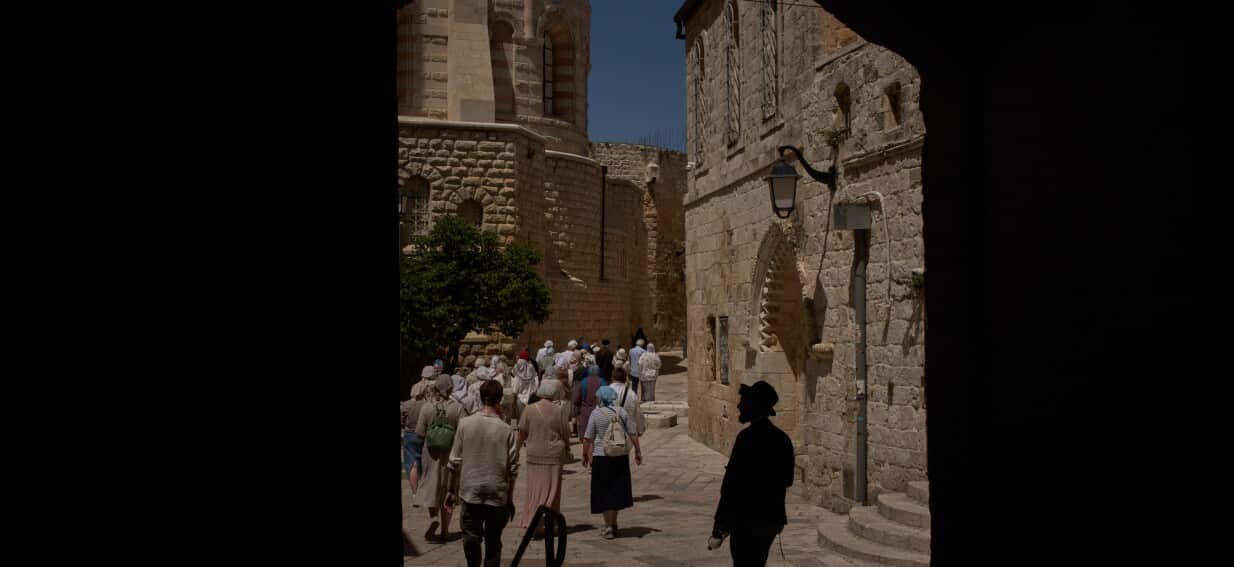
The limestone of Haifa glows a soft, deceptive gold when the sun begins its descent toward the Mediterranean. It is a city of layers, stacked steeply against Mount Carmel, where the air usually carries the salt of the sea and the hushed scent of jasmine. People here like to talk about coexistence as if it were a physical landmark—something you could point to, like the Baháʼí Gardens or the port. But for those who walk these streets in the garb of the sacred, that coexistence has started to feel like a thin pane of glass.
Sister Maria—a name we will use to represent the lived reality of many in her position—knows the weight of her habit. It is not just the heavy fabric or the starch of the veil. It is the way the world reacts to it. When she walks through the public squares of Israel, she is a walking target of history, theology, and, increasingly, a raw, unvarnished hatred that defies the city’s peaceful reputation.
The facts of the recent arrest are clinical. A man in his late 30s was taken into custody after an unprovoked attack on a nun in the northern city of Haifa. The police reports speak of physical assault and verbal abuse. They use words like "incident" and "apprehension." But these words are sterile. They do not capture the sound of a hand striking a woman who has sworn her life to peace. They do not describe the terrifying moment when a quiet street becomes a cage.
This was not an isolated flicker of madness. It is a pulse.
The Weight of the Invisible
Consider the daily ritual of a religious minority in a land where every square inch of soil is contested. You wake up. You pray for a world you hope to serve. You step outside, and you immediately begin a silent, subconscious scan of the faces passing by. Is that teenager looking at my cross with curiosity or contempt? Is that man’s stride too fast, his eyes too fixed?
For the Christian clergy in the Holy Land, the "worrying pattern" mentioned by officials is a lived soundtrack of spat-upon robes and whispered curses. In Jerusalem’s Old City, the act of spitting toward priests and nuns has become so frequent that it is almost rhythmic. In Haifa, a city that prides itself on being the "sane" alternative to the religious friction of Jerusalem, this recent attack felt like a breach of the final levee.
The stakes are not merely about a single arrest or a specific victim’s bruises. The stakes are the erasure of the other. When a man decides to strike a nun, he isn't seeing a person. He is seeing a symbol he wants to delete. He is participating in a regression where the "human" is stripped away, leaving only a caricature of an enemy.
A Geography of Friction
The geography of the Holy Land is unique because the spiritual and the secular don't just overlap—they collide. In most parts of the world, a religious habit is a sign of a specific vocation. In Israel, it is a geopolitical statement.
The attacker in Haifa likely didn't know his victim’s name. He didn't know her work with the poor or her years of quiet service in the community. To him, she was a landmark of a faith he deemed intrusive or offensive. This is the poisonous logic of the extremist: the belief that the presence of the different is a personal affront to the self.
Statistics tell us that attacks against Christians in Israel have spiked over the last two years. Vandalism at cemeteries, the disruption of processions, and physical harassment have moved from the fringes of the news cycle to the center. It is easy to blame "tensions." It is much harder to look at the systemic breakdown of empathy that allows a man to raise his hand against a woman of the church in broad daylight.
Behind the data lies a terrifying psychological shift. When a society begins to tolerate the "small" indignities—the spit on the sleeve, the shouted slur—it creates a permission structure for the "large" indignities. The man arrested in Haifa is the end result of a long chain of unchecked animosity. He is the physical manifestation of a thought that was allowed to grow in the dark: They don't belong here.
The Silence After the Scream
What happens after the police cars leave? The victim is left with a fractured sense of safety. The community is left with a deep, vibrating anxiety.
The Christian community in Israel is small, making up roughly 2% of the population. They are the "third party" in a dualistic struggle, often caught in the crossfire of a much larger nationalistic fire. When an attack like this happens, it sends a shiver through the parish halls and the convent kitchens. It whispers that the walls are closing in.
Imagine the conversation in the convent that night. There is no talk of "geopolitical shifts" or "macro-trends." There is only the shaking of tea into a cup and the quiet realization that the route to the market is no longer safe. There is the question of whether to wear the habit at all—a devastating choice between one’s identity and one’s survival.
The authorities often frame these events as the work of the "mentally unstable" or "isolated radicals." While that might be true in a clinical sense, it ignores the environment that directs that instability toward a specific target. Why nuns? Why now? Why Haifa?
The Architecture of Coexistence
True coexistence is not the absence of conflict. It is the presence of a shared humanity that is stronger than the urge to destroy.
In Haifa, the "Abbas" neighborhood and the German Colony have long been models of how people can live in the shadow of each other's steeples and minarets. But that architecture is built on a foundation of mutual respect that is currently being eroded by a broader, more aggressive form of exclusionism.
We see this elsewhere. We see it in the way minority groups are treated when a dominant culture feels threatened or emboldened. The nun in Haifa is a mirror. When we look at her, we see the vulnerability of anyone who dares to be different in a space that is demanding uniformity.
The arrest is a band-aid on a bullet wound. Locking up one man does not erase the ideology that put him on that street corner with a raised fist. The real work happens in the schools, in the synagogues, in the mosques, and in the Knesset. It happens when the leaders of a nation decide that the safety of a nun is just as paramount as the safety of a soldier.
Beyond the Headlines
The news cycle will move on. A new crisis will erupt, a new video will go viral, and the "man arrested in Haifa" will become a footnote in a police ledger.
But for the woman who felt the impact of his anger, the world has changed. The sun hitting the gold limestone will now always carry a shadow. The salt in the air will taste a little more like tears.
We often talk about the Holy Land as a place of miracles. Perhaps the greatest miracle we could ask for right now is the simplest one: the ability to walk down a street, dressed in the clothes of our convictions, and reach the other end without being broken.
The man is behind bars. The nun is back in her convent. But the street remains, long and winding and filled with the ghosts of what we are losing. The silence that follows the attack is not the silence of peace; it is the silence of a city holding its breath, waiting to see if the next footfall belongs to a neighbor or a predator.
The limestone continues to glow, but it is cold to the touch.