Every single time a rotorcraft kisses asphalt or collides with municipal infrastructure, the knee-jerk reaction from the media and the public follows a predictable, exhausted script. The headlines scream about death from above. Pundits who couldn't balance a lift equation demand immediate groundings. Activists dust off decades-old talking points about urban noise and aerial hazards, framing every flight as an ego trip for the wealthy or an unnecessary gamble with civilian lives.
It is lazy, emotional, and fundamentally wrong.
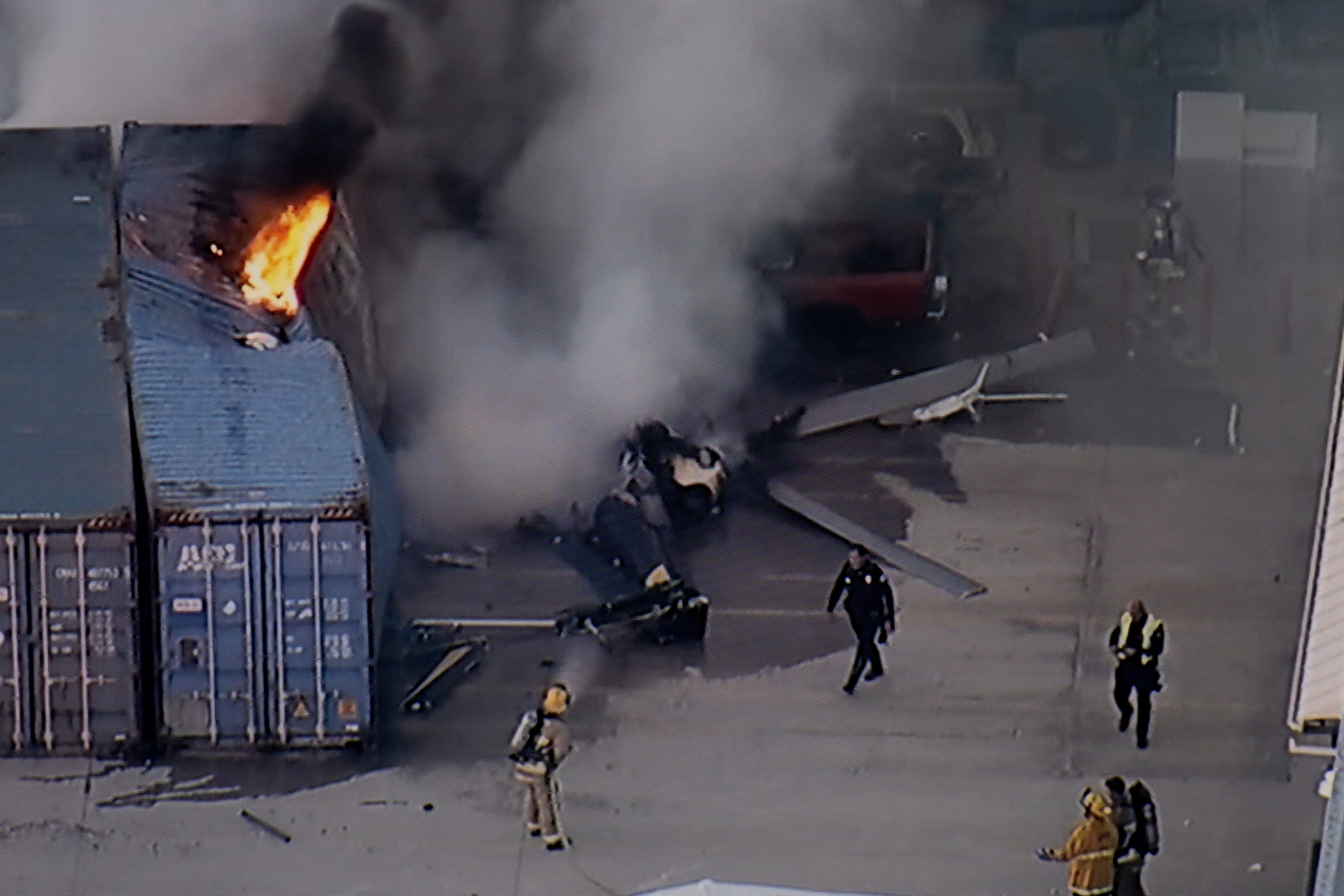
Let us look at the recent Los Angeles tragedy where a helicopter went down near a bus collision, claiming lives and sending shockwaves through local transit corridors. The immediate narrative pointed the finger straight up into the sky. Helicopters are dangerous, they said. Why are we letting them buzz over densely populated freeways?
The problem with this narrative is that it confuses a catastrophic routing intersection with an inherent mechanical or structural failure of vertical flight. If a semi-truck jackknifes on the interstate and takes out a minivan, we don't ban interstate trucking. We look at lane discipline, braking systems, traffic density, and driver error. Yet, the moment a helicopter intersects with a ground-level transit disaster, the entire rotor wing industry is hauled before the tribunal of public opinion.
Here is the contrarian truth that nobody in city planning wants to admit: ground-level transit is orders of magnitude more lethal per passenger mile than commercial or utility rotorcraft operations, yet we treat cars and buses as a baseline human right and helicopters as a reckless luxury.
The Safety Record Nobody Wants to Talk About
Let us clear up the data immediately. Total flight hours for civil helicopters in the United States run into the millions annually. When incidents happen, they are spectacular, fiery, and heavily televised, which warps human risk perception. We suffer from availability heuristic bias. A crash involving a fireball on a Los Angeles street corner burns itself into our collective memory far more deeply than the quiet, mundane daily slaughter of forty thousand people on American highways.
Statistically, general aviation and helicopter operations have tightened safety margins aggressively over the last three decades. The Federal Aviation Administration and private operators have poured capital into terrain awareness warning systems, synthetic vision, and mandatory safety management systems.
Yet, when a helicopter operates in a congested urban corridor like Los Angeles, it faces a unique matrix of environmental hazards that have almost nothing to do with the machine itself and everything to do with the chaotic ground environment below it.
Imagine a scenario where a transit bus loses control on a congested boulevard, swerves into a structural barrier, and creates an immediate crisis zone with compromised visibility, downed power lines, and unpredictable ground traffic behavior. Now introduce a low-altitude aircraft attempting to navigate that same airspace under compressed time constraints, dealing with wind shear bouncing off concrete high-rises, unmapped drone traffic, and blinding glare from asphalt.
Blaming the aircraft for the outcome of that collision is like blaming the ambulance for getting hit while speeding through a chaotic intersection.
The Anatomy of an Urban Transit Collision
To understand why these events happen, we have to strip away the sensationalism and look at how airspace and ground space interact in modern megacities. Los Angeles is not designed for multi-modal coordination. It is a sprawling grid of asphalt arteries choked with heavy vehicles, surrounded by vertical obstacles, and governed by legacy air traffic control protocols designed fifty years ago.
When a ground collision occurs between massive vehicles like buses and passenger cars, the kinetic energy dissipation is violent and immediate. It throws debris, shatters infrastructure, and creates localized atmospheric and visual chaos. Helicopters performing news gathering, medical evacuation, law enforcement, or commercial transit are frequently drawn to these exact zones because modern society demands real-time observation and rapid response.
We ask rotorcraft to fly straight into the eye of the chaos to cover the chaos, manage the chaos, or transport the victims of the chaos. Then, when the compounding risk factors trigger an accident, we act shocked that operating complex machinery in high-stress, low-altitude urban environments carries inherent danger.
The fault does not lie in the concept of vertical flight. The fault lies in our complete failure to integrate urban air mobility with modern ground infrastructure intelligence.
Dismantling the Ban-Happy Reflex
Every time a high-profile crash hits the news cycle, local politicians crawl out of the woodwork to propose flight restrictions, altitude caps, or outright bans on non-essential helicopter traffic over city centers. This is pure political theater.
Banning helicopters over Los Angeles or any other major metropolitan area would instantly paralyze critical urban functions. Think about what actually moves through that low-level airspace every single day. We are talking about organ transport, trauma response, police surveillance that intercepts suspects before they endanger neighborhoods, and emergency infrastructure assessment after earthquakes or fires.
If you eliminate urban rotorcraft operations because you are afraid of high-profile accidents, you trade a visible, low-probability risk for a massive, hidden certainty: longer response times for critical care, paralyzed emergency logistics, and an inability to manage disasters from the vantage point that matters most.
The critics want a sanitized city where nothing moves unless it has wheels on the ground. But ground transport is already choking on its own volume. Urban congestion is at an all-time high, transit systems are struggling with aging infrastructure, and surface streets are gridlocked. Surface mobility cannot scale horizontally anymore. The future requires vertical solutions, not a retreat into nineteenth-century planning.
What Actually Needs to Change
If we are going to fix the safety equation, we need to stop whining about the existence of helicopters and start upgrading the architecture of low-altitude urban transit.
First, we need automated, digital deconfliction for low-altitude airspace. Right now, pilots flying VFR through urban corridors are relying heavily on Mark One eyeball capability combined with fragmented radio calls, even as commercial drones, police units, news choppers, and private charters crowd the same sliver of sky. We need mandatory transponder density, real-time telemetry sharing, and geofenced corridors that keep different classes of traffic separated by design rather than by pilot vigilance alone.
Second, we need to overhaul how ground agencies and air units communicate during an active incident. Too many urban air accidents happen because a ground collision creates a chaotic vacuum, and multiple aircraft rush to the scene independently, creating a crowded, uncoordinated swarm over a disaster zone. Establishing strict temporary flight restriction protocols instantly upon major ground accidents would eliminate the second-wave congestion that frequently sets the stage for disaster.
Third, we must stop treating air transit as a playground privilege for the rich and start treating it as critical municipal infrastructure that demands rigorous investment, modernization, and professionalization.
The next time a machine goes down in a crowded city, do not let the talking heads convince you that the sky is falling. Look closer at the ground infrastructure that forced everyone into a bottleneck in the first place.
Stop fighting the future of vertical mobility just because the present is messy.