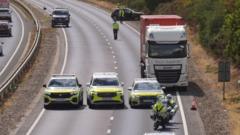
Every time metal meets concrete on a major arterial route and bodies break, the media machinery spins up its favorite, most intellectually lazy reflex. The headlines drop like clockwork: another tragedy, another outcry over the pavement, another municipal committee clutching its pearls and demanding lower speed limits, better signage, or fresh asphalt.
Let us stop lying to ourselves.
The A12, like every other high-capacity dual carriageway stretching across the country, is not a slaughterhouse waiting for blood. It is an engineering marvel designed to move thousands of tons of steel and human cargo at high velocities safely and efficiently. Yet, when a catastrophic collision occurs—such as the recent devastating incident claiming the life of a six-year-old child and leaving another critically injured—the public discourse immediately defaults to scapegoating the infrastructure.
We point the finger at lane configurations, lighting conditions, and design geometry because it is emotionally comfortable. It lets us pretend that concrete can be morally culpable. It allows drivers to absolve themselves of the terrifying reality that piloting a two-ton projectile requires absolute, unyielding cognitive engagement, not a passive reliance on modern safety crutches.
I have spent decades analyzing transportation networks, accident reconstruction data, and human factors engineering. I have watched municipal authorities waste millions of pounds modifying junctions that were never broken to begin with, all to appease a public that refuses to accept the burden of personal operational responsibility.
The lazy consensus is that roads are becoming more dangerous. The empirical data tells a vastly different story. Modern vehicles are mobile fortresses equipped with crumple zones, side-curtain airbags, autonomous emergency braking, and traction control systems that would have looked like science fiction thirty years ago. Statistically, the structural safety of our motoring environment has never been higher.
So why are families still being shattered?
Because safety technology has bred a dangerous species of psychological complacency.
When drivers feel invincible behind thick steel doors, sound-damped cabins, and adaptive cruise control, their risk thermostat recalibrates. They look down at glowing rectangular screens. They engage in complex mental calculations during high-speed merges. They treat eighty miles per hour on a crowded corridor like a casual Sunday stroll through a park. They rely on the machine to save them from their own distraction.
And when the physics of kinetic energy finally cash the checks that their divided attention wrote, we blame the road geometry.
The Myth Of The Dangerous Stretch Of Tarmac
Politicians love black spots. Labeling a specific section of a highway as dangerous is a political cheat code. It requires zero creative thought, demands a predictable budgetary outlay for superficial fixes like speed cameras or average-speed zones, and most importantly, it shifts the blame away from the electorate.
If a road is inherently flawed, nobody is at fault except the engineers who drew the blueprints.
Let us dismantle that comforting fiction.
In traffic safety engineering, we look closely at something called risk homeostasis. Coined by behavioral researcher Gerald Wilde, the theory posits that people adapt their behavior in response to perceived levels of risk. Make a road wider, clearer, and better paved, and drivers do not necessarily become safer; they simply drive faster and less attentively, consuming the safety margin that the engineers worked so hard to build into the system.
When an accident happens on a major route like the A12, the knee-jerk populist demand is always the same: reduce the speed limit. Drop it from seventy to sixty. Drop it to fifty. Slap up more speed enforcement gantries.
This is security theater of the highest order.
Artificially lowering speed limits on high-capacity corridors does not eliminate accidents; it often increases variance in driver speeds, creating frustration, tailgating, and erratic lane-changing maneuvers. Furthermore, it treats adult motorists like toddlers who cannot be trusted to match their speed to prevailing conditions, weather, and traffic density.
The problem is not that people are driving too fast for the road. The problem is that they are driving with entirely vacant minds.
The Cognitive Load Crisis
We need to talk about the elephant in the modern cockpit: cognitive fragmentation.
Twenty years ago, operating a vehicle required a baseline level of continuous sensory integration. You listened to the engine hum, you felt the road texture through the steering column, and your eyes scanned the mirrors. Today, the car interior is an entertainment lounge designed to siphon your attention away from the primary task of survival.
Infotainment systems mimic smartphones. Text notifications flash on heads-up displays. Bluetooth audio systems demand playlist curation at seventy miles per hour.
When a driver looks away from the road for just two seconds at highway speeds, they travel the length of a football field completely blind.
If you ask accident investigators what caused a fatal pile-up, they will rarely write "pure stupidity" on the report. They will write "failure to observe," "following too closely," or "inappropriate speed for conditions." But translate those bureaucratic euphemisms into plain English, and you get the unfiltered truth: someone was looking at something other than the traffic flow.
When a crash involves young children—as heartbreakingly occurred on the A12—the tragedy hits a visceral nerve. It demands an outlet. We want heads to roll. We want accountability. But directing that righteous anger toward the local council for failing to install enough lighting or barriers is a profound misallocation of moral clarity.
Accountability starts in the driver seat, not the town hall.
The Uncomfortable Solution
If we genuinely want to stop reading these devastating headlines, we have to abandon the nanny-state illusion that infrastructure can engineer stupidity out of the human race.
First, we must ruthlessly reform driver education. Current testing procedures are a joke. They measure a teenager's ability to parallel park on a quiet residential street and execute a three-point turn. They do nothing to prepare a driver for the sensory overload of merging onto a high-speed multi-lane corridor surrounded by heavy freight traffic while the driver's phone buzzes in the cup holder.
We need high-speed mandatory training. We need skid-recovery modules. We need drivers to experience firsthand the terrifying math of kinetic energy dissipation before they are ever handed the keys to a modern SUV.
Second, we must introduce draconian, socially unacceptable penalties for electronic device usage behind the wheel. The current regime of minor fines and a few license points is treated by affluent motorists as a minor subscription fee for convenience. Make the penalty for touching a handheld device while operating a motor vehicle match the severity of reckless endangerment. Suspend licenses immediately. Confiscate vehicles. Treat distracted driving with the same societal contempt we now reserve for drunk driving.
Third, automobile manufacturers must be forced to dial back the digital bloat inside cabins. The race to cram every dashboard with Tesla-style touchscreens that require three menu taps to turn on the defroster or adjust the air conditioning is an ergonomic disaster. Physical buttons allow tactile muscle memory; touchscreens demand visual fixation. Regulators should outlaw any interface feature that requires a driver to look away from the road for more than a fraction of a second.
None of these solutions are comfortable. None of them allow us to comfortably point our fingers at a stretch of pavement and pretend the concrete woke up with malicious intent.
The A12 did not kill anyone. A human being, operating heavy machinery without the requisite focus, respect, or cognitive presence, created the conditions for catastrophe.
Until we summon the courage to look in the rearview mirror and admit that the crisis is sitting right there in the driver's seat, the body count will continue to rise, and no amount of fresh asphalt will save us from ourselves.