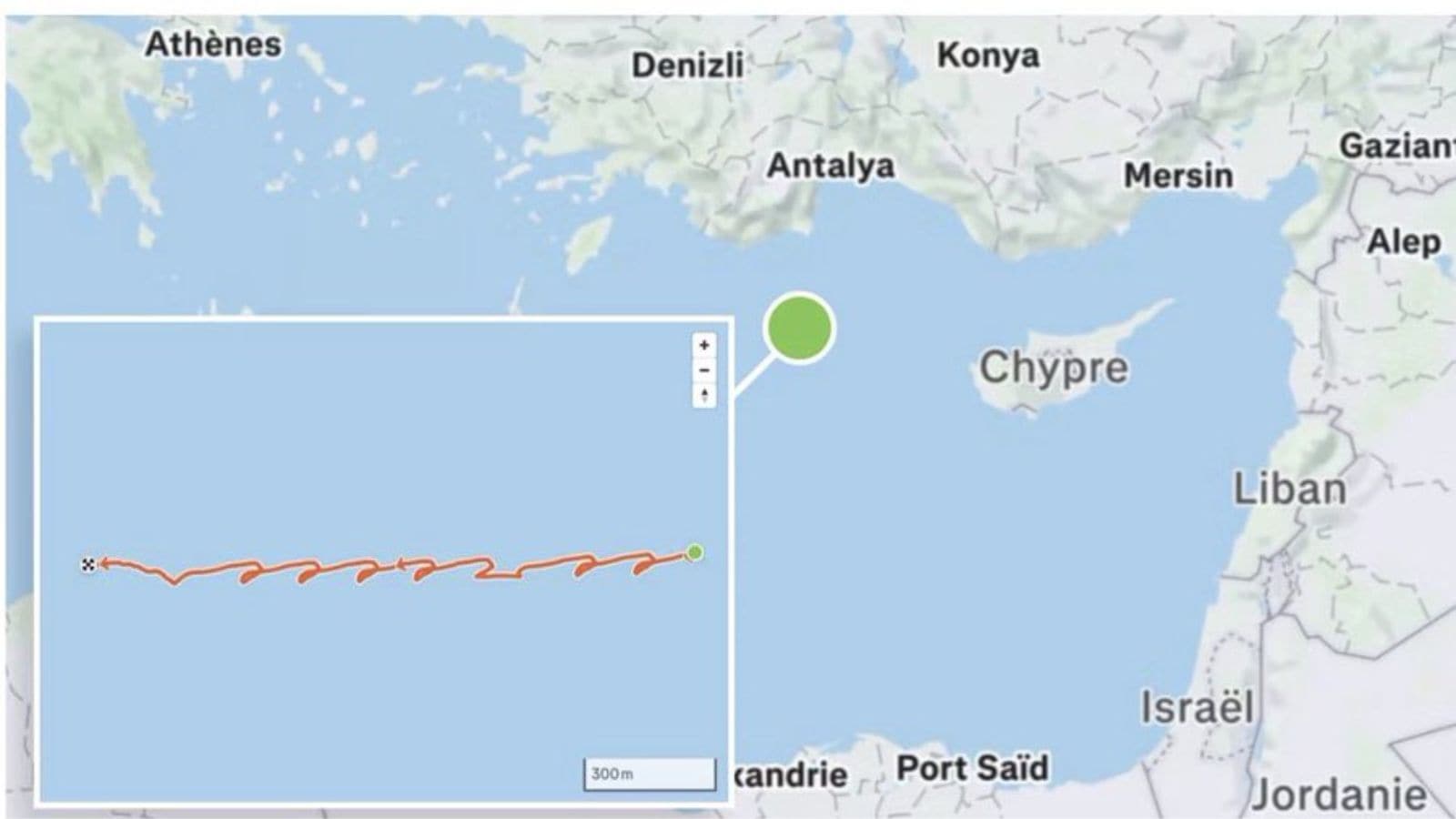
The media loves a "fitness tracker leaks secret base" story because it’s easy. It’s a tech-shaming narrative that fits neatly into the 24-hour news cycle. The recent panic over a French aircraft carrier’s location being "exposed" by a sailor’s morning jog is the latest entry in this catalog of misplaced outrage.
Everyone is pointing at the GPS data. Everyone is blaming the sailor. Everyone is acting like the Charles de Gaulle was invisible until some guy in neon shorts hit "Start" on his watch. Also making news in related news: The Logistics of Survival Structural Analysis of Ukraine Integrated Early Warning Systems.
They are all wrong.
The obsession with Strava heatmaps and "leaked" coordinates misses the terrifyingly obvious reality of modern electronic warfare: if a 42,000-ton nuclear-powered carrier is relying on a runner's privacy settings to stay hidden, the battle was lost decades ago. The "leaks" aren't the problem. The belief that absolute stealth exists for a carrier strike group is the delusion. Further insights on this are explored by MIT Technology Review.
The Myth of the Invisible Giant
Let’s dismantle the premise. The Charles de Gaulle is a floating city. It generates a massive thermal signature. It radiates electromagnetic energy across a dozen spectrums. It is trailed by supply ships and flanked by destroyers.
The idea that a fitness app provided "actionable intelligence" to a peer adversary is a joke. Russian and Chinese SIGINT (Signals Intelligence) satellites don't need to scrape a social media API to find a carrier. They use synthetic aperture radar (SAR) that sees through clouds and darkness. They track the wake. They monitor the radio frequency (RF) environment.
When a sailor posts a 5km run around the flight deck, it doesn’t tell an adversary where the ship is. It tells them the crew is maintaining a PT schedule. The location data is redundant noise in a sea of sophisticated surveillance. We are clutching our pearls over a flashlight in a room already lit by stadium floods.
The Strategic Theater of "Accidental" Leaks
In the intelligence world, there is a concept called Signaling. Sometimes, you want the enemy to know exactly where you are and how comfortable you feel.
I have watched command structures tighten and loosen social media policies like a faucet. When tensions are high, the "blackout" is absolute. When a carrier is loitering in the Mediterranean or the Persian Gulf to project power, a "leak" isn't a failure—it’s a flex.
A sailor posting a run on a carrier isn't just a breach of OPSEC (Operational Security); it’s a heartbeat. It signals that the ship is operating normally, the morale is high enough for recreational fitness, and the command isn't worried about being targeted. If the French Navy truly wanted that ship invisible, every personal device would be in a Lead-lined Faraday cage before the anchors were even raised.
By focusing on the "scandal" of the app, we ignore the deliberate choice of the military to allow these devices on board in the first place. This isn't a tech problem; it’s a human capital trade-off.
The Retention Crisis vs. The Faraday Cage
Why are smartwatches even allowed on a nuclear carrier? Because the military is currently losing a war against civilian life.
The French Navy, the US Navy, and every other major power are facing a recruitment and retention nightmare. If you tell a 22-year-old tech-native specialist that they have to live in the 1990s for a six-month deployment—no Spotify, no fitness tracking, no digital footprint—they don't sign the contract.
- The Status Quo Logic: Ban all wearable tech to ensure 100% signal silence.
- The Insider Reality: A 100% silent ship is a ship with a broken, isolated crew that will quit at the first opportunity.
The "Strava leak" is the price of keeping the lights on. Military leadership has done the math. They have decided that the negligible risk of a sailor’s GPS data (which, again, is redundant to satellite tracking) is worth the massive benefit of not having a mutiny of bored, disconnected Gen Z sailors.
The False Security of Geofencing
The "solution" always proposed after these headlines is more geofencing. "Why didn't the military just block the GPS signals?"
Because you can't block GPS reception without also potentially jamming your own navigation systems or signaling your presence even louder. GPS is a passive system; your watch doesn't "talk" to the satellite, it just listens. To stop a watch from knowing where it is, you have to flood the area with noise.
Doing that is the electronic equivalent of screaming "I AM OVER HERE" into a megaphone.
Instead of fixing the technology, we should be fixing the training. The real vulnerability isn't the coordinates ($x, y, z$). The real vulnerability is the metadata.
- Pattern of Life: Does the crew exercise at 06:00? That’s when the ship is most likely in a "low-alert" state.
- Personnel Mapping: Who is running with whom? By cross-referencing public Strava profiles, an analyst can map the social hierarchy of the ship’s officers.
- Stress Indicators: Heart rate data during specific maneuvers. That is the gold mine.
The media focuses on the map. The intelligence professional focuses on the pulse.
Why We Should Stop Fixing This "Problem"
The frantic scramble to "fix" fitness app leaks is a distraction from the real threat: ubiquitous surveillance.
We are living in an era where commercial satellite imagery is available to anyone with a credit card. Companies like Maxar and Planet Labs provide high-resolution photos of almost any point on Earth every few hours. In this environment, worrying about a Garmin watch is like worrying about a screen door during a hurricane.
The "lazy consensus" is that we can return to a state of total operational invisibility through better "digital hygiene." That world is dead. It was buried the moment the first commercial spy satellite went into orbit.
The goal shouldn't be to hide the ship. The goal should be Deception and Saturation.
Imagine a scenario where a fleet commander issues 5,000 cheap fitness trackers to sailors and then sends half of them on a supply ship heading in the opposite direction. Or better yet, uses automated scripts to generate thousands of "phantom runs" across the entire Atlantic.
If you can't hide the signal, you drown the enemy in noise. That is the nuance the "tech leak" articles miss. They want a simple villain (the app) and a simple victim (the Navy). They ignore the fact that the Navy has the tools to turn this "vulnerability" into a weapon of mass disinformation.
The Actionable Truth for Commanders
If you are in a leadership position, stop chasing the "app ban" ghost. It makes you look out of touch and it doesn't actually protect your assets.
- Accept the Redundancy: Assume the enemy already has your GPS coordinates. If your mission depends on a Garmin being off, your mission is poorly designed.
- Weaponize the Data: If you know the enemy is scraping Strava, give them something interesting to look at. Move your high-value targets while the "crew" is apparently running a marathon in a different quadrant.
- Educate on Bio-Data: Teach sailors that their heart rate is more classified than their location. A stressed crew is a vulnerable crew.
The Charles de Gaulle wasn't "exposed." It was exactly where everyone—from the Pentagon to the Kremlin—already knew it was. The only people surprised by the "leak" were journalists who still think we live in a world where a 40,000-ton ship can play hide-and-seek.
Stop treating digital footprints as mistakes. Start treating them as the unavoidable exhaust of a modern force. You don't try to hide the exhaust of a jet engine; you build a faster jet.
The era of hiding is over. The era of drowning the enemy in "truth" has begun. Use the app. Post the run. Just make sure the enemy is looking at the wrong map when the real move happens.
Throw away the privacy settings. Start practicing the art of the intentional leak.