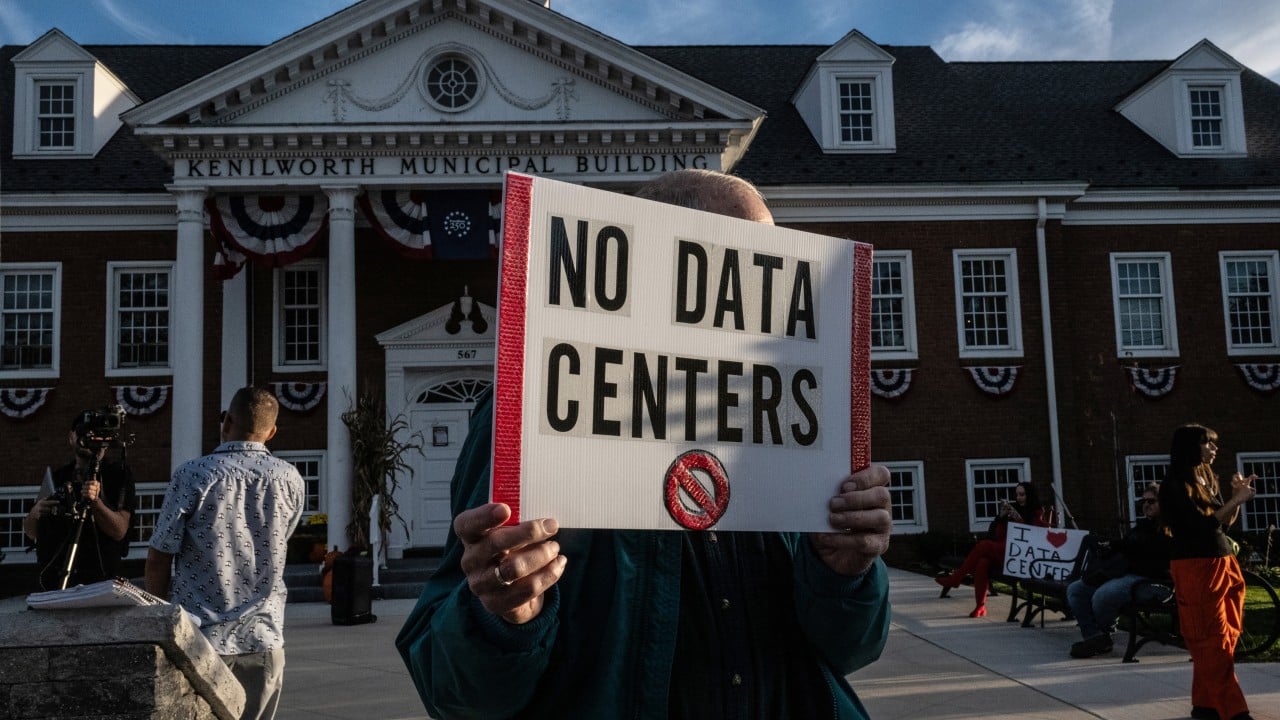
Silicon Valley has a favorite new coping mechanism. Whenever a county board in Northern Virginia or a city council in Georgia blocks a massive hyperscale campus, tech commentators nod sagely and call it a "blessing in disguise."
The story goes like this. Local pushback over power consumption and water usage will force AI companies to innovate. It will push compute away from crowded grids, accelerate decentralized edge inference, make models radically efficient, and drive clean energy investment into forgotten rural counties.
It is a comforting bedtime story for executives watching their multi-billion-dollar construction timelines evaporate. It is also completely detached from how power grids, thermodynamics, and fiber optics actually work.
Local opposition to US data centers is not a creative constraint. It is a hard physical wall. Treating political and infrastructural paralysis as a catalyst for efficiency misunderstands the fundamental physics of training frontier models. You cannot "innovate" your way around the speed of light, and you cannot wish gigawatts of baseload power into existence by scattering servers across a map.
The Myth of the Decentralized AI Miracle
The most seductive lie in the "blessing in disguise" narrative is that blocking mega-campuses will naturally force the industry toward distributed training. If Loudoun County says no, builders will supposedly just chop a 500-megawatt cluster into fifty 10-megawatt sites scattered across the Midwest.
Anyone who has ever debugged a distributed training run knows this is pure fantasy.
Training a frontier foundation model requires tens of thousands of accelerators—like NVIDIA Blackwell or custom ASICs—acting as a single, unified brain. During training, these chips must constantly synchronize their gradients using high-speed interconnects like NVLink and InfiniBand. We are talking about petabits of east-west traffic moving inside the building every single second.
If you separate those clusters by even fifty miles, the speed of light through fiber-optic glass introduces latency that turns multi-million-dollar silicon into expensive space heaters. Your GPUs spend more time waiting for packets to arrive from the next county over than they do performing matrix multiplications. Model FLOPs utilization collapses. Training runs that should take three months stretch into two years, by which point the architecture is already obsolete.
Inference—running the finished model—can be distributed. Training cannot. By choking off the massive, contiguous power footprints required for centralized training campuses, local moratoriums do not create a nimble, decentralized AI ecosystem. They simply ensure that frontier model training leaves the United States entirely.
Why Algorithmic Efficiency Won't Save the Grid
The second pillar of the lazy consensus relies on Jevons Paradox in reverse. Pundits argue that power constraints will force researchers to abandon brute-force scaling in favor of algorithmic breakthroughs, smaller models, and quantization.
We have seen companies blow tens of millions of dollars betting on this exact thesis. They assume that because models get cheaper per token every year, total compute demand will plateau.
In reality, the exact opposite happens. When efficiency improves, engineers do not turn off the power plants. They just run ten times as many experiments, expand context windows to millions of tokens, and spin up synthetic data generation loops that consume every spare watt they can find. Efficiency does not reduce infrastructure demand; it unlocks entirely new, heavier workloads that were previously uneconomical.
Furthermore, hardware efficiency is already hitting physical limits. Power Usage Effectiveness (PUE)—the ratio of total facility energy to the energy delivered directly to computing equipment—used to be an easy target. Ten years ago, poorly designed enterprise data centers ran at a PUE of 2.0, meaning half the electricity went to cooling and power distribution losses. Modern hyperscale facilities already operate near 1.1.
You cannot squeeze much more juice out of facility design. Liquid cooling and direct-to-chip cold plates are necessary just to keep racks exceeding 100 kilowatts from melting, not because they magically reduce total wattage. When a county blocks a substation upgrade, no amount of clever Python code or cooling plumbing is going to replace 300 megawatts of missing baseload generation.
The Dirty Secret Behind Local Backlash
To understand why the current backlash is so dangerous, you have to strip away the PR talking points from both sides.
Local residents rarely protest data centers because they hate artificial intelligence. They protest because utilities and developers have tried to socialize the costs of private infrastructure onto residential ratepayers.
When a tech giant announces a gigawatt-scale campus, the local electric utility has to build new transmission lines, substations, and peaking generation. Under traditional utility rate structures, those multi-billion-dollar capital expenditures get rolled into the general rate base. Grandma in a two-bedroom bungalow ends up paying higher monthly transmission fees so a trillion-dollar cloud provider can train a chatbot.
At the same time, developers frequently demand massive property tax abatements, promise hundreds of permanent jobs that turn out to be thirty security guards and HVAC technicians, and suck millions of gallons of municipal water through evaporative cooling towers during regional droughts.
Calling the resulting voter fury a "blessing" insults the intelligence of the people paying the bills. It is a market failure caused by opaque utility tariff structures and greedy municipal tax giveaways. Pretending this friction is good for tech innovation ignores the glaring regulatory rot that caused it in the first place.
What Everyone Gets Wrong About Grid Modernization
A common argument in favor of the backlash is that AI demand will finally force America to modernize its aging electrical grid and build out massive renewable energy projects.
Let's look at the actual timeline of the US transmission system. According to data from the Lawrence Berkeley National Laboratory, the median time a power project spends in the interconnection queue in the United States has stretched to roughly five years. In regions like PJM Interconnection—which covers Northern Virginia—the backlog is so severe that the grid operator had to freeze new applications just to clear existing paperwork.
AI hardware moves on an 18-to-24-month product cycle. Utility transmission planning moves on a 10-to-15-year cycle.
Even if a hyperscaler signs a Power Purchase Agreement (PPA) for a new solar and battery farm in Texas or Ohio, the electrons from that farm cannot reach the data center without high-voltage transmission lines. Permitting a single interstate transmission line in the US takes longer than building the entire Apollo space program.
When local opposition delays a data center by three years, the project does not magically reappear cleanly connected to a brand-new wind farm. Instead, developers panic and pivot to behind-the-meter fossil fuels. Right now, across the American South and Midwest, tech companies are quietly buying up industrial gas turbines and diesel generators to bypass utility interconnection queues entirely. Far from accelerating the clean energy transition, localized grid bottlenecks are actively driving a renaissance in off-grid natural gas generation.
Answering the Wrong Questions
If you look at the public debate surrounding AI infrastructure, people are obsessing over all the wrong variables.
Can't we just build data centers in rural areas with cheap land?
Land is the cheapest, least important part of the equation. A data center needs three things: massive high-voltage transmission capacity, redundant long-haul dark fiber routes, and access to specialized technical labor. Rural land with zero transmission infrastructure is useless unless you are willing to wait a decade for steel towers to be erected. If you drop a cluster in the middle of nowhere without low-latency fiber paths to major internet exchanges, it becomes an isolated island unsuitable for real-time cloud services.
Won't nuclear power and SMRs solve the bottleneck?
Small Modular Reactors (SMRs) are wonderful on PowerPoint slides. In the real world, not a single commercial SMR is operating in the United States today. Restarting shuttered legacy reactors—like the deal at Three Mile Island—helps at the margins, but there are only a handful of decommissioned plants viable for restart. Relying on next-generation nuclear to solve an infrastructure crunch happening right now is like planning to pay next month's rent with a lottery ticket.
Doesn't water scarcity prove data centers are unsustainable?
This is a classic distraction. Evaporative cooling uses water to save electricity. Closed-loop liquid cooling systems—which are now standard for high-density AI racks—use almost zero water after the initial fill, operating much like a giant car radiator. The catch is that closed-loop dry cooling requires more electricity to run massive banks of fans and chillers. Local protesters routinely weaponize water statistics from legacy facilities while ignoring the trade-off: forcing a facility off evaporative cooling directly increases its peak electrical load on the local grid.
The Real Cost of Delay
There is an undeniable downside to moving fast and bulldozing local concerns. Unchecked data center sprawl without strict tariff protections will distort local energy markets, strain municipal water supplies in arid regions like Phoenix, and create localized noise pollution from diesel backup testing. Communities have every right to demand that trillion-dollar corporations pay their own way.
However, celebrating the resulting gridlock as a strategic win for AI is sheer delusion.
Capital is globally mobile. Electrons are not. While US counties pass moratoriums and litigate substation permits for half a decade, sovereign wealth funds in the Middle East and state-backed developers in Asia are pouring concrete, building dedicated gigawatt-scale gas and solar complexes, and laying subsea fiber without a single zoning board hearing.
If the United States strangles its domestic compute buildout through regulatory paralysis and local NIMBYism, the AI industry will not become leaner, greener, or more clever. It will simply pack its GPUs and build the future somewhere else.
How to Actually Fix the Infrastructure Crunch
Stop pretending the backlash is a gift and start fixing the broken incentives causing it. If developers and policymakers want to clear the bottleneck without triggering a populist revolt, the playbook is obvious:
- Mandate Large-Load Tariffs: State utility commissions must require any customer demanding over 50 megawatts to pay 100% of the dedicated transmission and generation upgrade costs upfront, shielded entirely from residential rate bases. Follow the model pioneered by utilities like AEP Ohio—make the hyperscalers underwrite the grid expansion with binding, long-term take-or-pay contracts.
- Ban Municipal Tax Abatements for Compute: Data centers do not create enough permanent jobs to justify handing away hundreds of millions in local property taxes. Let the tax revenue flow directly into local schools and municipal budgets. When residents see their property taxes drop because a server farm moved in down the road, NIMBYism evaporates overnight.
- Co-Locate with Existing Curtailment: Instead of fighting for power in congested East Coast hubs, force new builds into regions with massive renewable curtailment—like West Texas or the Great Plains—where wind and solar farms regularly dump excess power because transmission lines are full. Pair behind-the-meter generation with industrial-scale battery storage to absorb wasted electrons before they ever hit the broader grid.
- Enforce Closed-Loop Cooling Standards: Strip water out of the political debate completely. Require all new builds in water-stressed watersheds to use closed-loop, zero-evaporation cooling architectures as a baseline condition for zoning approval.
The AI buildout is the largest industrial infrastructure project since the interstate highway system. You do not build an interstate highway by celebrating when every county blocks the asphalt. You pay the landowners fairly, engineer around the bottlenecks, and lay the road.


