Swimming fifteen kilometers across the Strait of Hormuz and calling the water "on fire" makes for a killer headline, a dramatic documentary trailer, and a comfortable press tour. It does nothing to lower the cost of war. In fact, turning one of the world’s most volatile maritime chokepoints into an endurance athletics backdrop actively obscures how modern geopolitical conflict actually bleeds the global economy dry.
The mainstream press loves a lone hero battling the elements. When British swimmer Lewis Pugh—or any high-profile endurance athlete—completes a grueling crossing in a contested waterway and flags the "cost of war," media outlets dutifully transcribe the poetic metaphors. Burning water. Ecological fragility. Human resilience against geopolitical madness. It is the exact kind of lazy consensus that makes readers feel informed while leaving them completely ignorant of the actual mechanics driving conflict in the Persian Gulf.
I have spent fifteen years advising maritime logistics firms, energy desks, and sovereign risk analysts on chokepoint economics. I have watched billion-dollar shipping conglomerates burn through tens of millions in war-risk premiums because boardrooms mistook symbolic news cycles for structural threat assessments. Romanticizing a 15-kilometer swim as a meaningful intervention in the Strait of Hormuz is not just naive. It is a distraction from the cold, unglamorous financial and military reality governing that 21-nautical-mile stretch of water.
The Spectacle Trap in Geopolitical Reporting
Endurance stunts rely on physical suffering to manufacture moral authority. The logic goes like this: an athlete endures extreme heat, jellyfish stings, treacherous currents, and proximity to naval warships, and that suffering earns them the platform to lecture world leaders about peace and environmental stewardship.
The problem is that naval commanders, commodities traders, and asymmetric warfare strategists do not read poetic warnings about water on fire. They read actuarial tables, radar cross-sections, and Automatic Identification System (AIS) transponders.
When an athlete enters a militarized strait with a support crew, safety boats, and pre-cleared diplomatic permits, they are not exposing the raw reality of conflict. They are operating inside a heavily choreographed security bubble. Every naval asset in the region—from Islamic Revolutionary Guard Corps (IRGC) fast-attack craft to U.S. Fifth Fleet destroyers—knows the swimmer is there days in advance. Nobody wants an international incident over a Western athlete in Speedos.
By framing a permitted, closely monitored athletic event as a frontline report on the cost of war, coverage flattens a complex, multi-decade standoff into a simple morality play. It shifts public attention away from the systemic drivers of Gulf instability—sanctions regimes, proxy drone proliferation, and hydrocarbon dependency—and replaces them with personal heroism.
Why "Water on Fire" Misses the Real Damage
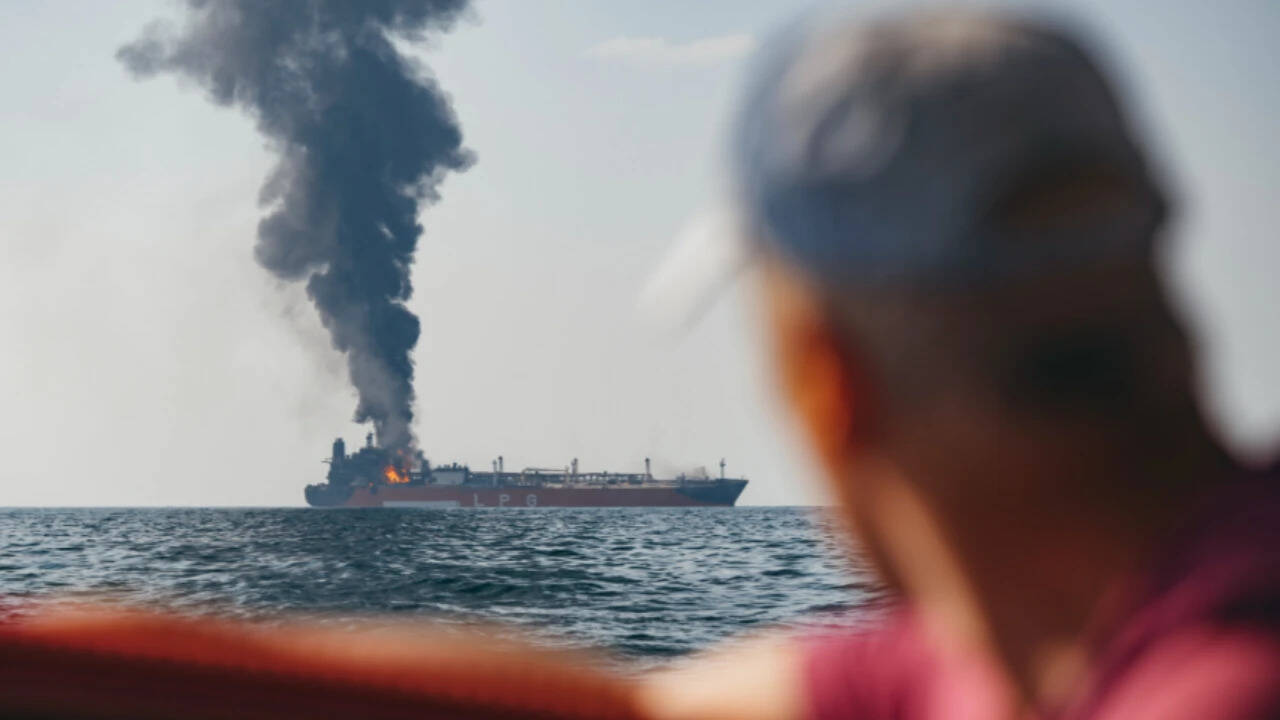
Let us examine the core metaphor. Calling the Strait of Hormuz "water on fire" evokes burning oil tankers, billowing black smoke, and immediate kinetic catastrophe. That imagery is frozen in the 1980s Tanker War.
Modern conflict in the Strait of Hormuz rarely looks like an inferno. It looks like friction.
- GPS Spoofing and Electronic Warfare: Commercial vessels routinely have their navigation systems hijacked, showing ships sailing inland across Iranian desert while physically drifting toward contested territorial waters.
- Limpet Mines and Drone Harassment: Low-cost, asymmetric strikes designed not to sink supertankers, but to puncture hulls just enough to trigger force majeure clauses in shipping contracts.
- Shadow Fleet Proliferation: Hundreds of aging, uninsured, flag-hopping tankers operating with transponders turned off, creating a silent ecological time bomb that requires zero kinetic warfare to detonate.
An athlete swimming through calm morning swells with a camera boat alongside does not experience electronic warfare. They do not experience the financial paralysis of a Lloyd’s of London underwriting committee raising war-risk surcharges by 400% overnight. When media narratives prioritize visceral athletic metaphors over invisible systemic friction, the public fundamentally misunderstands what war in a maritime chokepoint actually costs.
The Actuarial Reality of the Strait of Hormuz
To understand why symbolic stunts fail to move the needle, you have to understand the exact geometry and economics of the Strait of Hormuz. At its narrowest point, the strait is roughly 21 nautical miles wide. The shipping lanes themselves—the Traffic Separation Scheme—are even tighter: two miles wide for inbound traffic, two miles wide for outbound traffic, separated by a two-mile buffer zone.
Through that narrow corridor passes roughly one-fifth of the world’s total petroleum liquids consumption and a massive share of global liquefied natural gas (LNG), primarily from Qatar.
| Metric | Operational Reality in Hormuz | What Athletic Stunts Emphasize |
|---|---|---|
| Primary Threat Vector | Asymmetric mines, UAVs, seizure by fast-attack boats, GPS spoofing | Extreme heat, currents, psychological stress |
| Economic Mechanism | Hull & machinery war-risk premiums, rerouting delays, spot market volatility | Abstract moral appeals to "peace" and "sustainability" |
| Environmental Hazard | Uninsured shadow-fleet collisions and sanction-evading ship-to-ship transfers | Generalized warnings about climate change and warming seas |
| Decision Makers | Underwriting syndicates, naval task forces, sovereign energy ministries | General public and international media audiences |
Notice the disconnect. The people who actually price the cost of war do not measure it in kilometers swum or degrees of water temperature. They measure it in basis points on hull value.
When tensions spike in the Gulf, the Joint War Committee in London designates the area as a "Listed Area." Instantly, every Very Large Crude Carrier (VLCC) worth $100 million entering that zone faces an additional war-risk premium for a seven-day transit. Multiply that across hundreds of vessels a month, add the cost of armed private maritime security teams, and factor in the fuel burn of ships idling outside Fujairah waiting for naval escorts. That is the real, daily tax of conflict. It is paid quietly by consumers at gas pumps and grocery stores from Rotterdam to Tokyo, regardless of whether a single shot is fired.
Dismantling the "Awareness" Myth
Whenever anyone critiques high-profile environmental or anti-war stunts, the default defense is always the same: At least it raises awareness.
Awareness is the most overvalued currency in modern advocacy. Nobody in the Pentagon, Tehran, Brussels, or Singapore is unaware that the Strait of Hormuz is a powder keg. Energy executives do not need a swimmer to remind them that a blockade would trigger a global depression. Environmental scientists do not need a press release to know that the Persian Gulf is one of the warmest, most ecologically stressed marine basins on Earth.
What People Actually Ask—And Why the Questions Are Flawed
When stories like a 15-kilometer Hormuz swim hit the news cycle, search engines light up with predictable queries. Let us strip away the fluff and answer them directly.
Is swimming across the Strait of Hormuz actually dangerous?
Physically, yes. Water temperatures in the Persian Gulf regularly exceed 32°C (90°F) in warmer months, creating severe risk of hyperthermia—a condition where the body cannot cool itself through sweat because the surrounding water is nearly at core body temperature. Add strong tidal currents and venomous jellyfish, and the physiological strain is undeniable. Geopolitically, however, the danger is heavily mitigated. State actors treat sanctioned Western media events with extreme caution; nobody wants the diplomatic blowback of harming an unarmed swimmer under international camera surveillance. The real geopolitical danger belongs to the anonymous Filipino, Indian, and Ukrainian seafarers crewed on commercial tankers who have zero diplomatic immunity and no camera crews following them.
Can symbolic endurance feats influence geopolitical peace talks?
No. Not once in modern maritime history has an athletic feat altered the strategic calculus of a chokepoint conflict. Diplomacy in the Persian Gulf is transactional, driven by hard security guarantees, frozen asset releases, sanctions relief, and credible military deterrence. Thinking a swim can soften hardline naval doctrine is like thinking a charity marathon can alter central bank interest rates.
Does conflict in the Strait of Hormuz destroy marine ecosystems?
Yes, but rarely in the cinematic way people imagine. While the 1991 Gulf War saw the intentional release of millions of barrels of crude oil into the water, today’s primary ecological threat is regulatory collapse. Sanctions force oil producers to rely on decrepit, poorly maintained tankers operating outside international maritime safety standards. When one of those vessels runs aground or leaks, there is no legitimate insurer on the hook to fund a multi-billion-dollar cleanup. War destroys the legal accountability required to protect the ocean.
The Unintended Consequence: Normalizing the Abnormal
Here is the counter-intuitive truth that PR teams behind these expeditions never admit: staging an athletic event in a conflict zone subtly normalizes the militarization of the space.
When an athlete successfully completes a crossing, gets out of the water, poses for photographs, and declares a victory for human endurance, the subconscious takeaway for the casual reader is that the strait is navigable, manageable, and essentially safe enough for extreme tourism. The military presence becomes mere scenery—a dramatic backdrop of gray hulls on the horizon that adds grit to the documentary footage.
Imagine a scenario where a major logistics firm uses that exact media narrative to downplay transit risks to its board, or where retail investors misread calm visual footage from a sanctioned swim as a sign of regional de-escalation. Visuals carry immense psychological weight. Showing a human being swimming peacefully across a contested waterway visually contradicts the verbal message that the water is "on fire." The image wins every time, and the image says everything is under control.
What Actually Lowers the Cost of Maritime Conflict
If the goal is genuinely to reduce the human, financial, and environmental cost of conflict in places like the Strait of Hormuz, we have to abandon performative awareness campaigns and focus on structural leverage points. None of them make for good documentary footage, which is why they rarely make the front page.
1. Decouple Chokepoint Leverage Through Pipeline Redundancy
Geopolitical extortion only works when there is no alternative route. Every barrel of crude that bypasses the Strait of Hormuz reduces the strategic value of threatening the waterway. Projects like the Habshan–Fujairah pipeline in the UAE and Saudi Arabia’s East-West Petroline directly strip naval forces of their ability to hold the global economy hostage. Expanding overland bypass capacity does more to prevent a Gulf war than a thousand peace rallies.
2. Enforce Flag-State Accountability on the Shadow Fleet
If environmental groups and geopolitical advocates want to protect the Persian Gulf from burning oil, they should target the maritime registries and classification societies enabling the shadow fleet. Port state controls in major transshipment hubs can refuse entry, bunkering, and pilotage services to vessels lacking verifiable Protection and Indemnity (P&I) insurance from reputable clubs. Choking off the financial and logistical infrastructure of uninsured tankers eliminates the single biggest environmental threat in the region.
3. Protect the Invisible Workforce
Instead of spotlighting celebrity athletes, international labor and maritime organizations need to enforce strict seafarer rights in high-risk zones. Commercial crews are routinely abandoned on contested vessels for months without pay or relief when ships are impounded during diplomatic disputes. Mandatory escrow accounts for crew repatriation and automatic hazard-pay triggers tied to Joint War Committee listings put real financial costs on shipowners who gamble with human lives in conflict zones.
4. Standardize Counter-Spoofing and Autonomous Navigation
Investing in resilient, multi-constellation inertial navigation systems that cannot be fooled by local GPS jamming removes a massive trigger for accidental military escalation. When a commercial tanker drifts into territorial waters because its electronic chart was spoofed, naval patrols treat it as a border incursion. Eliminating navigational ambiguity prevents the exact kind of miscalculation that sparks shooting wars.
The Honest Downside of Cold Realism
Strip away the poetic metaphors and focus strictly on insurance markets, pipeline bypasses, and naval deterrence, and you run into an uncomfortable flaw: cold realism does not move human hearts.
Technocratic solutions do not inspire a twenty-year-old student to care about marine conservation, nor do they capture the emotional horror of watching a region slide toward armed conflict. Symbolic acts—even flawed, media-choreographed ones—exist because human beings process massive geopolitical abstractions through individual stories. Telling someone that war-risk premiums rose fifty basis points puts them to sleep; telling them a human swam across burning water wakes them up.
The danger is mistaking the wake-up call for the solution. Emotional resonance is an entry point, not a strategy. When journalists and commentators treat an endurance athlete’s observations as authoritative geopolitical analysis, they trade rigor for clicks and leave the public ill-equipped to understand the forces actually shaping their world.
Stop applauding athletes for swimming through geopolitical fault lines and calling it diplomacy. If you want to see the real cost of war in the Strait of Hormuz, stop looking at the swimmer in the water and start auditing the cargo manifests, insurance ledgers, and shadow tankers slipping past in the dark.