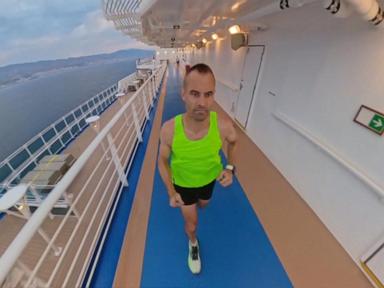
The internet went wild last week over a viral clip of some guy running seven marathons in seven days aboard a massive floating resort. Commentators called it an absolute masterclass in human endurance. Influencers wept tears of digital joy. Brands rushed to congratulate the runner for defying human limits inside a steel behemoth plowing through international waters.
It is absolute theater. And worse, it completely misses the point of athletic achievement.
Let us strip away the PR gloss, the sponsor dollars, and the dopamine hits generated by short-form video algorithms. Running 26.2 miles a day on a treadmill or a narrow wraparound deck of a cruise ship is not a triumph of gritty human will. It is a glorified marketing stunt engineered for engagement metrics, performed in the most sterile, environmentally dubious fitness conditions imaginable.
I have spent two decades analyzing elite performance, biomechanics, and the commercialization of endurance sports. I have watched corporate sponsors fund absurd gimmicks while true physiological excellence goes unnoticed in obscurity. We need to stop confusing logistical logistics with athletic greatness.
The Engineered Illusion Of Extreme Endurance
The core narrative pushed by the media surrounding ship-bound marathons is that the runner faces unique, insurmountable odds. The vessel rolls. The air is recycled. The tracks are short and repetitive.
Here is the truth nobody in the mainstream fitness media wants to admit: running on a cruise ship is actually mechanically easier on certain kinetic chains and infinitely more controlled than battling raw nature.
When you run on land, your body deals with variable terrain, cambered roads, wind resistance, thermal regulation shifts, and true gravity-driven propulsion. On a modern megaship, you are often relying on high-end commercial treadmills equipped with shock absorption that actively reduces ground reaction forces. Even when pounding the open deck, the surface is uniform, predictable, and engineered for high foot traffic rather than athletic trauma.
The real challenge of doing seven marathons in seven days is not the physical distance or the ocean breeze. It is boredom and logistical scheduling.
True endurance requires adaptation to hostile environments. A ship offers a climate-controlled bubble complete with room service, massage therapists on standby, endless buffet calories tailored for macro recovery, and zero commute time to the start line. You are not waking up at four in the morning in a freezing tent, managing your own nutrition drops, or navigating treacherous mountain passes. You are stepping off a luxury elevator onto a rubberized belt while staff mop the floor around you.
Calling this the pinnacle of human grit devalues what actual endurance athletes endure on trails, tracks, and ultra-distance circuits across the globe.
Why We Fall For The Spectacle
Why did
Why Running Marathons on Cruise Ships is a Waste of Money and Sweat
sports, travel
Every few months, the internet loses its collective mind over a stunt. A guy boards a floating hotel, loops around a wet promenade deck the size of a postage stamp for seven days straight, and completes seven marathons. Media outlets trip over themselves to applaud the grit. The headlines scream about extraordinary human willpower, mental toughness, and breaking through perceived limits.
It is theater. Expensive, repetitive, joint-destroying theater.
If you strip away the romantic gloss of endurance marketing, running seven marathons on a cruise ship is not a triumph of athletic prowess. It is a masterclass in marketing synergy for the cruise line, wrapped in an exercise science nightmare for the runner. I have spent years coaching athletes through extreme volume blocks, and watching people glorify repetitive-motion trauma on a moving, vibrating steel oval makes my teeth ache. We need to stop praising physical punishment disguised as achievement.
The Biomechanical Absurdity of the Floating Oval
Let us talk about the math nobody wants to do. A typical cruise ship promenade deck is short. You are looking at laps that measure anywhere from 150 to 250 meters. To clear 26.2 miles, you have to execute roughly 200 to 300 sharp, unrelenting turns per marathon. Over seven days, that translates to thousands of tight corners, usually on synthetic decking that lacks the energy return of proper asphalt or a synthetic running track.
Human hips, knees, and ankles are not designed to handle asymmetrical torque on a curved, banked, vibrating platform powered by massive diesel engines. Marine diesel engines create low-frequency vibrations that course through the entire steel superstructure of a vessel. When you run on a treadmill at home, the belt moves beneath you. When you run on a cruise ship deck, the floor itself is subtly shifting, absorbing engine resonance, and reacting to ocean swells.
Sports medicine specialists who actually treat overuse injuries will tell you that lateral stability is the first thing to go when you introduce uneven micro-movements to high-volume linear running. You are begging for IT band syndrome, severe plantar fasciitis, and acute patellar tendinitis. The runner gets a viral video; their skeletal system gets a demolition derby.
Stunts that prioritize camera angles over sound training principles destroy longevity for a headline.
The Cult of Volume Over Intent
The underlying myth here is that high volume equals high character. If you suffer enough, you earn some nebulous badge of honor. This is the lazy consensus of modern endurance culture. We measure worth in miles logged rather than adaptations gained.
Look at what elite marathoners actually do. They periodize. They manage training stress. They optimize recovery windows. Running seven marathons in seven days forces the body into a catabolic nosedive. Muscle protein breakdown outpaces synthesis by day two. By day four, you are not building aerobic capacity; you are chewing through lean muscle mass and spiking systemic inflammation to dangerous levels, all while breathing recirculated maritime air mixed with heavy fuel exhaust from the funnel stacks upwind.
Why do people defend it? Because it looks hard. But stupidity that looks hard is still stupidity.
If you want to test your limits, run a single marathon where you negative split every mile, holding a precise lactate threshold pace on a challenging, hilly road course. That requires discipline, pacing intelligence, and physiological mastery. Jogging in circles past the shipboard buffet while passengers watch you sweat into your synthetic singlet requires stubbornness, not skill.
How the Cruise Industry Wins While Your Knees Lose
Notice who benefits most from these viral endurance stunts. It is never the athlete's long-term health; it is the corporate entity selling berths. A passenger running seven marathons onboard becomes a floating billboard. It generates organic PR that money cannot buy. The cruise line gets framed as a destination for active lifestyle enthusiasts, shifting their demographic away from the buffet-and-bingo crowd toward the lucrative wellness-tourism market.
The runner becomes an unpaid marketing department. They pay for their cabin, pay for their food, endure the grueling physical toll, and hand the cruise corporation a week's worth of viral content. It is a brilliant business model, and a terrible athletic endeavor.
We need to decouple spectacle from substance. Endurance sports are undergoing an identity crisis where the loudest, weirdest logistical challenge wins attention over the smartest training.
What You Should Do Instead
If you are tempted by these extreme calendar challenges, ask yourself what you are actually trying to prove. If the goal is self-discovery, book a wilderness trail race with real elevation profiles. If the goal is fitness, invest that entry fee and vacation time into a proper coaching block that targets a personal record on a flat, fast course where your joints do not have to compensate for marine engine vibrations.
Stop applauding people for making bad training decisions just because they committed to them for a week.
Your joints will thank you when you can still walk downstairs at age sixty.