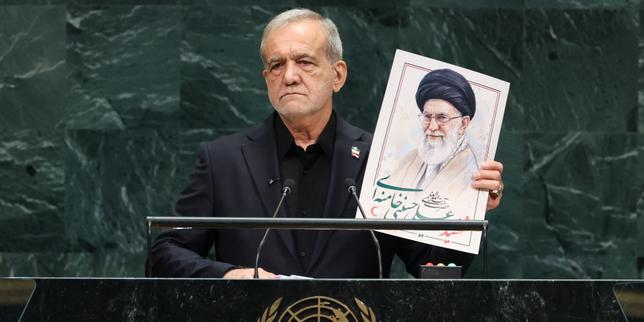
Western foreign ministries suffer from a chronic, incurable case of amnesia. Every decade or so, Tehran rolls out a technocrat with a soft voice, a sorrowful expression, and a tailored suit. This figure stands at a podium in New York, speaks fluent diplomacy, and talks about mutual respect, regional peace, and constructive engagement.
Instantly, journalists swoon. Pundits write breathless columns about a historic opening. Editorial boards praise the subtle art of balancing firmness with diplomatic grace.
It is elaborate, cynical theater.
Massoud Pezeshkian at the United Nations General Assembly was never a reformer breaking new ground. He was a carefully selected prop executing a well-rehearsed script designed for a gullible international audience. Treating his rhetoric as a genuine pivot away from four decades of hardline state ideology is not sophisticated analysis. It is professional malpractice.
The Architecture of Illusion
To understand why international commentary on Pezeshkian misses the mark, you must first dismantle the fundamental misunderstanding of how power operates in Iran.
The Iranian presidency is not a sovereign executive office in the Western sense. It is a middle-management administrative tier reporting to an absolute chief executive and a deeply entrenched paramilitary board of directors. The executive branch manages municipal water systems, handles bureaucratic budgets, and implements domestic economic policies under severe structural constraints. It does not control foreign policy. It does not command the Islamic Revolutionary Guard Corps. It does not dictate nuclear enrichment timelines.
Pezeshkian did not author his own political platform. He cleared rigorous security vetting by the Guardian Council precisely because the regime knew he posed zero systemic threat to the clerical-military complex. When he speaks at the United Nations, he is reading talking points cleared by the Supreme National Security Council.
Yet, international analysts insist on evaluating him through the lens of Western democratic governance, projecting desires onto a system that views compromise as an existential vulnerability.
The Death of the Moderate Binary
For thirty years, Western media has recycled the exhausted binary of "moderates versus hardliners" inside Iran. This framework expired long ago. The Islamic Republic operates as a factional cartel where internal disputes are tactical, not ideological.
When Mohammad Khatami talked about a dialogue among civilizations in the late nineties, the security state expanded its clandestine operations. When Hassan Rouhani and Javad Zarif negotiated the Joint Comprehensive Plan of Action in the mid-2010s, the windfall cash was channeled directly into funding regional proxy networks across Syria, Yemen, Iraq, and Lebanon.
Pezeshkian is simply the newest iteration of this cycle. His election was not a popular triumph of reformist citizens over reactionary clerics. It was a calibrated safety valve meant to lower voter apathy and prevent explosive domestic unrest after years of economic collapse, severe inflation, and brutal crackdowns on civil society.
When commentators describe Pezeshkian as attempting to conciliate firmness and diplomatic openness, they are laundering regime messaging. In Tehran's lexicon, firmness means exporting regional instability, executing dissidents, and advancing nuclear capabilities. Openness means demanding sanctions relief without conceding a single millimeter of strategic regional dominance.
The Economics of Charm
Why does the regime deploy a charming former heart surgeon to Manhattan while its proxies fire ballistic missiles across the Middle East?
The answer is simple arithmetic. The Iranian economy is bleeding. Sanctions bite deeply. Managing a vast network of regional militias, domestic security apparatuses, and a sprawling clandestine industrial base requires immense capital. Oil sales require complex, high-friction workaround networks that siphon billions in transit and brokerage fees.
The regime needs hard currency, but it refuses to alter its foundational security doctrine.
Enter the diplomatic charm offensive. Send a mild-mannered doctor to New York. Let him express sorrow over regional tensions. Let him paint Iran as the aggrieved party reacting to Western hostility. It is classic geopolitical jujitsu. The regime uses Western liberal guilt, diplomatic yearning, and the desperate desire for a Middle Eastern breakthrough against itself.
Foreign diplomats fall for it because admitting the truth is too exhausting. Acknowledging that Tehran's foreign policy is hardwired toward regional disruption and ideological confrontation requires sustained, unpleasant deterrence policies. Pretending that a moderate president is fighting a lonely internal battle against hardliners allows Western capitals to offer concessions while pretending they are encouraging reform.
The European Comfort Blanket
European foreign ministries are the primary addicts of this illusion. Facing stagnant economies, immigration pressures originating from regional instability, and energy anxieties, European diplomats desperately need a diplomatic win. They latch onto any Iranian official who speaks English, wears a western-style suit without a tie, or references universal values.
When Pezeshkian speaks of constructive engagement, European bureaus hear what they want to hear: a promise that the refugee flows will slow, the shipping lanes will stay open, and the nuclear crisis will quietly recede into a technical subcommittee. This is willful self-deception of the highest order. European capitals trade short-term economic wishful thinking for long-term strategic catastrophe, funding a regime that views European diplomatic anxiety as a weapon to be exploited.
Dismantling the Popular Fallacies
Every time an Iranian president visits New York, the same set of flawed questions dominates policy circles.
Can Pezeshkian revive the nuclear deal?
No. The nuclear program is an insurance policy managed directly by the military-security complex. No elected president has the authority to dismantle enrichment infrastructure or sign away asymmetric deterrent capabilities.
Does the administration control its own armed proxies?
Categorically not. The Quds Force answers to Ali Khamenei, not the cabinet. When regional militias strike coalition forces or commercial shipping, the Iranian president often learns about it from news broadcasts at the same time Washington does.
Treating these questions as open debates demonstrates a profound ignorance of institutional realities. The questions themselves are flawed because they treat the Iranian executive branch as an autonomous actor rather than a public relations department for a revolutionary clergy.
The Cost of Self-Delusion
Foreign policy built on hope rather than institutional reality always collapses.
I have watched successive generations of diplomats waste years pursuing phantom breakthroughs with Tehran, ignoring the structural realities on the ground. Every dollar released through diplomatic compliance, every sanction waiver granted in the name of empowering moderates, directly funds the internal suppression of Iranian citizens and the external arming of proxy armies.
When foreign bureaus treat theatrical UN speeches as genuine diplomatic openings, they signal weakness. They signal that the regime can export terror with one hand while shaking hands in Manhattan with the other, facing zero structural consequences for the duality.
Stop looking for reformers in a totalitarian apparatus designed to crush them. Stop buying the myth that a change of suit in Tehran changes the direction of the ballistic missiles. Deal with the regime as it actually is, not as you wish it were.
The podium in New York is a stage. Turn off the broadcast.