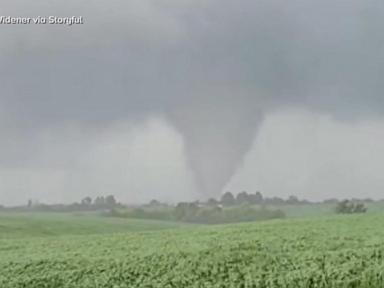
Media coverage of multi-state tornado outbreaks follows a predictable script. A system sweeps from the Ohio Valley to the Mid-Atlantic, camera crews rush to damaged neighborhoods, and news anchors breathlessly declare these events as unprecedented anomalies.
They sell you a narrative of unavoidable catastrophe. They focus entirely on the horror of nature's wrath while ignoring the reality of structural engineering failure.
I have spent years analyzing disaster response data and structural damage assessments after severe storm events. Watching local news outlets parade footage of shredded roofs from Kentucky to New Jersey treats every storm like an unpredictable act of god that no community could ever prepare for.
That narrative is wrong. It is convenient, expensive, and dangerous.
The Myth of the Unstoppable Twister
The mainstream media wants you to believe that when a tornado hits a town, total destruction is inevitable. They show extreme footage of high-end EF4 or EF5 storms to convince the public that houses are simply no match for wind.
Here is what the storm chasers and nightly news broadcasts fail to mention: over 90% of all tornadoes in the United States are weak to moderate events, rated EF0 to EF2. Even within the path of a violent EF4 storm, the vast majority of the damage footprint experiences wind speeds equivalent to an EF1 or EF2.
[Image of enhanced fujita scale tornado damage]
So why do entire neighborhoods from the South to the East Coast look like they were carpet-bombed after a routine windstorm?
It is not because the wind was inherently un-survivable. It is because modern residential construction standards prioritize rapid developer margins over basic structural integrity.
Most residential home collapses during severe storms do not begin with the walls blowing down. They begin when high winds get underneath an unsealed roof overhang or soffit. The wind creates immense uplift pressure, peeling the roof deck off the framing. Once the roof disappears, the walls lose their lateral support and pancake inward.
A standard home builder uses basic smooth-shank nails to attach roof sheathing. In a strong gust, those nails pull straight out of the rafters like butter. Switching to ring-shank nails costs less than $100 for an entire house, yet it increases a roof deck's uplift resistance by more than 100%.
Developers do not use them because local building codes do not force them to, and local news outlets never ask why.
The East Coast Illusion
When tornado outbreaks cross the Appalachians and strike states like Pennsylvania, Maryland, or New Jersey, panic ensues. Commentators declare that severe weather is invading regions never designed to handle it.
This reaction stems from a complete misunderstanding of regional risk and structural exposure.
While the central plains see a higher frequency of strong tornadoes per square mile, the Mid-Atlantic and East Coast feature a vastly higher population density and built environment density. When a fast-moving squall line hits New Jersey, it does not hit open wheat fields; it hits thousands of tightly packed suburban developments constructed during post-war housing booms.
Many of these homes were built long before modern wind-load provisions existed in building codes. They lack hurricane ties, structural strapping, or reinforced garage doors.
A standard double-car garage door acts as a massive structural failure point. When wind forces collapse an unreinforced garage door, air rushes inside, pressurizing the interior of the house like a balloon until the roof literally pops off.
High Wind Gusts -> Unreinforced Garage Door Buckles -> Internal Pressurization -> Roof Deck Detaches
If you live in New Jersey or Kentucky, the primary threat to your safety during a severe weather outbreak is not a rare 200-mph monster vortex. It is the cheap garage door and un-strapped roof joists on your own home.
The Disaster Economy Feeds on Ignorance
Follow the money after a major storm outbreak. Millions of dollars in federal emergency relief flow into affected counties. Rebuilding efforts commence immediately, driven by insurance payouts and municipal promises to "build back stronger."
Yet, in city after city, homes are reconstructed using the exact same flawed techniques that caused them to fail in the first place.
Local governments resist adopting modern building standards—such as the IBHS FORTIFIED Home standard—because regional homebuilder associations lobby aggressively against them. They claim that requiring metal hurricane straps, ring-shank nails, and sealed roof decks will make housing unaffordable for the average family.
Imagine a scenario where spending an extra $2,000 during initial home construction prevents $150,000 in catastrophic wind damage a decade later. That is not an added cost; it is basic risk mitigation.
The insurance industry knows this. Insurers are quietly pulling out of high-risk regions or skyrocketing deductibles for wind and hail damage across the interior United States. They realize what the public has not yet grasped: our infrastructure is failing not because the storms are magically getting stronger every single month, but because our structures are built to absolute minimum compliance.
Stop Watching Storm Chasers and Retrofit Your Property
Relying on Doppler radar apps and watching sensationalized TV coverage will not keep your roof overhead when a squall line arrives at 2:00 AM.
If you want to survive the next cross-country severe weather outbreak without losing your livelihood, stop focusing on weather drama and address your structure.
- Reinforce the garage door: Install a vertical bracing kit or upgrade to a wind-rated door. This single intervention eliminates the primary pressure vector for residential structural collapse.
- Seal the roof deck: When replacing your shingles, insist on a ring-shank nail pattern and a self-adhering polymer membrane over the roof deck joints. If shingles blow off, water will still not enter your interior.
- Anchor the structure: Ensure your home's sill plates are properly bolted to the foundation, rather than fastened with basic powder-actuated pins that shear under lateral tension.
We do not have a tornado crisis in America; we have a structural integrity crisis masked as a weather event. Stop framing normal wind dynamics as an act of god, and start holding builders to a standard that actually keeps a roof over your head.