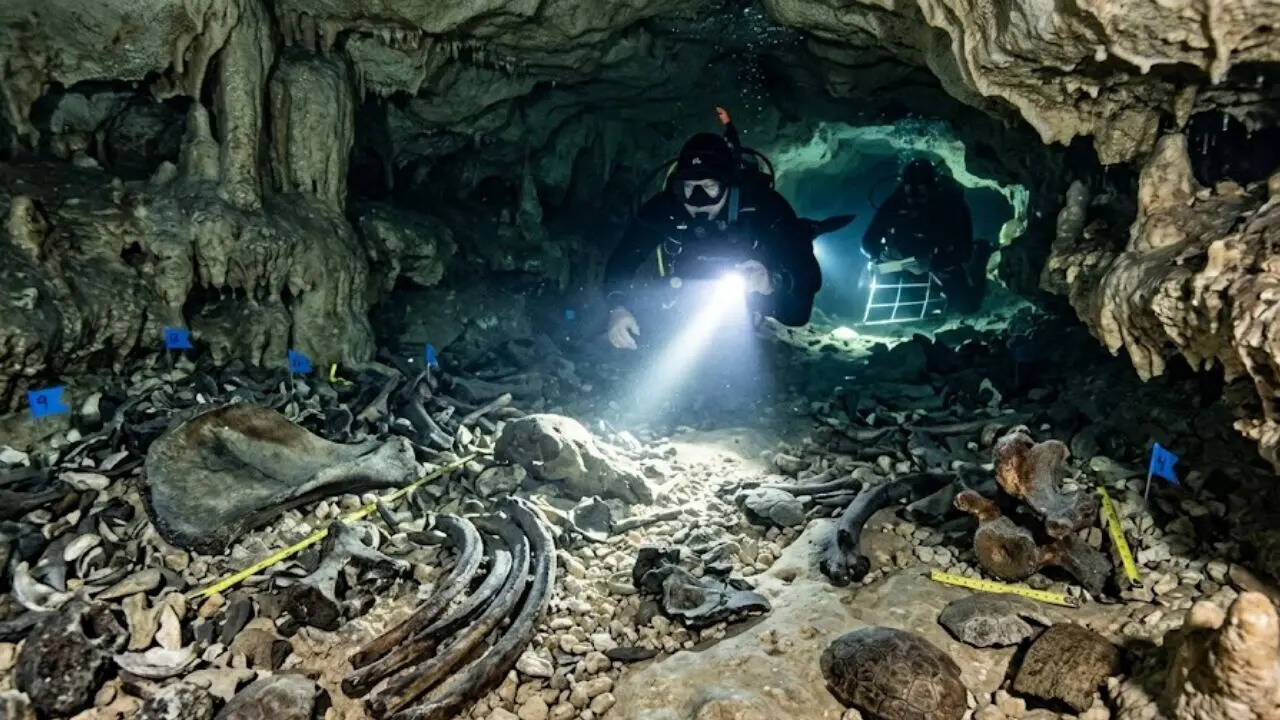
The headlines are bleeding with the same exhausted trope. A handful of bone fragments found in a dark Texas hole are being hailed as the "missing link" to rewriting ancient history. It is a classic move in pop-science journalism: take a routine paleontological find, wrap it in a shroud of mystery, and pretend it shatters everything we know about the Pleistocene.
It doesn’t.
If you are waiting for a single cave floor in central Texas to overturn the foundational laws of paleoclimatology, you are fundamentally misunderstanding how data works. These fossils—likely teeth and limb fragments from mammoths, dire wolves, or ancient horses—aren’t rewriting history. They are exposing the sheer fragility of the binary climate models we’ve been leaning on for decades. The problem isn't the fossils. The problem is our desperate need for a linear narrative in a world that was always chaotic.
The Micro-Refugia Myth
Standard academic consensus loves the idea of massive, sweeping climate shifts. They want to tell you that the world got cold, everything moved south, and then the world got warm and everything died. It’s clean. It’s easy to put into a textbook.
But these "groundbreaking" Texas finds actually point to a much more annoying reality for researchers: micro-refugia. These are tiny pockets of geography that stubbornly refused to follow the global trend. While the rest of the continent was a frozen hellscape or a sun-scorched desert, these caves and valleys acted as biological bunkers.
Finding a "cold-weather" species in a "warm" latitude doesn't mean the entire climate was different; it means that specific 20-acre plot of land was an anomaly. We are looking at the exceptions and trying to turn them into the rule. I’ve seen this happen in data science across every industry. Analysts find an outlier, get excited, and try to rebuild the entire model around a glitch.
In paleontology, a glitch is just a fossil that doesn't fit your pre-conceived map.
Stop Asking if the Climate Changed
The most common "People Also Ask" query regarding these finds is: "Does this prove the Ice Age ended differently than we thought?"
It’s the wrong question. It’s a boring question.
The real question is: Why are we still surprised by ecological resilience? We treat the Pleistocene-Holocene transition like a light switch. Off. On. Cold. Hot. The reality was a jagged, violent mess of micro-climates. Finding a mammoth in Texas isn't a shocker if you understand that "Ice Age" is a broad-brush term that ignores the granular reality of the terrain. We are obsessed with global averages, but no animal ever lived in a "global average." They lived in specific, humid, sheltered creek beds.
When you see a headline claiming a fossil "challenges the timeline," what it actually means is "our current maps are too low-resolution to be useful." We are looking at a 144p image of the past and acting stunned when a few extra pixels show up.
The Carbon Dating Trap
Let’s talk about the "battle scars" of field data. I have watched research teams dump hundreds of thousands of dollars into radiocarbon dating only to have the results contaminated by groundwater leached through limestone. Texas is a giant block of limestone.
Caves are not pristine time capsules. They are active geological drains.
The "lazy consensus" assumes that if a bone is found in a certain layer of sediment, it belongs to the era of that sediment. But "bioturbation"—the fancy word for animals, water, and gravity moving stuff around—means that cave floors are often a jumbled mess of centuries. A tooth from 12,000 years ago can easily end up resting next to a bone from 20,000 years ago due to a single heavy flood event.
When a competitor's article claims these finds "rewrite the timeline," they are banking on the fact that you won't ask about the stratigraphy. They want you to believe in a perfect, layered cake of history. In reality, the cake has been in a blender.
The Hubris of "Pristine" Environments
We have this romanticized vision of the ancient world as a stable, balanced ecosystem until a sudden "event" (a comet, a volcano, a flash freeze) ruined it. This is a fairy tale.
The Texas finds suggest that the environment was in a constant state of flux. The species we find there were survivors of a chaotic, high-variance system. We use these fossils to predict our own climate future, but we are doing it backwards. We look for stability in the past to justify our fear of change in the present.
If we want to actually learn from these fossils, we have to stop treating them like museum pieces and start treating them like data points in a high-volatility market.
Why the "Ancient Mystery" Angle is Toxic
- It devalues existing expertise: We don't need a "mystery" to make science interesting. The mechanics of how a dire wolf survived a Texas summer are fascinating enough without the clickbait.
- It creates a "God of the Gaps" for climate deniers: By claiming every new find "rewrites" history, we imply that we previously knew nothing. This isn't a total rewrite; it's a footnote. A significant footnote, but a footnote nonetheless.
- It ignores the technology: We should be talking about the proteomic analysis of the bone collagen, not just the "scary" size of the animal. We can now sequence proteins from bones that are too old for DNA. That’s the real story. Not the bone, but the tech that lets us read it.
The Logic of the Outlier
Imagine a scenario where a future archaeologist finds a discarded snow parka in the middle of the Sahara Desert. If they followed the logic of modern science journalism, the headline would read: "Sahara Desert Was Once an Arctic Tundra, New Find Suggests."
It sounds ridiculous, right? Because we know the context. We know that humans move things, and that anomalies exist.
Paleontology lacks that luxury of context, so we over-correct. We take a single data point—a tooth in a Texas cave—and we stretch it until it covers the entire map of North America. It is a massive logical leap that we’ve all agreed to ignore because it makes for a better story.
The "contrarian" truth is that these fossils probably don't change the big picture at all. They just confirm that the past was just as messy, inconsistent, and unpredictable as the present.
The Actionable Reality
If you are an investor in "green tech" or a policy maker looking at climate models, stop looking for "tipping points" in the fossil record. They don't exist. There are only shifts in variance.
What we see in these Texas caves is a testament to the fact that life doesn't wait for a "stable" climate. It finds the cracks. It hides in the caves. It waits out the heat in the shadows of the canyon.
Stop looking for a "rewrite." Start looking for the noise in the signal. The noise is where the actual history is hiding. The fossils aren't telling us the world was different; they are telling us our models are too simple to handle the truth of how chaotic the world has always been.
The Texas cave isn't a window into a lost world. It’s a mirror reflecting our own inability to process complex, non-linear data.
Stop reading the headlines. Read the sediment.