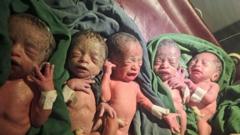
Hayat Mustofa didn't just have a baby. She had an entire family in one afternoon. After twelve long years of trying to conceive, the 30-year-old Ethiopian woman gave birth to quintuplets at Dessie Referral Hospital. It's the kind of news that stops people in their tracks. It should. The odds of naturally conceiving quintuplets are roughly one in 60 million. When you've spent over a decade waiting for a single heartbeat, hearing five is enough to floor anyone.
I've watched how these stories usually get told. They're framed as simple "miracles" or "blessings." While that's true, it ignores the sheer physical and medical grit required to bring five humans into the world at once. Hayat’s journey isn't just a feel-good headline. It’s a case study in human endurance and the high-stakes reality of multiple births in regions where medical resources are often stretched thin.
The Long Road to Five Heartbeats
Twelve years is a lifetime when you’re waiting for a child. In many communities, especially in rural or traditional parts of Ethiopia, a woman’s identity is often tied tightly to motherhood. The social pressure is suffocating. Hayat and her husband dealt with that weight for over a decade. They didn't give up. That’s the first part of this story that most people gloss over. The emotional exhaustion of a twelve-year wait changes a person. It hardens your resolve but also makes every ultrasound a moment of extreme anxiety.
When Hayat finally became pregnant, the news of quintuplets—two boys and three girls—wasn't just a surprise. It was a medical emergency in the making. Carrying five fetuses puts an incredible strain on the female body. You aren't just eating for two; you're essentially a life-support system for a small crowd. The risk of pre-eclampsia, gestational diabetes, and early labor is almost 100%.
The fact that she reached 30 weeks of pregnancy is a testament to her health and the care she received. Most quintuplet pregnancies don't make it that far. Every extra day in the womb is a victory. It means more developed lungs. It means a better chance of surviving the first 48 hours.
Medical Reality of Multiple Births in Ethiopia
We need to talk about the doctors. Dr. Teklu Gebrehiwot and the surgical team at Dessie Referral Hospital pulled off something remarkable. Performing a C-section for quintuplets isn't a standard procedure. It’s a coordinated dance. You need five separate neonatal teams ready to catch, stabilize, and intubate if necessary.
In a country like Ethiopia, where specialized neonatal intensive care units (NICUs) aren't on every corner, this success is a huge win for the local healthcare system. It shows that despite the narrative of "limited resources," the expertise in these regional hospitals is formidable. They managed the delivery without losing a single baby or the mother. That's a high-bar medical achievement anywhere in the world, from New York to Addis Ababa.
The Numbers Behind the Miracle
- Natural Quintuplets: 1 in 55 million to 60 million births.
- Gestational Age: Most quintuplets are born between 28 and 32 weeks.
- Birth Weights: Usually range from 2 to 3 pounds (around 1 to 1.5 kg).
- Survival Rates: Significantly improved over the last decade due to better steroid treatments for lung development before birth.
The weights of Hayat’s babies ranged from 1.3kg to 1.9kg. Those are "good" weights for quintuplets. It suggests that her placenta—or placentas—worked overtime to distribute nutrients.
Why This Story Matters Beyond the Headlines
People love the "joy" aspect. I do too. Seeing a woman who waited twelve years finally hold her children is powerful. But there’s a deeper conversation here about maternal health and the support systems required after the cameras leave.
Most people don't realize the sheer logistics of five newborns. We're talking 40 to 50 diaper changes a day. We're talking about a feeding schedule that never ends. For a family in a regional area, this isn't just a blessing; it’s a massive economic and physical challenge. The community support in Ethiopia is usually strong, but quintuplets require a level of intervention that goes beyond what a few helpful neighbors can provide.
I've seen similar cases where the initial "miracle" fame fades, and the family is left struggling to buy formula or pay for the specialized medical follow-ups these babies need. Quintuplets are almost always born premature, which means they are at higher risk for developmental delays or respiratory issues. They need long-term monitoring.
The Science of Success in Dessie
Dessie Referral Hospital didn't just get lucky. To handle a birth like this, a hospital has to have a functioning blood bank, a prepared anesthesiology department, and a NICU that doesn't lose power. It’s a reflection of the investment Ethiopia has been making in its healthcare infrastructure over the last few years.
While the "joy" is the hook, the "how" is the real story. The "how" is a team of Ethiopian doctors who stayed calm when a dozen lives—including the mother's—were on the line. They didn't have the luxury of a Hollywood medical suite. They had their training, their equipment, and a woman who was determined to see her twelve-year wait end in a win.
What You Should Take Away
If you're following this story, don't just look at the photos of the tiny babies. Think about the twelve years of silence in that house before this. Think about the doctor who had to make sure five different umbilical cords were clamped and cleared in seconds.
The success of the "Ethiopian quintuplets" is a reminder that medical excellence exists everywhere. It's also a reminder that reproductive struggles are a silent epidemic that many women face alone for years. When it ends like this, it’s worth the noise.
If you want to support maternal health initiatives, look toward organizations that provide specialized equipment to regional hospitals in East Africa. That’s where the real difference is made. The next Hayat Mustofa is already out there, waiting and hoping. She’ll need a hospital that’s ready for her miracle.
Check your local news for updates on the family's fundraising efforts. They’ll need the help. Most families aren't built for an overnight 500% increase in size. If you're moved by the story, look for ways to support neonatal care centers that make these survival stories possible. Don't just read and forget. Support the systems that keep these "miracles" alive.